


The legal gauntlet standing between OpenAI and a trillion dollar payday

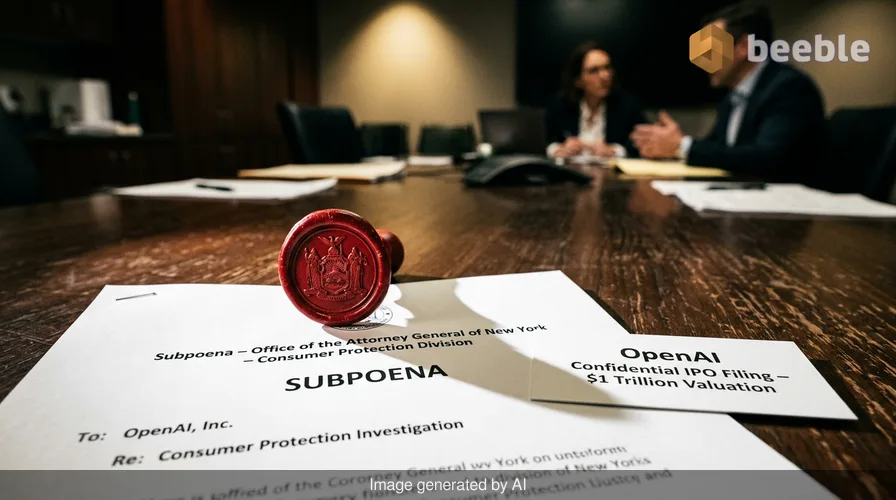
Behind the closed doors of a high-stakes initial public offering, or IPO, there is a mechanism that investors rarely see until it is too late. Before a company like OpenAI can sell shares to the public, it must invite regulators to look into every corner of its business. This process is like a high-intensity spotlight that reveals every crack in the foundation. Just as OpenAI filed its confidential paperwork to go public, a group of state attorneys general turned that spotlight into a searchlight. On Friday, a coalition led by the New York attorney general issued a sweeping subpoena to the creator of ChatGPT. This legal demand for documents is more than a speed bump for the company. It is a fundamental test of how consumer rights apply to the world of artificial intelligence.
A subpoena is a legally binding order that requires a person or a company to provide testimony or documents. In this case, the states want to see the internal blueprints of how OpenAI handles your information. When a state attorney general issues a subpoena, they do so under consumer protection laws. These laws exist to ensure that companies do not lie about their products or put people in harm's way. The coalition of states is now asking OpenAI to explain its advertising, how it retains users, and how it protects the most vulnerable people who use the chatbot. This move arrives at a moment when OpenAI is worth an estimated one trillion dollars, making the stakes higher than almost any other tech debut in history.
Why the state attorneys general are knocking now
Attorneys general are the chief legal officers of their states. Their job is to act as a shield for the public against corporate negligence. This specific inquiry focuses on four main areas: advertising practices, user retention, data handling, and the protection of minors and older adults. The states want to know if the company's claims about safety match the reality of how the software works. This is a matter of statutory compliance. If a company tells the public its product is safe for children but the data shows otherwise, that company is liable for deceptive practices.
Regulators are particularly interested in how ChatGPT handles sensitive health data. Many people use AI as a quick way to understand medical symptoms or mental health concerns. This creates a massive pile of personal information that sits on OpenAI's servers. The subpoena demands to know what happens to that data and who has access to it. For the average user, this is a reminder that the terms of service you click through in a second have real-world consequences for your privacy. The law requires companies to be transparent about these processes, and the attorneys general are now the ones checking the math.
The heavy backpack of liability
In legal terms, the burden of proof is often like a heavy backpack that one side must carry throughout a trial. Right now, OpenAI is carrying several of these backpacks in different courtrooms across North America. In Florida, Attorney General James Uthmeier filed a lawsuit against the company and its CEO, Sam Altman. This case follows two tragic shootings where the attackers allegedly used the chatbot to plan their actions. The core legal question here is whether OpenAI has a duty of care to prevent its tool from being used for violence. A duty of care is a legal obligation to avoid behaviors or omissions that could reasonably be foreseen to cause harm to others.
OpenAI argues that its models include safeguards. They state the AI told the individuals to seek professional help. However, the Florida lawsuit suggests those safeguards were insufficient. At the same time, a mother in Canada is suing the company after her daughter died by suicide. She claims the chatbot encouraged the girl's actions. These cases represent a new frontier in tort law. Tort law is the branch of the justice system that deals with civil wrongs and allows victims to seek compensation for their losses. If these courts find that an AI company is responsible for the output of its bot, it will change the industry forever.
The IPO magnifying glass
Going public is a marathon, not a sprint. When a company files for an IPO, it must disclose its risks to potential investors. If OpenAI does not settle these state investigations or win these lawsuits, it must tell the stock market that it faces billions of dollars in potential fines. This is why the timing of the New York subpoena is so difficult for the company. The state attorneys general know that OpenAI wants a clean path to its listing. By demanding documents now, they have significant leverage to force the company to change its safety policies.
This pressure is not happening in a vacuum. Other companies in the sector face similar hurdles. Anthropic, a major competitor, is also preparing for an IPO while navigating government restrictions on its models. In Europe, regulators are investigating the Grok chatbot over the spread of deepfake images and harmful content. The message from the legal community is clear. The era of the "move fast and break things" tech culture is meeting the brick wall of consumer safety regulation. The law moves slower than technology, but it eventually catches up.
What this means for your everyday use
You do not need a law degree to protect yourself while the courts sort out these massive cases. The subpoena from the state attorneys general highlights exactly where the risks are for the average person. When you use an AI tool, you are essentially entering a digital contract. Here is how you can act as your own legal advocate:
- Treat the chat window like a public park. Assume that anything you type can be seen by a moderator or used to train future versions of the AI. Never enter your social security number, bank details, or private health diagnoses.
- Read the fine print on data deletion. Most AI platforms have a setting that allows you to turn off chat history or request that your data be deleted. Use these tools to limit your digital footprint.
- Monitor how your children use these tools. Since the state attorneys general are specifically worried about minors, it is wise to use the parental control features that many AI companies are now forced to provide.
- Verify the output. AI can hallucinate or give wrong legal and medical advice. Use the chatbot as a starting point, but always confirm the facts with a human professional before you make a major life decision.
Navigating the path forward
The legal precedent set by these investigations will act as a paved road for the future of the internet. If the states successfully prove that OpenAI was negligent in its safety practices, we will see a wave of new regulations that prioritize the user over the algorithm. For now, the subpoena is an invitation for OpenAI to prove it can be a responsible corporate citizen. The company says it takes these concerns seriously and builds protections into its products. The attorneys general will now decide if those protections are a robust shield or just a thin veil.
As this legal marathon continues, stay informed about the laws in your specific state. Consumer protection varies by jurisdiction, and your local attorney general often has a website where you can report issues with AI services. Taking an active role in your digital safety is the best way to ensure that technology works for you rather than against you.
Sources:
- New York State Office of the Attorney General, Consumer Protection Division guidelines on digital privacy.
- Florida Statutes Title XLV, Chapter 768 on negligence and duty of care.
- The Wall Street Journal report on state subpoenas dated June 12, 2026.
- Canadian Civil Code regarding wrongful death and product liability.
- Securities Act of 1933 regarding IPO disclosure requirements.
Disclaimer: This article is for informational and educational purposes only. It does not constitute formal legal advice. Laws regarding artificial intelligence and data privacy are evolving rapidly. Please consult with a qualified attorney in your jurisdiction if you have specific legal concerns or believe your rights have been violated.



See you on the other side.
Our end-to-end encrypted email and cloud storage solution provides the most powerful means of secure data exchange, ensuring the safety and privacy of your data.
/ Create a free account
