


The legal wall Apple is building around OpenAI

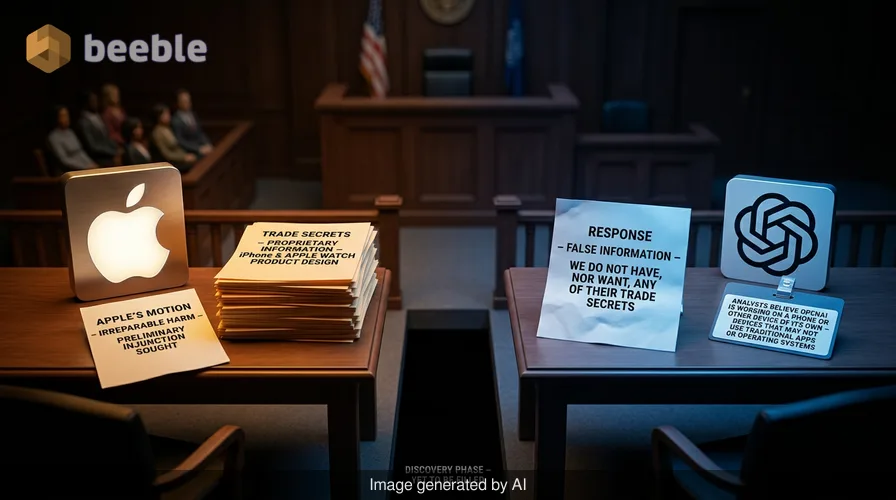
Most professionals believe that when they quit a job, their experience and knowledge belong to them. In the eyes of the law, the line between personal skill and company property is a high-voltage fence. When a high-level executive leaves a tech giant like Apple to join a fast-rising competitor like OpenAI, they carry a mental briefcase of strategies, blueprints, and internal failures. Apple is now asking a federal judge to lock that briefcase. On Monday, August 3, 2026, Apple filed a motion for a preliminary injunction. This legal maneuver seeks to stop two former employees and OpenAI from using what Apple calls its crown jewels.
This case is a battle over the future of how we use technology. For over a decade, the iPhone has been the center of the consumer universe. OpenAI is reportedly building a device that could make the smartphone obsolete. If OpenAI uses Apple’s internal secrets to build that device, Apple argues it loses an advantage it spent billions of dollars to create. This dispute shows that in the modern economy, the most valuable assets are the ones you cannot see.
The legal emergency brake Apple wants to pull
A preliminary injunction is a legal emergency brake. In a typical lawsuit, a judge decides who wins after months or years of evidence and a trial. An injunction changes that timeline. It allows a court to order a defendant to stop a specific action immediately, even before the trial begins. Apple argues that if OpenAI continues to access or use its proprietary information today, the damage will be impossible to fix later. This is what lawyers call irreparable harm. If a secret is leaked or used to launch a rival product, you cannot simply take the secret back. The bell cannot be unrung.
To win this motion, Apple must prove more than just a suspicion of wrongdoing. It has to show a high likelihood that it will eventually win the case. It also must show that the harm it will suffer outweighs any hardship the injunction might cause OpenAI. Apple is asking the court to bar OpenAI and the two former employees, Chang Liu and Tang Yew Tan, from accessing, acquiring, or disclosing any confidential information. This move aims to freeze the status quo while the court digs into the facts.
Who are the individuals at the center of the storm
The two former employees named in the suit are not entry-level staffers. Tang Yew Tan was Apple’s vice president of product design for both the iPhone and the Apple Watch. He was a person who saw the long-term roadmap of Apple’s hardware. Chang Liu was a senior system electrical engineer. These roles involve more than just following instructions. These individuals helped write the instructions.
Apple alleges that these employees took trade secrets to benefit OpenAI’s foray into consumer hardware. A trade secret is information that has economic value because it is not generally known to the public. It can be a formula, a program, a device, or a method. Unlike a patent, which is public but protected for a limited time, a trade secret remains a secret as long as the company takes reasonable steps to hide it. Apple argues that the specialized knowledge Tan and Liu possess regarding hardware design constitutes a set of trade secrets that OpenAI is eager to exploit.
Why Apple is demanding expedited discovery
Alongside the injunction, Apple filed a motion for expedited discovery. In a standard lawsuit, the discovery phase is a slow exchange of documents and emails. Apple wants to skip the line. It is asking the judge for immediate access to documents related to how the defendants accessed proprietary information. It also wants to put several people under oath for depositions right away.
Apple has requested to depose Tan and Liu, along with another OpenAI employee named Yu-Ting Peng and an unnamed staffer who also previously worked at Apple. A deposition is a formal interview where a witness must answer questions under penalty of perjury. Apple is also seeking testimony from corporate representatives of OpenAI and its commercial arm, io Products. This aggressive approach indicates that Apple believes the evidence of misappropriation is already within OpenAI’s digital files. The company wants to find the smoking gun before it is deleted or buried in a mountain of standard legal paperwork.
The defensive stance from OpenAI
OpenAI is not staying silent. In a blog post released late Monday, the company called Apple’s request unnecessary and based on false information. OpenAI claims it has no interest in Apple’s trade secrets. This is a common defense in misappropriation cases. Companies often argue that they hire talent for their general expertise and industry knowledge, not for the specific secrets of their former employers.
There is a fine legal distinction between a worker's general skill and a trade secret. You are allowed to take your talent to a new job. You are not allowed to take a specific spreadsheet or a proprietary hardware design. OpenAI’s defense suggests that Apple is using this lawsuit to intimidate former employees and stifle competition in the AI hardware market. This argument focuses on the idea that Apple is trying to own the skills of its workers even after they leave the payroll.
The high stakes of the post smartphone era
This legal battle is happening because the tech industry is at a crossroads. For years, OpenAI and Apple were collaborators. Apple recently integrated ChatGPT into its operating systems. However, that relationship has soured as OpenAI moves toward building its own physical devices. Analysts believe OpenAI is developing a phone or a wearable device that relies entirely on artificial intelligence rather than traditional apps.
If a device can answer your questions, book your flights, and manage your schedule through a voice interface, you might not need to look at an iPhone screen as often. This threat to Apple’s primary source of revenue is the real backdrop of the litigation. Apple is using the law as a shield to protect its market position. If OpenAI can build a revolutionary device without using Apple’s secrets, the law will likely allow it. If OpenAI uses a shortcut paved with Apple’s internal research, the court will likely intervene.
What this means for the everyday professional
You do not have to be a vice president at Apple to be affected by these legal principles. Trade secret disputes are becoming more common across all industries. If you are changing jobs, you must be careful about what you take with you. Even something as seemingly harmless as a list of client contacts or a template for a project proposal can be considered a trade secret.
When you sign an employment contract, you often agree to keep company information confidential. This duty does not end the day you turn in your badge. It is a binding commitment that follows you to your next employer. If your new boss asks you to share how your old company handled a specific technical problem, you are entering a legal minefield. The burden of proof in these cases is a heavy backpack for the plaintiff to carry, but Apple has the resources to carry it for a long time.
Key takeaways for protecting your career
Navigating a job transition in a competitive industry requires a clear understanding of your legal obligations. Here are several steps to ensure you stay on the right side of trade secret laws:
- Review your non-disclosure agreement before you give notice. Know exactly what your former employer considers proprietary.
- Return all company property immediately. This includes digital files, physical prototypes, and even handwritten notes taken during internal meetings.
- Avoid downloading large amounts of data shortly before your departure. IT departments frequently flag this activity as a sign of data theft.
- Be honest with your new employer. If they ask for information that belongs to your previous company, decline the request in writing to create a paper trail.
- Understand that your general professional growth is yours to keep, but specific internal processes belong to the company that paid you to develop them.
Apple’s request for a preliminary injunction is a signal to the entire tech world. It shows that the company will go to great lengths to prevent its talent from becoming its biggest competitive threat. The court’s decision on this motion will set a precedent for how much control a company has over its secrets in the age of artificial intelligence. The litigation is a marathon, and the first few miles will determine who has the stamina to win the race.
Sources:
- Uniform Trade Secrets Act (UTSA)
- Defend Trade Secrets Act of 2016 (DTSA)
- U.S. District Court for the Northern District of California Case Filings
- Federal Rules of Civil Procedure, Rule 65 (Injunctions and Restraining Orders)
- California Business and Professions Code Section 16600
Disclaimer: This article is for informational and educational purposes only and does not constitute formal legal advice. You should consult a qualified attorney in your jurisdiction for specific issues regarding employment contracts or trade secret disputes.



See you on the other side.
Our end-to-end encrypted email and cloud storage solution provides the most powerful means of secure data exchange, ensuring the safety and privacy of your data.
/ Create a free account
