


The library is infinite, yet Spotify is now labeling who among us does not exist

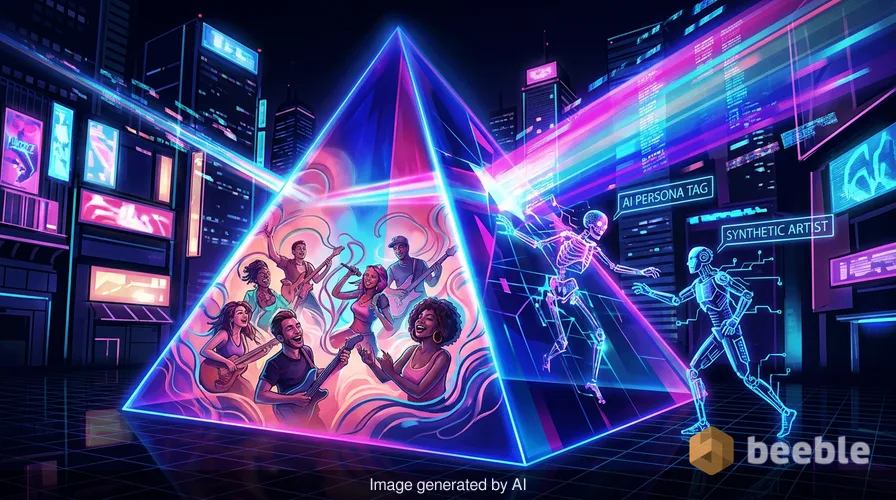
There is a specific, cold disappointment in finding a perfect song only to realize the face on the cover is a prompt. You feel a flicker of betrayal, a sense that the emotional connection you just formed was a one-way mirror. This reaction is exactly what Spotify aims to manage with its new labeling system. By introducing the AI Persona tag, the platform is attempting to perform a digital autopsy on the concept of stardom. It is a clinical response to a growing problem where human identity is a commodity that machines can now mimic with unsettling accuracy.
Spotify announced on Tuesday that it will begin labeling AI-generated artists with these new badges. The rollout starts in mid-September, affecting how these profiles appear in search results, banners, and track lists. The company is not just adding a sticker to a profile. It is fundamentally changing how these entities exist within the music ecosystem. These labeled artists face a form of algorithmic exile, as Spotify will exclude them from its editorial and algorithmic recommendations. This move draws a hard line between human creators and synthetic constructs.
segregating the soul from the script
The implementation of the AI Persona badge is a reactive strike against the dilution of the listener experience. When a user opens the app, they expect a connection to a person or a group of people. The new policy ensures that this expectation remains grounded in reality. The badges will appear in the About section and on track rows across playlists. This transparency is a tool for the audience to discern between a career musician and a high-frequency content generator. Spotify is clear that the label is a judgment on the artist’s public identity rather than the music itself. The company states that while artists use AI as a creative tool, the question of whether a profile is an actual human is a clear determination it can make.
This distinction is vital for the health of the platform. We have entered an era where a song can be haunting, beautiful, and entirely soulless. The music industry calls this deluge of low-quality, mass-produced content slop. If a streaming service allows slop to overwhelm its curation, the user experience suffers. People cancel their subscriptions when they feel like they are being fed synthetic filler. Consequently, Spotify is prioritizing music from authentic artists who are building traditional careers. The company will use pre-defined audience thresholds to review profiles, focusing on the most popular artists first to ensure the highest impact.
the high cost of algorithmic slop
Behind the scenes, the struggle for the future of the recommendation engine is intense. Algorithms are the lifeblood of modern music consumption, driving millions of streams through Discover Weekly and Daily Mix playlists. When AI Personas enter these feeds, they compete for the same finite attention as human artists. However, these machines do not have rent to pay or tours to fund. They can produce thousands of tracks in the time it takes a human to write a single verse. This creates a supply-side imbalance that threatens to bury human creators under a mountain of generated noise.
Spotify is protecting its walled garden by removing these personas from the default discovery pathways. By default, the platform will not include AI Personas in personalized recommendations. This is a defensive maneuver to prevent the algorithm from becoming a self-feeding loop of synthetic content. If the AI begins to recommend other AI, the human element of the platform evaporates. The company is essentially building a quarantine zone for non-human identities. This ensures that the music you stumble upon while driving or working is the result of human intent.
why the follow button is the last line of defense
There is one way for a synthetic artist to reach your ears under these new rules. Spotify will allow AI Personas to appear in your recommendations if you explicitly follow them. This turns the follow button into a conscious act of consent. In everyday terms, it is the difference between being served a meal at a restaurant and specifically ordering a meal you know is lab-grown. If a user wants to hear music from a digital avatar, that is a valid creative choice. Spotify is not banning the music, but it is removing the illusion of human presence where none exists.
Only users can provide the signal that they want to hear more from a specific AI entity. This shifts the power away from the algorithm and back to the listener. It creates a meritocracy for synthetic art where the music must be compelling enough for a person to take an active step to support it. Paradoxically, this might make the most successful AI artists even more influential. If an AI Persona can build a massive following without the help of the Discover Weekly engine, it proves the music has a genuine audience. Starting August 11, 2026, artists will have the ability to self-disclose their AI status through Spotify for Artists. This self-disclosure is the first step in a larger effort to map the new geography of the music industry.
drawing the line between tools and avatars
It is important to understand that Spotify is not declaring war on AI technology. The company continues to use AI-powered features like the AI DJ and Prompted Playlists to manage its library. The distinction lies in the difference between a tool and an identity. A human artist using AI to master a track or generate a beat is still a human artist. An AI Persona is a profile where the name and imagery represent a photorealistic, generated identity. The company is even rolling out a tool that allows fans to report profiles they suspect are unlabeled AI Personas.
This policy also creates space for the forthcoming wave of AI-generated remixes and covers. Recent deals with labels like UMG and Merlin will soon allow fans to create their own versions of popular songs. These remixes will have clear licensing that returns money to the original human artists. By labeling the standalone AI Personas now, Spotify is clearing the path for these authorized, collaborative uses of technology. It prevents a scenario where a fan-made remix is indistinguishable from a bot-generated artist profile. The metadata is the map that helps the listener navigate this increasingly fragmented reality.
the future of the human brand in a synthetic era
We often think of music as a purely auditory experience, but the industry is built on the architecture of personality. We buy into the narrative of the artist as much as the melody. When that narrative is a fabrication of an LLM or an image generator, the social contract of entertainment changes. Spotify is acting as a mediator in this new contract. By providing AI Credits and SongDNA, the platform offers layers of information about how music is made. The AI Persona badge is simply the most visible layer, sitting at the top of the funnel to warn or inform the user before they press play.
This shift reflects a broader cultural fatigue with the artificial. As the internet becomes saturated with generated text and images, we find ourselves craving the friction of a real human life. We want to know that the heartbreak in a lyric came from a heart that can actually break. Spotify’s decision is an admission that, for all its technical power, the algorithm cannot replace the cultural weight of a real person. The platform is betting that, given the choice, audiences will choose the messy reality of a human artist over the polished perfection of a prompt. It is a moment for us to reflect on what we value in our digital leisure. We are no longer just listeners; we are now the curators of our own human experience in a world that is increasingly comfortable with fakes.



See you on the other side.
Our end-to-end encrypted email and cloud storage solution provides the most powerful means of secure data exchange, ensuring the safety and privacy of your data.
/ Create a free account
