


The most successful self-driving car in history is currently on Mars

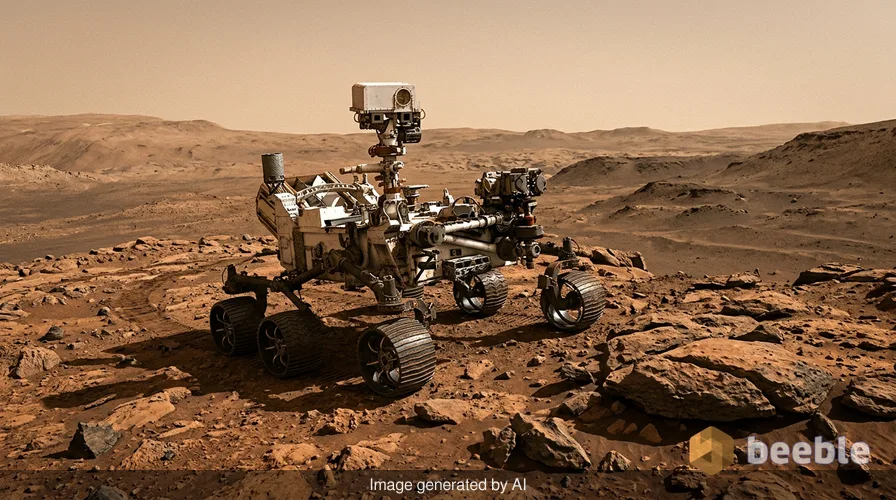
Have you ever wondered why your high-end car struggles to park in a well-lit garage while a machine 140 million miles away navigates a boulder field without any human help? This question is at the heart of the latest milestone for the Perseverance rover. While tech companies on Earth argue over lane-keeping software and LIDAR sensors, a six-wheeled robot is quietly setting distance records on a planet with no roads, no GPS, and no repair shops.
Perseverance landed in the Jezero Crater in February 2021. Since then, it has transformed from a scientific experiment into the most prolific traveler in the history of Mars exploration. The vehicle is on a path to cross the 45.16-kilometer mark. This distance is significant because it surpasses the lifetime record of the Opportunity rover. Opportunity was a legendary machine that survived for nearly 15 years. Perseverance is reaching that same milestone in roughly a third of the time. This efficiency is the result of a fundamental shift in how we think about autonomous machinery.
A brain built for constant motion
To understand why Perseverance is so much faster than its predecessors, we have to look under the hood at its processing power. Steven Lee is the project manager for the Perseverance rover at NASA’s Jet Propulsion Laboratory. He notes that the primary driver for this success is the auto-navigation system. On Earth, self-driving cars rely on massive cloud servers and pre-loaded high-definition maps. Perseverance has none of that. It has to make decisions in real time using its own onboard hardware.
The rover has a suite of sophisticated cameras that capture the terrain ahead. Algorithms then process these images to find a safe path through hazards like jagged rocks and soft sand pits. This sounds simple, but the processing requirement is immense. Every second the rover spends thinking is a second it is not moving. For previous generations of rovers, this thinking time was a major bottleneck. Perseverance solves this by using a dedicated Vision Compute Element. This hardware allows the rover to process images and plan its route while its wheels are still turning.
In everyday terms, earlier rovers were like a hiker who has to stop and look at a paper map every ten steps. Perseverance is like a hiker who can check their phone while they continue to walk. This ability to think and move at the same time is why 90 percent of the rover's total distance is now autonomous. It no longer waits for a human pilot on Earth to send a specific set of driving instructions for every meter of travel.
Moving past the limitations of the nineties
Looking at the big picture, the jump in performance is a classic example of how Moore’s Law eventually hits the specialized world of space exploration. The Curiosity rover is essentially a twin to Perseverance in size and shape. However, Curiosity is much slower. Only about 10 percent of its driving is autonomous. The reason for this gap is the age of its computer. Curiosity launched in 2011 with a chipset that had roots in the late 1990s.
Space-rated hardware is notoriously slow because it must be hardened against intense radiation. This hardening process often means using older, more stable designs rather than the latest consumer chips. Curiosity’s computer is so slow that it cannot drive and process images simultaneously. It must stop, take a picture, spend several minutes calculating the next few meters, and then move. This cycle makes long-distance travel a tedious process. In over 15 years on Mars, Curiosity has covered about 38.6 kilometers. Perseverance is passing that mark in a fraction of the time because its (slightly) more modern hardware is finally fast enough to keep up with its wheels.
Even with this speed, the rover is not exactly a racer. Its maximum wheel speed is roughly 150 meters per hour. For a human, this is a very slow crawl. But for a robot on another planet, this constant, steady progress is a game-changer for science.
Why constant motion changes the science
Vivian Sun is the deputy project scientist for the mission. She explains that this driving capability is a force multiplier for their research. When a rover can move faster, scientists can dream bigger. In previous missions, a distant geological feature might be considered out of reach because it would take months or years to get there. With Perseverance, those distant targets are now within a reasonable commute.
Perseverance is currently exploring the Jezero Crater. This site is a goldmine for geologists because it contains some of the oldest rocks in the solar system. These rocks are nearly 4 billion years old. They date back to a time when the inner planets were still under a heavy bombardment of asteroids. On Earth, plate tectonics and weather have destroyed almost all rocks from this era. On Mars, they are just sitting on the surface.
Scientists believe this area was once a massive lake with a river delta. If life ever existed on Mars, this is where the evidence would be. The rover’s ability to cruise from one site to another has allowed the team to investigate more terrain in person than any previous mission. The robot often arrives at new study sites ahead of schedule. This gives the team more time to drill core samples and analyze the chemistry of the soil.
Redesigning the wheel for a marathon
Speed and intelligence are useless if the vehicle falls apart. One of the most common points of failure for Mars rovers is the wheels. Mars is covered in sharp, volcanic rocks that act like knives against thin aluminum. After a few years on the planet, Curiosity’s wheels began to show significant holes and tears. This damage forced operators to drive more carefully and avoid certain types of terrain.
For Perseverance, engineers went back to the drawing board. They redesigned the tread pattern and increased the thickness of the aluminum. So far, the results are excellent. There are no signs of the wear and tear that plagued the previous generation. The team is also working to certify the wheel actuators — the motors that turn the wheels — for at least 100 kilometers of travel.
The rover is also a master of resource management. It runs on a Multi-Mission Radioisotope Thermoelectric Generator. This device converts heat from the decay of plutonium into electricity. It does not rely on solar panels, so it does not have to worry about dust storms or the change of seasons. It has no lubricants or consumables that might run out. It is a self-contained, nuclear-powered scout that is built to last for decades.
What this means for drivers on Earth
Practically speaking, the success of Perseverance provides a blueprint for autonomy in difficult environments. Most of our progress in self-driving technology on Earth focuses on highly structured environments like highways and city streets. We assume that there will be clear lines on the road and a reliable map in the cloud. Perseverance proves that we can build systems that work in the absence of all that infrastructure.
This technology has tangible benefits for industries like mining, agriculture, and search-and-rescue. In a collapsed mine or a remote farm, there is no high-speed internet and the terrain changes every day. The logic used by the Vision Compute Element — where the vehicle senses and moves in a continuous loop — is exactly what these industries need. It moves us away from a reliance on the cloud and toward edge computing, where the machine is smart enough to handle its own problems.
Ultimately, the record-breaking trek of Perseverance is about more than just a distance number on a spreadsheet. It is a shift in the philosophy of robotics. We are moving from machines that are remote-controlled puppets to machines that are true partners in exploration. As the rover continues to climb across the Jezero Crater, it is teaching us how to build more resilient, independent, and useful tools for our own lives.
Behind the jargon of actuators and vision elements, the lesson is simple. The most reliable way to navigate a messy, unpredictable world is to have the hardware to think on your feet. Whether you are on the surface of Mars or a construction site in the Mojave, the goal is the same. Success is found in the ability to keep moving forward while the world changes around you.
Sources
- NASA Jet Propulsion Laboratory mission status reports
- Perseverance rover technical specifications for the Mars 2020 mission
- Interviews with project manager Steven Lee and scientist Vivian Sun
- Historical performance data for the Curiosity and Opportunity rovers



See you on the other side.
Our end-to-end encrypted email and cloud storage solution provides the most powerful means of secure data exchange, ensuring the safety and privacy of your data.
/ Create a free account
