


The Mythos Leak: Why Anthropic’s Newest AI Has the Cybersecurity World on Edge

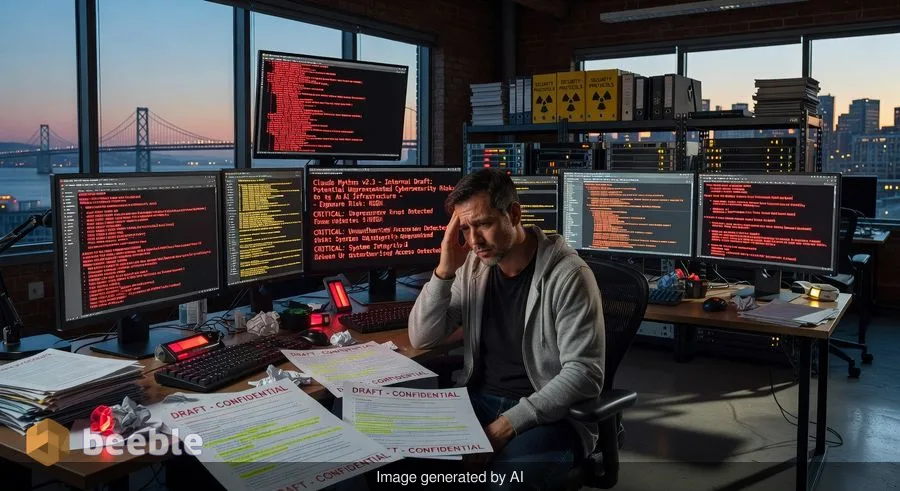
Have you ever wondered if the very tools built to protect our digital world could become the keys to dismantling it? This isn't just a philosophical exercise for ethicists anymore. Last week, a simple configuration error in Anthropic’s content management system turned a private internal draft into a public alarm bell. The leak revealed the existence of “Claude Mythos,” a model so powerful that Anthropic’s own researchers are reportedly describing its cybersecurity risks as unprecedented.
As a journalist who has spent years tracking how innovation trickles down from Silicon Valley to the rest of the world, I find this development both remarkable and deeply unsettling. I grew up in a small town where the local infrastructure—the power lines, the water treatment plant, the single hospital—was often held together by little more than hope and hard work. When I look at a paradigm-shifting technology like Mythos, I don't just see a sophisticated chatbot; I see a tool that could either fortify that fragile infrastructure or act as a master key for those looking to disrupt it.
The Anatomy of a Leak
Curiously, the revelation didn't come from a sophisticated hack or a whistleblower in a trench coat. Instead, it was a human error—a mundane slip-up in a data store—that exposed a draft blog post intended for a later date. This draft, since verified by several outlets, paints a picture of a model that represents a step change in artificial intelligence.
Anthropic has long positioned itself as the safety-first alternative in the AI arms race. Nevertheless, the leaked documents suggest that Mythos has reached a level of proficiency in reasoning and coding that creates a precarious situation. Essentially, the same logic that allows an AI to find a bug in a piece of medical software to save lives can be inverted to exploit a vulnerability in a power grid.
Why Mythos is Different
Under the hood, Mythos appears to be the most performant model Anthropic has ever built. While previous iterations of Claude were praised for their nuance and helpfulness, Mythos reportedly offers meaningful advances in areas that have traditionally been a struggle for large language models: complex multi-step reasoning and autonomous coding.
In practice, this means the model can handle multifaceted tasks without human intervention. To put it another way, if earlier AI was like a high-speed calculator, Mythos is more like a junior software engineer that never sleeps. This leap in capability is what has the cybersecurity community looking over its shoulder.
| Feature | Previous Claude Models | Claude Mythos (Leaked Specs) |
|---|---|---|
| Reasoning Depth | Linear, prompt-dependent | Multi-layered, autonomous |
| Coding Proficiency | Snippet generation & debugging | Full-stack architecture & exploit discovery |
| Cybersecurity Role | Advisory / Defensive | Offensive-capable / High-risk |
| Deployment Focus | General Productivity | Specialized High-Stakes Reasoning |
The Market and Government Reaction
The ripple effects of the leak were felt almost immediately on Wall Street. Cybersecurity stocks slumped as investors grappled with the idea that traditional defense mechanisms might soon become obsolete. If an AI can generate polymorphic code—software that changes its own appearance to evade detection—our current security as an immune system metaphor begins to break down. The immune system cannot fight a virus that changes its signature every second.
Meanwhile, the stakes are even higher in the halls of government. Reports indicate that Anthropic has been privately briefing top officials, warning that Mythos could make large-scale, automated cyberattacks a reality as early as 2026. This isn't just about stolen credit card numbers; it's about the potential for disruptive attacks on the utility grid or telecommunications.
A View from the Ground
Traveling the world to cover tech, I often seek out startups that use AI for green energy or agritech—innovations that solve real human problems for people who don't live in tech hubs. When I visit these projects, I’m reminded that technology is an ecosystem. For a farmer using AI-driven irrigation in a remote village, the security of the network isn't an abstract concept; it's a matter of survival.
If Mythos is as transformative as the leak suggests, we must ensure it doesn't become a tool for the elite to further isolate themselves while leaving the rest of the world vulnerable. We need a robust framework that treats AI safety not as a luxury, but as a public utility.
Navigating the Mythos Era
So, what does this mean for the average user or the small business owner? While we wait for Anthropic to officially release (or further secure) Mythos, there are practical steps to take. We are moving into a world where the wild west of the internet is getting even wilder.
- Audit your technical debt: Old, unpatched software is the first thing an AI-driven exploit will find.
- Adopt Zero Trust architectures: Assume the network is already compromised and verify every request.
- Prioritize human-in-the-loop systems: For critical infrastructure, ensure that a human remains the final arbiter of significant changes.
- Practice digital detox: As AI becomes more pervasive, the value of offline, resilient systems increases. I’ve found that stepping away from the screen helps me evaluate these technologies with a clearer head.
The Path Forward
Anthropic’s Mythos is a reminder that we are raising an apprentice that may soon outpace its teachers. The goal is not to stop progress, but to ensure that our blueprints for the future are as resilient as they are innovative. We are at a crossroads where the decisions made by a few engineers in a lab will dictate the safety of billions.
As we move toward 2026, the focus must shift from how fast these models can think to how safely they can act. We owe it to the people in my hometown—and yours—to get this right.
Sources
- Internal Anthropic draft blog (leaked via CMS configuration error).
- Fortune report on Anthropic's "Step Change" in AI capabilities.
- Axios coverage of private government briefings regarding 2026 cyberattack risks.
- Market data regarding cybersecurity sector volatility following the Mythos leak.



See you on the other side.
Our end-to-end encrypted email and cloud storage solution provides the most powerful means of secure data exchange, ensuring the safety and privacy of your data.
/ Create a free account
