


The New Corner Office is a GPU Cluster: Why AI Compute is the Latest Salary Perk

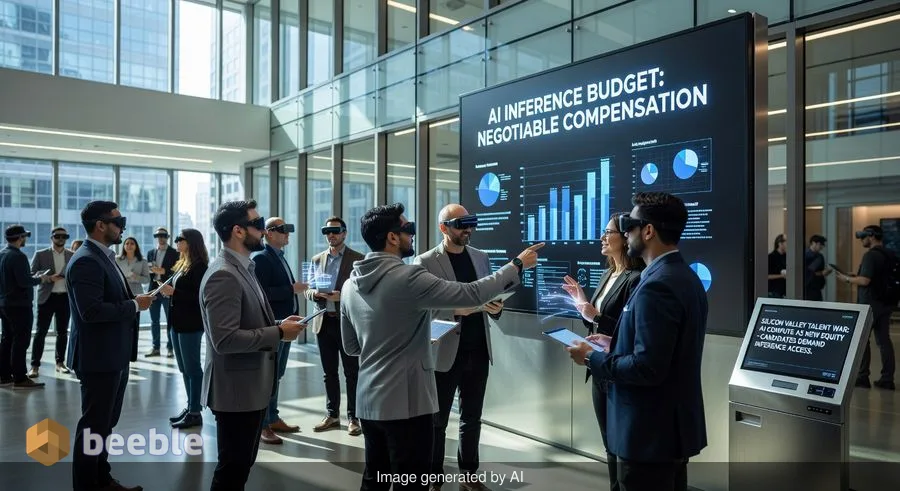
For decades, the hierarchy of Silicon Valley was measured in square footage and stock options. A decade ago, it was the 'Google bus' and free kombucha. Five years ago, it was the remote-work stipend and the promise of a four-day workweek. But as we move through 2026, the most coveted line item in a software engineer’s offer letter isn't a signing bonus or a gym membership. It is a dedicated allocation of AI inference and training credits.
In the current landscape, where generative AI has moved from a novelty to the literal engine of software development, 'compute poverty' has become a genuine career risk. Top-tier talent is no longer just asking about their base salary; they are asking about their FLOPs. This shift is redefining the relationship between employers and employees, turning raw processing power into the ultimate status symbol and productivity tool.
The Rise of Computational Capital
To understand why compute has become a form of currency, one must look at how the daily workflow of a senior developer has changed. In 2026, writing code without a high-reasoning LLM (Large Language Model) is like trying to build a skyscraper with a hand saw. Engineers rely on these models not just for autocomplete, but for architectural simulation, automated unit testing, and real-time debugging.
However, the best models—those with the lowest latency and highest reasoning capabilities—are expensive to run. Companies are finding that their cloud compute bills are rivaling their payroll. To manage these costs, finance departments have begun implementing strict quotas. A junior developer might be restricted to a smaller, open-source model, while the 'compute elite' are granted unfettered access to the latest proprietary frontier models and dedicated H200 or Blackwell GPU clusters.
Why Engineers are Negotiating for Inference
For a high-performing AI researcher or software engineer, access to compute is a matter of professional survival. If an engineer at a startup is limited by a monthly inference cap, their ability to iterate is throttled. Conversely, an engineer with a 'compute-rich' package can run thousands of simulations or fine-tune personal agents to automate the mundane parts of their role.
We are seeing a trend where candidates treat compute as a 'tooling equity.' Just as a graphic designer might insist on a high-end workstation, an AI engineer now insists on a dedicated 'inference sandbox.' This is a private budget of tokens or GPU hours that the employee can use for experimental projects, personal upskilling, or optimizing their own workflows without needing departmental approval for every API call.
The CFO’s Dilemma: Balancing the Books
From a corporate perspective, this trend is a logistical challenge. Unlike a fixed salary, the cost of compute can be volatile. If a team of engineers decides to push a massive batch of synthetic data generation through a frontier model over a weekend, the bill can reach tens of thousands of dollars in hours.
| Compensation Element | Traditional Model | 2026 AI-Integrated Model |
|---|---|---|
| Core Pay | Base Salary + Bonus | Base Salary + Performance Bonus |
| Ownership | RSUs / Stock Options | RSUs + Compute Credits |
| Tooling | Standard Laptop + Software | Dedicated GPU Instances + API Quotas |
| Growth | Training Budget | Model Fine-tuning Allowance |
Finance chiefs are now forced to treat compute as a fringe benefit, similar to how they might handle a company car. They must calculate the 'burn rate' per employee, not just in terms of their salary, but in terms of the electricity and hardware cycles they consume.
The Competitive Edge for Startups
Interestingly, this trend is giving some well-funded startups an edge over legacy tech giants. While a massive corporation might have more total GPUs, they often suffer from internal bureaucracy that makes accessing those resources a nightmare of tickets and approvals.
Startups are winning talent by offering 'unencumbered compute.' Their pitch is simple: "Join us, and we will give you a direct line to a cluster that you control." For a developer who has spent months waiting for a priority queue at a Big Tech firm, the promise of immediate, high-priority inference is more intoxicating than a 10% bump in equity.
Practical Takeaways for Candidates and Hiring Managers
As this trend solidifies, both sides of the hiring table need to adapt. If you are navigating this new landscape, consider the following:
For Job Seekers:
- Ask for the 'Inference Tier': Don't just ask if the company uses AI. Ask which models are available to developers and whether there are per-user token caps.
- Negotiate a Sandbox Budget: Request a dedicated monthly credit for 'Research and Development' that is outside of your project-specific needs.
- Check the Hardware: If the role involves training, ask about the internal cluster architecture. Is it on-premise, or are you at the mercy of a third-party cloud provider's availability?
For Employers:
- Standardize Compute Tiers: Create clear guidelines for compute access based on seniority and project impact to avoid resentment among the ranks.
- Transparency in Costs: Use internal dashboards to show engineers the cost of their inference. When developers see the 'price tag' of their queries, they often become more efficient without needing top-down restrictions.
- Use Compute as a Retention Tool: Offer 'compute bonuses'—extra processing time for personal projects—as a reward for hitting milestones.
The Future of Work is Computational
We are entering an era where the divide between the 'haves' and 'have-nots' in tech will be defined by access to intelligence. Silicon Valley’s shift toward compute-as-compensation is a recognition that in the age of AI, an engineer is only as powerful as the models they can command. As we look toward the end of the decade, the 'corner office' may disappear entirely, replaced by a high-priority login to a server farm in the desert.
Sources
- NVIDIA Investor Relations: Data Center and GPU Growth Trends (2025-2026)
- Gartner Research: The Evolution of Developer Experience in the AI Era
- Bureau of Labor Statistics: Emerging Trends in Tech Compensation Packages
- Cloud Infrastructure Report 2025: Inference vs. Training Cost Analysis



See you on the other side.
Our end-to-end encrypted email and cloud storage solution provides the most powerful means of secure data exchange, ensuring the safety and privacy of your data.
/ Create a free account
