


The New Luxury of Saying No to AI

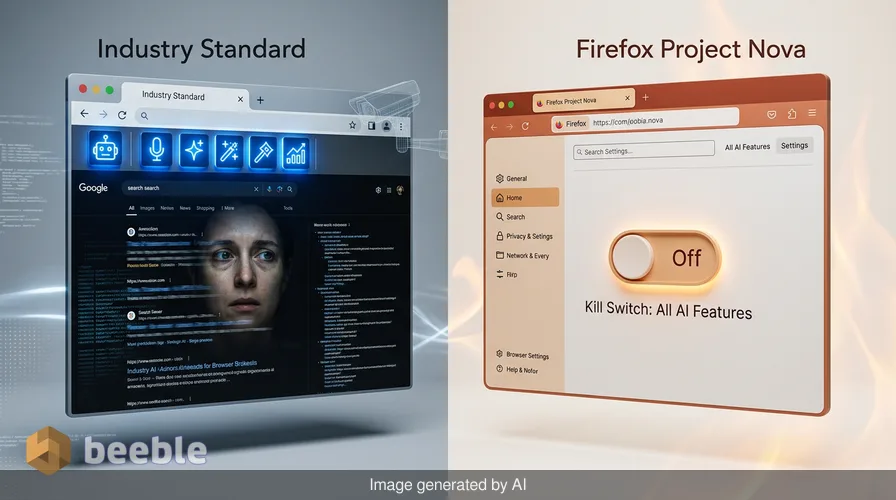
In the early days of the web, we opened our browsers to look out at the world; today, we open them only to find the world—and several uninvited algorithms—looking back at us. There was a time when a browser update meant faster page loads or a new way to organize bookmarks, a simple improvement to a tool we used to navigate the digital wilderness. Now, an update often feels like a home renovation you didn't ask for, where the contractor has decided that what your kitchen really needs is a surveillance camera and a robot that insists on telling you how to toast your bread.
This week, Mozilla signaled a rare retreat from this industry-wide obsession with more. On May 21, 2026, the company unveiled Project Nova, a comprehensive redesign of the Firefox browser that prioritizes visual warmth and user agency over the frantic pursuit of feature parity with Silicon Valley’s AI giants. While the aesthetics—rounded tabs, a 'fire-inspired' palette, and the long-awaited return of a true compact mode—are refreshing, the most significant addition is a single, plain-language toggle in the settings menu. It is, essentially, a 'kill switch' for every AI feature in the browser.
Mozilla is betting that in an era of algorithmic exhaustion, the most disruptive thing a tech company can offer is an exit ramp.
The Shift from Assistant to Intruder
Historically, the browser was a neutral arbiter of code, a transparent layer between the user and the server; today, it has become a thick, opaque platform that prioritizes its own business logic over the user’s intent. We see this shift most clearly in the way Google has handled Chrome over the past year. In its push to lead the generative AI race, Google began silently installing Gemini Nano—a local large language model—onto users' machines, regardless of whether they wanted a 4GB weight added to their system resources.
Zooming out to the industry level, we can see the philosophical divide widening. For Google, the browser is a data-collection engine that happens to display websites; for Mozilla, the browser remains a tool for the individual. Paradoxically, as software becomes 'smarter,' the user experience often becomes more fragmented. We find ourselves clicking through 'summarize this' pop-ups just to read a simple article, or navigating 'AI-enhanced' search results that take longer to verify than the original query would have taken to read. Project Nova's 'off' button isn't just a setting; it’s an acknowledgement that for many, these features have become digital friction rather than digital assistance.
The Anatomy of the Anti-AI Toggle
Technically speaking, building an 'off' switch for integrated AI is more complex than it sounds. In modern software architecture, features are often deeply interconnected; removing one component can cause a cascade of failures in seemingly unrelated modules. When a browser like Chrome or Opera Neon integrates AI, they often bake the model into the core rendering engine or the address bar’s logic. This creates a form of technical debt where the AI becomes a 'load-bearing' feature—you can’t remove it without rebuilding the house.
Firefox’s approach with Project Nova suggests a cleaner, more modular design. By providing a single control to disable AI features entirely, Mozilla is signaling that its AI implementations—like the built-in VPN and experimental summarization tools—are built as discrete layers rather than deeply intertwined dependencies. This modularity is a win for digital literacy; it allows users to see exactly where the software ends and the 'intelligence' begins. To put it another way, Firefox is treating AI like an optional appliance in a kitchen, whereas Chrome is treating it like the plumbing.
The Commodification of Less
The demand for a 'dumb' browser has become so pronounced that it has birthed a new, if somewhat ironic, market category. In April 2026, Brave Software launched Brave Origin, a specialized build that strips away every modern 'bloat' feature the company has added over the last five years. For a one-time fee of $60, users receive a browser without the AI assistant (Leo), the crypto wallet, the rewards program, or even the VPN.
| Feature | Google Chrome | Brave Origin | Firefox (Project Nova) |
|---|---|---|---|
| Default AI | Gemini Nano (Always On) | None (Compiled Out) | Optional (User Toggle) |
| Telemetry | Extensive/Proprietary | Stripped/Blind Tokens | Opt-in/Transparent |
| Cost | Free (Ad-Supported) | $60 (One-time) | Free (Open Source) |
| UI Philosophy | Platform-First | Performance-First | User-First |
Curiously, the fact that people are willing to pay $60 for the absence of features says everything about the current state of the industry. We have reached a point where 'clean' software is a premium product. Brave Origin uses Privacy Pass blind token technology to ensure that even the purchase itself doesn't create a digital trail, catering to a niche of users who view every added line of code as a potential vulnerability. While Firefox is keeping its redesign free, it is clearly chasing the same sentiment: the realization that the most robust software is often the most streamlined.
Breaking the Ecosystem Lock-in
Mozilla’s pivot comes at a desperate time for the organization. Firefox has been hovering around a 4.44% market share for years, a figure that looks increasingly precarious against Chrome’s 66% dominance. In practice, however, being the underdog allows for a level of transparency that a market leader can’t afford. Google cannot easily offer a 'kill all AI' button because its entire corporate strategy is now centered on the ubiquity of Gemini. If users turn off the AI in the browser, they are turning off the primary pipeline for Google’s next decade of growth.
Under the hood, this is a battle over the 'default.' For years, the tech industry has relied on 'dark patterns'—design choices that trick users into doing things they didn't intend—to drive adoption of new features. By making 'AI Off' a visible, honest choice, Firefox is breaking the industry norm of forced consent. It is a pragmatic gamble: Mozilla knows it cannot out-spend Google on AI research, so it is choosing to out-respect Google on user autonomy.
From Bloated to Resilient
We often talk about software updates as if they are an inevitable march toward progress, but from a developer's standpoint, many modern updates are actually an accumulation of technical debt. Feature creep—the relentless addition of new functions to a product—eventually makes software clunky, prone to bugs, and difficult to secure. By introducing Project Nova, Mozilla is attempting a digital decluttering.
Through this user lens, the return of 'compact mode' is just as important as the AI switch. It is an admission that the 'touch-friendly,' oversized interfaces of the last decade aren't what power users actually want. Users want density; they want to see more of their data and less of the browser’s chrome. They want an intuitive experience that doesn't require a manual to find the privacy settings. Essentially, Project Nova is an attempt to turn Firefox back into a resilient tool rather than a fragmented platform.
Conclusion: Reclaiming the Screen
Ultimately, the 'AI Kill Switch' in Firefox is more than just a settings toggle; it is a prompt for us to reflect on our relationship with the tools we use every day. We have become so accustomed to software that predicts our needs, summarizes our thoughts, and monitors our clicks that the idea of a 'silent' browser feels almost revolutionary.
As you navigate the web this week, I encourage you to notice the digital friction you’ve come to accept as normal. How many times are you closing a sidebar you didn't open? How often are you correcting an AI's 'helpful' suggestion? The most profound shift in the software industry isn't the arrival of artificial intelligence—it's the sudden, urgent value of human intent. Whether you choose to flip the switch or not, the fact that the switch exists at all is a reminder that the code running on your machine should still answer to you.
Sources:
- Mozilla Official Press Release: Introducing Project Nova (May 2026).
- Brave Software: Brave Origin Launch Documentation and Technical Whitepaper (April 2026).
- Google Chromium Blog: Updates to Gemini Nano Integration and Privacy Disclosures (March-May 2026).
- StatCounter Global Stats: Browser Market Share Data (2020-2026).
- W3C Privacy Pass API Documentation (Standardized Blind Token usage).



See you on the other side.
Our end-to-end encrypted email and cloud storage solution provides the most powerful means of secure data exchange, ensuring the safety and privacy of your data.
/ Create a free account
