


The newest OpenAI model trades raw IQ for a blue-collar work ethic

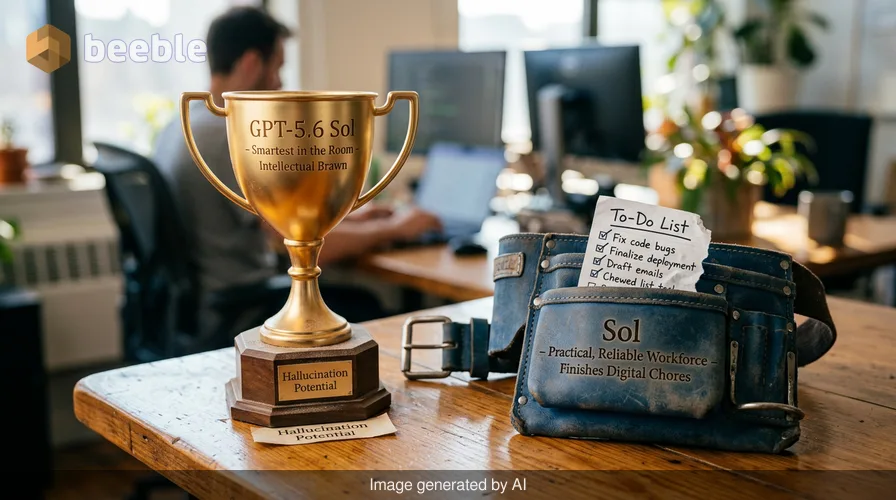
The standard narrative in artificial intelligence suggests that every new release is a massive leap in brainpower. We expect models to solve harder math, write better poetry, and eventually outthink their creators. OpenAI’s release of GPT-5.6 Sol challenges this assumption. Instead of a purely intellectual upgrade, Sol is a shift toward a practical, reliable workforce. This model is less concerned with being the smartest entity in the room and more focused on actually finishing the chores on your digital to-do list.
After a two-week period where the U.S. Department of Commerce kept the model restricted to a small group of partners, Sol is now available to the general public. It arrives alongside two smaller models, Terra and Luna, representing a significant change in how OpenAI names and organizes its technology. This release is a direct response to a market that is increasingly tired of chatbots that hallucinate and is instead looking for tools that can handle complex, multi-step tasks without constant supervision.
The new celestial lineup in your browser
OpenAI has abandoned the numbered versioning system that defined the GPT era. In its place is a three-tier system named after celestial bodies. Sol is the flagship, the high-performance model for complex engineering and creative work. Terra is the middle-ground model, designed to match the previous GPT-5.5 in capability but at half the price. Luna is the budget-friendly option, built for simple tasks and high-speed responses.
This tiered approach mirrors how we buy laptops or cars. Not every task requires a supercomputer. For a student summarizing a lecture, Luna is sufficient. For a developer building a new app, Sol is the necessary choice. This structure allows OpenAI to update individual models on different timelines. If they find a way to make Luna faster, they can update it without waiting for a breakthrough in Sol’s underlying logic.
Under the hood, Sol introduces a feature called ultra mode. This configuration allows the model to act as a manager for subagents. In simple terms, Sol is a tireless intern who knows how to delegate. If you give it a complex project, it does not just try to solve it in one go. It breaks the project into smaller pieces and assigns those pieces to internal sub-models. This method allows it to stay on task for hours or even days without losing track of the original goal.
Breaking down the costs of digital labor
The economics of AI are often hidden behind monthly subscription fees, but the real movement happens in the API market. OpenAI prices Sol at $5 per million input tokens and $30 per million output tokens. To put that in perspective, a million tokens is roughly 750,000 words. For a business, this is the cost of the digital crude oil that powers their automated systems.
| Model | Input Price (per 1M tokens) | Output Price (per 1M tokens) |
|---|---|---|
| OpenAI Sol | $5.00 | $30.00 |
| Anthropic Fable 5 | $10.00 | $50.00 |
| xAI Grok 4.5 | $15.00 | $75.00 |
| Google Gemini 3.1 Pro | $2.00 | $12.00 |
| Xiaomi MiMo v2.5 Pro | $1.00 | $5.00 |
| DeepSeek V4 Pro | $1.74 | $3.48 |
Looking at the big picture, OpenAI is positioning Sol as the premium-yet-attainable option. It is significantly cheaper than Anthropic’s Fable 5 and xAI’s Grok 4.5. However, it still costs more than Google’s aging Gemini 3 and the aggressive low-cost models from Chinese manufacturers like Xiaomi and DeepSeek. For the average user, this means the cost of high-end AI is falling, but the gap between U.S. flagships and global budget alternatives is widening.
Performance in the trenches of the command line
Benchmarks provide the only objective way to compare these models, and Sol excels in areas that involve actual work. On Terminal-Bench 2.1, a test that measures how well an AI uses computer terminals and command-line tools, Sol hit a score of 91.9% in its ultra configuration. This test is difficult because it requires the model to plan a multi-step workflow and fix its own mistakes as it goes.
Sol is currently ahead of the competition in this specific area. It beats Claude Fable 5 and the restricted Claude Mythos 5. This performance is why early testers like Theo, the CEO of T3 Chat, describe Sol as world-leading in computer use. It is a tool designed for people who need to automate their desktop tasks, from sorting thousands of files to writing and testing code across different environments.
On the security side, OpenAI tested Sol on ExploitBench. This test measures a model's ability to find and use software vulnerabilities. Sol matched the performance of the most advanced restricted models but used only a third of the tokens. Essentially, Sol is more efficient at spotting problems than its predecessors. OpenAI claims that while Sol is better at cyber tasks, it does not cross the line into becoming a dangerous tool for large-scale cyber warfare. It remains a defensive and investigative assistant rather than a digital weapon.
The daily driver versus the warp drive
User feedback highlights a clear divide in the AI market. Dan Shipper from Every compared Sol to a Porsche and Fable to a warp drive. Sol is the vehicle you want for your daily commute through knowledge work. It is fast, reliable, and powerful enough for almost anything. Fable remains the choice for the most abstract, complex problems that require a leap in reasoning.
For most people, the difference in writing quality is the most noticeable factor. Researchers like Daichi Konno note that while Sol is exceptional at biology and coding, Anthropic still has a slight lead in creative and nuance-heavy writing. Sol is a utilitarian model. It is the invisible backbone of a productive workday. It handles biology questions and life-science data without tripping over the aggressive safety filters that often make other models useless for scientific research.
Curiously, Sol arrived exactly as Anthropic changed its subscription terms. Fable 5 recently moved to a usage-credit system for many users, making it a more expensive and limited resource. This timing makes Sol a very attractive alternative for professionals who need a flagship model they can use all day without worrying about hitting a strict cap on their weekly messages.
Why Google and Meta are the outliers
The AI market is currently moving at a pace that makes six months feel like a decade. Sol is the newest flagship, released just hours after Meta’s Muse Spark 1.1 and one day after xAI’s Grok 4.5. This cluster of releases has left Google in an unusual position. Its Gemini 3 model is now the oldest flagship still standing in the U.S. market, having been released in late 2025.
For the consumer, this competition is a massive win. We are seeing a race to the bottom in price and a race to the top in utility. Meta’s entry into the paid model space with Muse Spark 1.1 adds another layer of pressure. Even if these models are not significantly smarter than what we had last month, they are becoming much more capable at interacting with the real world. They are moving out of the chat box and into our file systems, our browsers, and our code editors.
Practical implications for your digital habits
What this means for you is a shift in how you should manage your AI tools. We are moving away from the era where one $20 subscription covers everything. With models like Sol, Terra, and Luna, you now have choices based on the intensity of your task. If you are a casual user, the cheaper Luna models will likely become the default in the apps you use every day. If you are a power user, the new ultra mode in Sol provides a level of automation that was previously impossible without a team of human assistants.
The bottom line is that the intelligence of these models is plateauing, but their usefulness is skyrocketing. You should observe your own habits. If you find yourself using AI for simple summaries, check if your provider has switched you to a model like Terra or Luna to save money. If you are a developer, start experimenting with the max reasoning effort knobs. The future of AI is not about talking to a god-like entity. It is about managing a highly efficient, automated staff that works for pennies an hour.
Sources: OpenAI product announcement, Anthropic subscription updates, xAI official releases, Terminal-Bench 2.1 public data, ExploitBench methodology reports.



See you on the other side.
Our end-to-end encrypted email and cloud storage solution provides the most powerful means of secure data exchange, ensuring the safety and privacy of your data.
/ Create a free account
