


The next major data center for artificial intelligence is currently orbiting the Earth

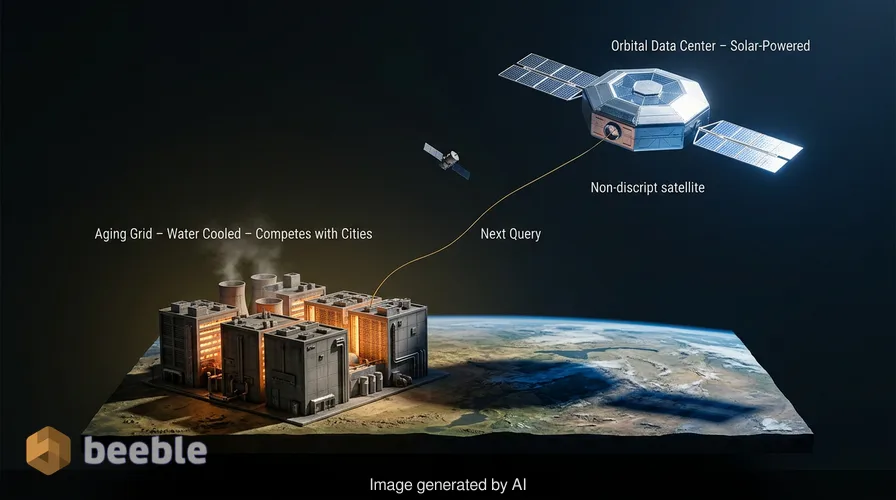
The sleek, AI-generated image on your smartphone screen began its life as a series of electrical pulses. Those pulses traveled through fiber-optic cables to a windowless warehouse in a place like Northern Virginia or Dublin. Inside that warehouse, thousands of high-end processors consumed enough electricity to power a medium-sized city and enough water to cool a stadium. This massive consumption of resources is the reason the tech industry is now looking toward the stars.
To understand why your next AI query might be processed in orbit, you have to look at the physical limitations of our planet. Modern artificial intelligence requires an immense amount of power. On Earth, providing that power means competing with homes, hospitals, and factories for a share of an aging electrical grid. In the vacuum of space, however, the sun provides a constant and nearly infinite supply of energy. This reality has sparked a new race among startups to build orbital data centers. Companies are now in active talks with insurers to cover these high-stakes missions, marking a transition from science fiction to a legitimate financial sector.
The physical wall hitting your favorite AI apps
Every time a new version of a popular chatbot arrives, the hardware required to run it becomes more demanding. We are currently seeing a shift where the bottleneck for AI development is no longer just the code or the data. The bottleneck is the physical infrastructure of the electrical grid. On the market side, utility companies in major tech hubs are already warning that they cannot keep up with the demand from new data centers. Some jurisdictions have even placed moratoriums on new construction to protect the local power supply.
This is where the "space as a power plant" concept becomes practical. A satellite in Low Earth Orbit can have solar panels that receive unfiltered sunlight for almost 24 hours a day. There are no clouds, no atmosphere, and no nighttime to interrupt the flow of energy. By moving the most power-hungry parts of AI training into space, tech companies can bypass the limitations of the terrestrial grid. This move is not about moving away from Earth. It is about moving the heavy lifting to a place where the energy is free and the space is vast.
Why insurance is the invisible backbone of the space economy
Building a data center in space is an expensive venture. A single satellite equipped with the latest AI chips can cost tens of millions of dollars. For a startup to scale this technology, it needs more than just venture capital. It needs debt financing from banks. Historically, banks do not lend large sums of money for hardware that might explode on a launchpad or get fried by a solar flare unless that hardware is insured.
Insurance companies are the gatekeepers of this new industry. They are currently evaluating the risks of radiation, space debris, and the extreme thermal cycles that occur when a satellite moves from shadow to sunlight. If a server rack on Earth fails, a technician can swap it out in ten minutes. If an AI processor in orbit fails, it is effectively a piece of very expensive space junk. Insurers are tasked with putting a price on that risk. Without their approval, the orbital data center remains a hobby for billionaires rather than a scalable business model.
The SpaceX and Blue Origin effect on cost
For decades, the cost of sending anything into space was the primary barrier to entry. It was like trying to start a delivery business where the delivery truck costs $100 million and you have to throw it away after every trip. SpaceX changed this math with reusable rockets. The upcoming SpaceX Starship and Blue Origin's New Glenn are designed to carry massive payloads for a fraction of the historical cost.
| Factor | Terrestrial Data Center | Orbital Data Center |
|---|---|---|
| Power Source | Local Grid (Coal, Gas, Nuclear) | Direct Solar Energy |
| Cooling Method | Water and Air Conditioning | Passive Thermal Radiation |
| Real Estate | Expensive Land and Permits | Infinite Orbital Slots |
| Maintenance | Easy Access for Repairs | Impossible or Robotic Only |
| Primary Risk | Power Outages or Fires | Radiation and Space Debris |
These new launch vehicles are the digital crude oil of the space age. They provide the transport necessary to get heavy, power-hungry server racks into orbit. As the cost per kilogram of launch continues to drop, the math for orbital data centers becomes more attractive. Startups are no longer asking if they can afford to launch. They are asking how many units they can get into a single fairing.
Under the hood of an orbital server
Operating a computer in the vacuum of space is fundamentally different from operating one in a climate-controlled room. On Earth, we use fans to move air over hot components. In space, there is no air to move. Heat must be managed through radiation, using large panels to bleed thermal energy into the cold void of space. This requires a complete redesign of how AI chips are packaged.
Furthermore, space is a high-radiation environment. The tiny transistors on a modern AI chip are susceptible to cosmic rays, which can flip a bit from a zero to a one and cause a calculation error. This is a systemic risk for AI training, which requires absolute precision over weeks of computation. Startups are developing specialized shielding and software-based error correction to handle these strikes. These are the technical details that insurers are currently scrutinizing. They want to know that a single solar storm won't wipe out a company's entire balance sheet.
What this means for your digital life
For the average user, the move to orbital data centers might seem invisible at first. You will still type a prompt into your phone and get a response. However, there are tangible implications for the cost and availability of these services. If the industry successfully moves AI processing to space, the cost of running these models could stabilize. This would prevent the "AI tax" that many fear will make high-end tools unaffordable for regular people.
On the other hand, there is the issue of latency. Light travels at a finite speed. Sending data from your phone to a satellite 500 miles up and back down again adds a small delay. For batch-processing tasks like training a new model or analyzing large datasets, this delay is irrelevant. For real-time applications like voice assistants or gaming, it could be a dealbreaker. We will likely see a decentralized approach where the "thinking" happens in space, but the "talking" still happens on Earth.
Looking at the big picture of sustainability
Ultimately, the push for space-based AI is a response to the environmental footprint of our digital habits. Data centers are one of the fastest-growing consumers of electricity and water on the planet. By moving these industrial processes off-world, we are effectively outsourcing our pollution to a place where it has no biological impact.
This is a resilient strategy for a world that is increasingly conscious of resource scarcity. It allows us to continue the rapid advancement of artificial intelligence without putting further strain on the terrestrial environment. It is a transition from a world where technology is a burden on our resources to one where it utilizes the vast, untapped energy of our solar system.
From a consumer standpoint, you should observe how your favorite tech companies talk about their "carbon neutral" goals in the coming years. Many of those goals will likely depend on hardware that never touches the ground. The next time you use an AI tool, consider the journey that data took. It is a reminder that the invisible backbone of modern life is no longer just under our feet. It is increasingly over our heads.
Sources:
- SpaceX Starship User Manual and Payload Specifications
- International Union of Aerospace Insurers (IUAI) Annual Reports
- International Energy Agency (IEA) Data Center Energy Consumption Report 2024
- Blue Origin New Glenn Technical Overview
- Axiom Space Orbital Infrastructure Documentation



See you on the other side.
Our end-to-end encrypted email and cloud storage solution provides the most powerful means of secure data exchange, ensuring the safety and privacy of your data.
/ Create a free account
