


The OpenAI Orbit: Mapping the Talent War Fueling the AI Revolution
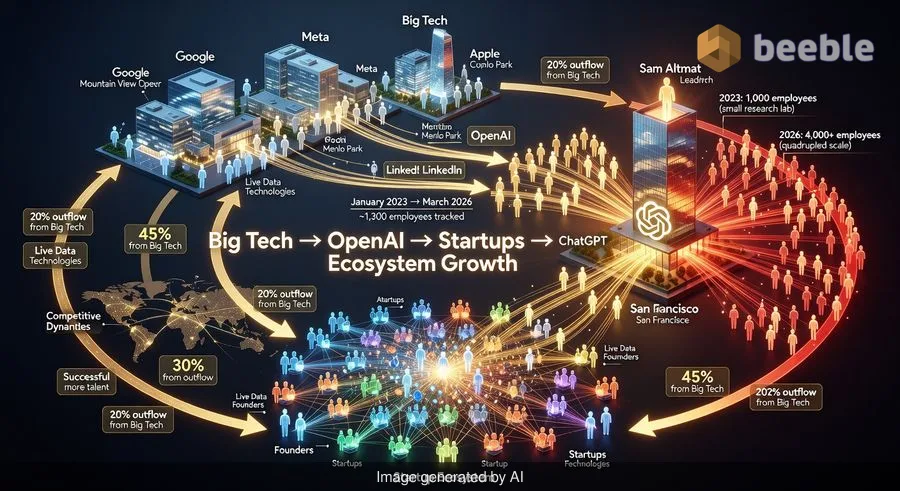
Have you ever noticed how the tech world feels less like a static map and more like a fluid, living organism? In the high-stakes world of artificial intelligence, this ecosystem is currently defined by a single, massive gravity well: OpenAI. Since the launch of ChatGPT, the San Francisco-based giant has acted as both a vacuum for elite talent and a high-pressure incubator for the next generation of founders.
Recent data from workforce intelligence providers like Live Data Technologies paints a remarkable picture of this churn. Between January 2023 and March 2026, OpenAI’s workforce didn't just grow; it exploded. The company nearly quadrupled in size, scaling from a relatively lean research lab of 1,000 employees to a robust tech titan with more than 4,000 workers. But where are these people coming from, and perhaps more importantly, where are they headed when they decide to leave the nest?
The Great Inward Migration: Harvesting Big Tech
For years, Google, Meta, and Apple were the undisputed destinations for the world’s most sophisticated AI researchers. Nevertheless, the tide has shifted. OpenAI has successfully pulled hundreds of engineers and researchers from these legacy incumbents. Under the hood, the draw is simple: the promise of working on the most performant models and the chance to achieve AGI (Artificial General Intelligence) in our lifetime.
In practice, this migration often feels like a paradigm-shifting event for the individuals involved. I remember talking to a senior researcher who left a cushy, decade-long tenure at Google DeepMind. He described the transition as moving from a well-manicured library to a construction site in the middle of a gold rush. At Google, he was a small cog in a massive, deterministic machine; at OpenAI, he was suddenly responsible for building the bridges while crossing them. This influx of "Big Tech" DNA has provided OpenAI with the scalable infrastructure expertise needed to support millions of concurrent users, even as it occasionally clashes with the company's original, more academic roots.
Scaling Pains: From Research Lab to Product Powerhouse
Growing from 1,000 to 4,000 employees in three years is an intricate, often friction-heavy process. To put it another way, it’s like trying to perform city planning while the population is doubling every few months. When a company scales this quickly, technical debt can accumulate like financial debt, threatening to bankrupt the engineering culture if not managed carefully.
Many of the new hires are not just researchers, but product managers, sales executives, and customer success leads—the "immune system" of a mature enterprise. Curiously, this shift has led to a nuanced cultural tension. The original "old guard" who joined for the pure research mission sometimes find the new, product-focused OpenAI to be a different beast entirely. We’ve seen this before in tech history; it’s the classic tug-of-war between pure innovation and the pragmatic business goals of a multi-billion-dollar entity.
The OpenAI Mafia: Seeding the Competition
If OpenAI is the sun in this ecosystem, the startups spinning off from it are the planets. Just as the "PayPal Mafia" defined the 2000s, an "OpenAI Mafia" is currently reshaping the AI landscape. After sticking around for a year or two—often long enough to see a major model release—many employees go on to found or join rival startups.
Consequently, we are seeing a proliferation of companies like Anthropic, xAI, and Safe Superintelligence (SSI) being staffed by former Altman lieutenants. These departures aren't always a sign of trouble; often, they are the natural result of ambitious people wanting to build their own blueprints. Oddly enough, this churn actually benefits the broader industry by diffusing cutting-edge knowledge across the network. However, for OpenAI, it creates a precarious situation where they are constantly training their future competitors—essentially raising an apprentice who might eventually challenge the master.
The Talent War in 2026: A Comparative Look
As of March 2026, the battle for talent has reached an unprecedented level of intensity. The following table illustrates how the flow of workers has stabilized across the major players:
| Company | Primary Talent Source | Primary Talent Destination | Key Retention Strategy |
|---|---|---|---|
| OpenAI | Google, Meta, Apple | Rival Startups, VC Firms | Massive Equity, Compute Access |
| Universities, Startups | OpenAI, Anthropic | Stability, Deep Research Budgets | |
| Anthropic | OpenAI, Google | Specialized AI Safety Labs | Mission-driven Culture |
| Meta | Academic Labs, Apple | OpenAI, xAI | Open Source (Llama) Advocacy |
Practical Takeaways for Navigating the AI Talent Landscape
Whether you are a founder trying to hire or an engineer looking for your next move, the current volatility offers both risk and opportunity. Here is how to navigate the current climate:
- Focus on the Mission, Not Just the Hype: The most resilient teams are those joined by people who believe in the specific problem being solved, not just the brand name. Avoid jumping on a hyped tech trend too early without a clear use case.
- Beware of Technical Debt in Rapid Scaling: If you are joining a fast-growing company, ask about their documentation and onboarding. Inheriting a messy and completely undocumented system during a 3 AM system outage is a rite of passage you’d rather avoid.
- The Golden Rule of Networking: In an asynchronous, remote-heavy world, your reputation is your most valuable API. The person you work with today at OpenAI might be the founder of the startup you want to join tomorrow.
- No Friday Updates: As a professional courtesy to your sanity and your team’s, keep the "no Friday updates" rule sacred, especially in high-pressure AI environments where a single bug can take down a global service.
The Future of the Pipeline
As we look toward the second half of 2026, the question remains: Can OpenAI maintain its status as the industry’s primary talent magnet? While they have the advantage of scale and a massive war chest, the allure of smaller, more agile startups remains a powerful disruptive force. The AI ecosystem is not a zero-sum game, but it is a high-velocity one.
Ultimately, the movement of these 4,000 individuals tells a story of a technology that is still in its infancy. We are watching the building blocks of the future being laid down, one hire (and one resignation) at a time.
Are you looking to make your next move in the AI space? Keep a close eye on the secondary ripples—the smaller startups founded by ex-OpenAI engineers—as they are often where the most innovative, friction-free work is happening today.
Sources:
- Live Data Technologies: Workforce Intelligence Report (2023-2026).
- Business Insider: Analysis of LinkedIn Talent Flows in Big Tech.
- OpenAI Official Blog: Scaling the Organization and Research Milestones.
- TechCrunch: The Rise of the AI Mafia and Startup Funding Trends.



See you on the other side.
Our end-to-end encrypted email and cloud storage solution provides the most powerful means of secure data exchange, ensuring the safety and privacy of your data.
/ Create a free account
