


The Paradox of Shared Prosperity in an Era of Individual Obsolescence

A thumb hovers, trembling slightly, over the blue glow of a smartphone screen in the muffled silence of a 6:00 AM subway car. The man holding it doesn’t look like a revolutionary; he looks like a person trying to survive the morning commute. He is using an AI-integrated app to draft a response to a performance review he hasn’t yet fully processed, choosing the professional yet firm tone from a dropdown menu. In this fleeting, flickering moment of digital assisted-agency, the individual is performing a micro-negotiation with a machine that has already read more performance reviews than any human could in a thousand lifetimes. This small, visceral interaction—the outsourcing of a difficult emotion to a predictive algorithm—is the smallest unit of a much larger, systemic transformation that is currently rewriting the unspoken rules of our civilization.
Zooming out from that single subway car, we see an entire urban landscape operating on similar, invisible rails. The city functions as a theater stage where we perform our shifting social identities, yet the scripts are increasingly being co-authored by Large Language Models. Culturally speaking, we are witnessing the emergence of a new habitus, a set of deeply ingrained dispositions where we no longer just use technology, but allow it to curate our very capacity for expression. This shift is not merely about convenience; it is about the fundamental restructuring of the human experience within what sociologists call liquid modernity—a state where the structures of society are changing faster than the time it takes for us to adapt to them. In this context, the proposal recently released by OpenAI, titled Industrial Policy For The Intelligence Age, ceases to be a mere corporate white paper and becomes an archaeological artifact of our near future.
The Silent Architect of the New Agreement
Historically, social contracts have been the product of bloody revolutions or the slow, grinding gears of democratic legislation. The New Deal and the Progressive Era were visceral responses to the smoke and steel of the Industrial Revolution, born from a desperate need to keep the human element from being crushed by the engine of mass production. Today, however, we face a curious irony: the primary architects of our new social contract are not the elected officials in the halls of Congress, who remain largely paralyzed by a paucity of social imagination, but the very disrupters whose technology is forcing the change.
On a macro level, OpenAI’s proposal is a recognition that the old world—where labor was the primary ticket to economic participation—is dissolving. We are moving into an era where the value of human labor in production is diminishing while the value created by intelligent machines is skyrocketing. Consequently, we are entering an archipelago of existence: we live in densely packed digital spaces, yet we are increasingly atomized, separated from the traditional economic tethers that once bound us to a community of shared work. OpenAI’s framework attempts to build a bridge across this fragmented reality by proposing three guiding principles: sharing prosperity, mitigating systemic risks, and democratizing agency.
The Decoupling of Work and Worth
At its core, the most profound challenge of the Intelligence Age is the divorce of productivity from the paycheck. For nearly a century, our sense of self and our place in the social hierarchy have been rooted in our professional identity. Through this lens, the threat of superintelligence is not just the loss of a job, but the loss of a social anchor. Paradoxically, the more productive our society becomes through AI, the more precarious the individual’s position feels. If a machine can perform the work of a thousand analysts, the wealth generated by that machine typically accrues to the person who owns the machine, not the analysts who were displaced.
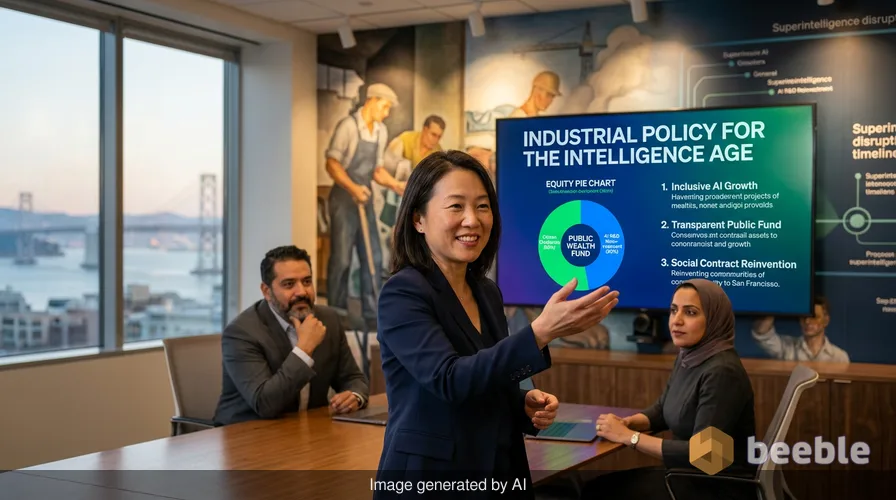
To address this, OpenAI proposes a Public Wealth Fund. Linguistically speaking, the term public wealth fund sounds like a dry economic mechanism, but in practice, it is a radical reimagining of ownership. The idea is to seed a fund—perhaps through a 2.5% tax on the market value of elite AI firms, payable in shares—that provides every citizen with a stake in the compounding returns of the intelligence economy. Essentially, it is an attempt to turn the entire population into a class of owners. In everyday terms, this means that even if your specific skill set becomes obsolete because an algorithm can do it better, your bank account still reflects the growth of the system that replaced you.
Reclaiming Agency in the Attention Economy
One of the most nuanced aspects of the OpenAI proposal is the call to democratize access and agency. In our current digital landscape, social media feeds act as a hall of mirrors, reflecting and amplifying our biases while stripping us of our attention. There is a systemic risk that AI could become the ultimate tool for this kind of cognitive capture, where the most powerful models are controlled by a tiny elite to manipulate the masses or consolidate power.
Democratizing agency means ensuring that the person in that 6:00 AM subway car isn't just a passive consumer of a tone-shifting app, but a person with real influence over how that tool functions in their life. It requires moving away from an opaque system where algorithms make decisions behind the scenes to a transparent framework where individuals can use AI to expand their own capabilities. Without this, we risk a future where a few individuals own the robots and the rest of society is reduced to a marginalized class, living on the digital equivalent of a fast-food diet—quick and accessible, but lacking any real substance or emotional nutrition.
The Fragility of the Silicon Promise
While the vision is more comprehensive than anything produced by the moribund political class, we must view it with a measured, perhaps even slightly ironic, detachment. To put it another way, when the person who builds the fire also offers to sell you the extinguisher, it is wise to check the pressure gauge. The transition to superintelligence is not a natural phenomenon like a thunderstorm; it is a series of proactive political choices.
OpenAI admits that capitalism, as it currently exists, is not equipped to manage the opportunities and risks of this new epoch. This is a startling admission from a company at the heart of the market. It suggests that even the disrupters realize that a society where the majority of people lack agency and access to AI-driven opportunity is a society that will eventually collapse under the weight of its own inequality. The proposed social contract is a patchwork quilt, stitched together from fragmented collective experiences and the hope that we can avoid the dislocation that usually accompanies technological upheaval.
Navigating the Shifting Ground
As we look toward 2026 and beyond, the pervasive nature of AI will only become more deeply rooted in our mundane routines. From the way we order our morning coffee to the way we seek healthcare, the intelligence age will be ubiquitous. The challenge for us, on an individual level, is to remain hyper-observant of how these tools change our relationships and our sense of community.
We must ask ourselves: as we share in the prosperity of the Public Wealth Fund, what happens to the human connections that were once forged in the shared struggle of labor? If we are no longer defined by what we do, how will we define who we are? These are not questions for OpenAI’s engineers; they are questions for us, the people currently navigating the transition.
Food for Thought: Navigating the Intelligence Age
- Observe Your Outsourcing: The next time you use AI to draft a message, pause and ask why you are doing it. Are you saving time for something more meaningful, or are you losing the ability to navigate complex human emotions yourself?
- Redefine Your Worth: If your economic value is increasingly decoupled from your labor, where do you find your sense of purpose? Consider reclaiming a hobby or a community role that has no market value but high human value.
- Question Ownership: As the conversation around Public Wealth Funds grows, think about what it means to be a stakeholder in a technological future. What kind of say should you have in how that wealth is generated?
- Seek Third Places: In an increasingly atomized world, prioritize physical spaces—cafes, libraries, parks—where interaction isn't mediated by a screen or an algorithm.
Ultimately, the social contract for the Age of Intelligence cannot be signed by a corporation on our behalf. It must be something we negotiate daily, through our choices, our language, and our refusal to be reduced to mere data points in an overarching system of superintelligence. The blue glow of the smartphone screen may be pervasive, but the hand that holds it still has the power to turn it off.
Sources
- OpenAI. "Industrial Policy For The Intelligence Age: Ideas To Keep People First." (Official Proposal, 2024).
- Bauman, Zygmunt. "Liquid Modernity." Polity Press.
- Bourdieu, Pierre. "The Logic of Practice." Stanford University Press.
- Altman, Sam. "Moore's Law for Everything." (Public Essay/Proposal on Public Wealth Funds).
- Economic data regarding the concentration of equity ownership in the United States (Federal Reserve reports).



See you on the other side.
Our end-to-end encrypted email and cloud storage solution provides the most powerful means of secure data exchange, ensuring the safety and privacy of your data.
/ Create a free account
