


The Pentagon Pivot: Why Sam Altman is Stuck Playing Defense in the New AI Arms Race

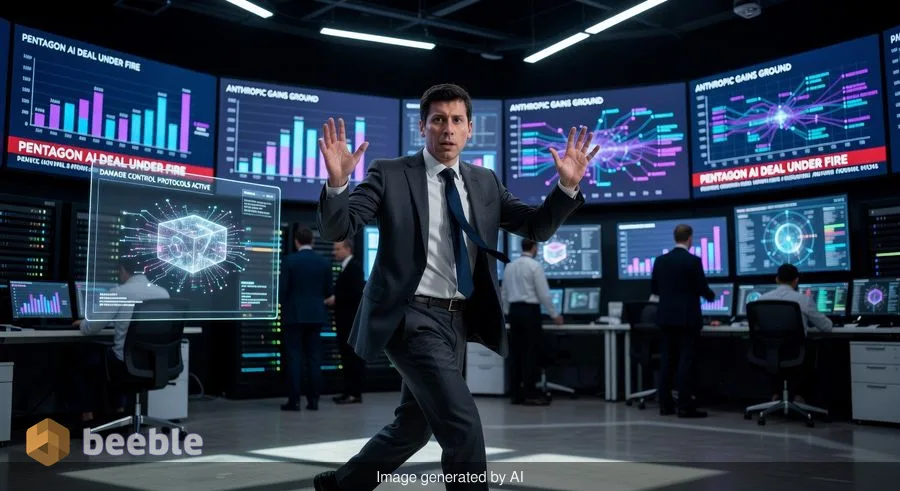
Just over a week ago, Sam Altman was on top of the world. OpenAI had just secured a landmark partnership with the U.S. Department of Defense, a deal that promised to integrate GPT-level intelligence into the heart of national security operations. It was framed as a patriotic victory—a moment where Silicon Valley’s most prominent lab stepped up to ensure American technological hegemony.
But the victory lap was short-lived. Today, the narrative has shifted from strategic triumph to a grueling exercise in damage control. For the first time in OpenAI’s history, the company is facing a crisis that cannot be solved with a more efficient algorithm or a larger GPU cluster. This is a battle of optics, ethics, and consumer trust, and the stakes are higher than ever.
The Deal That Divided the Valley
The current turmoil traces back to a high-stakes bidding war for a massive Pentagon contract aimed at modernizing military logistics and decision-support systems. While several AI labs were in the running, the competition eventually narrowed down to two titans: OpenAI and Anthropic.
In a move that surprised many industry insiders, Anthropic—the company founded on the principles of 'AI Safety' and 'Constitutional AI'—walked away from the table. Citing concerns over the potential for their models to be used in kinetic operations or to bypass ethical guardrails, Anthropic refused to sign the government’s terms.
OpenAI, under Altman’s leadership, took a different path. They worked with the Pentagon to carve out a specific set of use cases, arguing that it is better for the U.S. military to use 'aligned' models than to fall behind global adversaries. However, the nuance of that argument was quickly lost in the public square. To the average user, the optics were simple: Anthropic chose principles; OpenAI chose the contract.
The Public’s Verdict: Voting with the Wallet
Unlike previous controversies involving data privacy or board-room drama, this 'Pentagon Pivot' has triggered a tangible shift in the consumer market. Over the last seven days, social media platforms have been flooded with screenshots of users canceling their ChatGPT Plus subscriptions.
Data from third-party app trackers suggests a significant spike in downloads for Claude, Anthropic’s flagship chatbot, and a corresponding dip in OpenAI’s retention rates. This isn't just a vocal minority complaining on the internet; it is a migration of the 'prosumer' class—the developers, writers, and researchers who have been the backbone of OpenAI’s growth.
For these users, the concern isn't necessarily that ChatGPT is becoming a weapon. Rather, it is the fear that OpenAI’s priorities have shifted from building 'AI for everyone' to building 'AI for the state.' This perceived loss of independence is a blow to a brand that once positioned itself as a non-profit-adjacent safeguard for humanity.
Why This Isn't a Technical Fix
Sam Altman is a master of the 'product pivot.' When GPT-4 was criticized for being too 'lazy,' the team pushed updates to improve responsiveness. When privacy concerns arose, they introduced Enterprise modes and incognito browsing. But you cannot 'patch' a government contract.
This is a structural challenge. The Pentagon deal comes with long-term commitments and oversight that make it impossible for OpenAI to simply back out without massive legal and reputational repercussions. Altman is now in the uncomfortable position of having to justify the company’s moral compass to a public that feels increasingly alienated.
"The challenge for OpenAI isn't the code; it's the character of the institution," says one industry analyst. "You can't A/B test your way out of an ethical divide."
The Geopolitical Tightrope
To understand why Altman took the deal, one must look at the broader geopolitical landscape. In 2026, AI is no longer just a productivity tool; it is the primary engine of national power. The U.S. government is desperate to ensure that the leading AI models are developed within a framework that supports domestic interests.
By partnering with the Pentagon, OpenAI has essentially become a 'national champion.' This grants them immense political capital and access to resources that few other companies can match. However, it also paints a target on their back. Adversaries view the company as an extension of the U.S. state, while domestic critics fear the militarization of a technology that was supposed to be a global utility.
Practical Takeaways for Users and Developers
If you are a regular user of these tools or a developer building on their APIs, the current drama provides a few essential lessons for navigating the changing AI landscape:
- Diversify Your Stack: Relying on a single AI provider is increasingly risky. If a provider’s ethical stance or partnership status conflicts with your brand or values, you need a backup plan. Ensure your code is modular enough to switch between OpenAI, Anthropic, or open-source models like Llama.
- Review Data Governance: With government contracts in play, it is more important than ever to understand where your data goes. Check if your provider offers 'Zero Data Retention' (ZDR) options for sensitive projects.
- Monitor Model Drift: As models are tuned for specific government or military requirements, their general-purpose performance may change. Keep a close eye on your automated benchmarks.
- Watch the 'Sovereign AI' Trend: This deal is the first of many. Expect more 'national' AI models to emerge, which may lead to a fragmented internet where different regions use different, state-aligned AIs.
What Comes Next?
Sam Altman is currently on a 'listening tour,' meeting with developers and key stakeholders to explain the company’s vision. He is framing the Pentagon deal as a necessary step for safety—arguing that by being 'in the room,' OpenAI can influence how the military uses AI responsibly.
Whether the public buys this explanation remains to be seen. For now, the 'Chatbot Wars' have entered a new, more complicated phase. It is no longer just about who has the smartest model; it is about who you trust to hold the keys to that intelligence. OpenAI may have won the contract, but they are currently losing the battle for the hearts and minds of the people who built them.
Sources:
- Department of Defense: AI Modernization Initiative (March 2026)
- TechCrunch: The Anthropic-OpenAI Divergence
- The Verge: Sam Altman’s Defense Strategy
- AppTopia: AI Subscription Migration Trends Q1 2026



See you on the other side.
Our end-to-end encrypted email and cloud storage solution provides the most powerful means of secure data exchange, ensuring the safety and privacy of your data.
/ Create a free account
