


The physical toll of the intellectual property era and the rise of the wrestler-actor

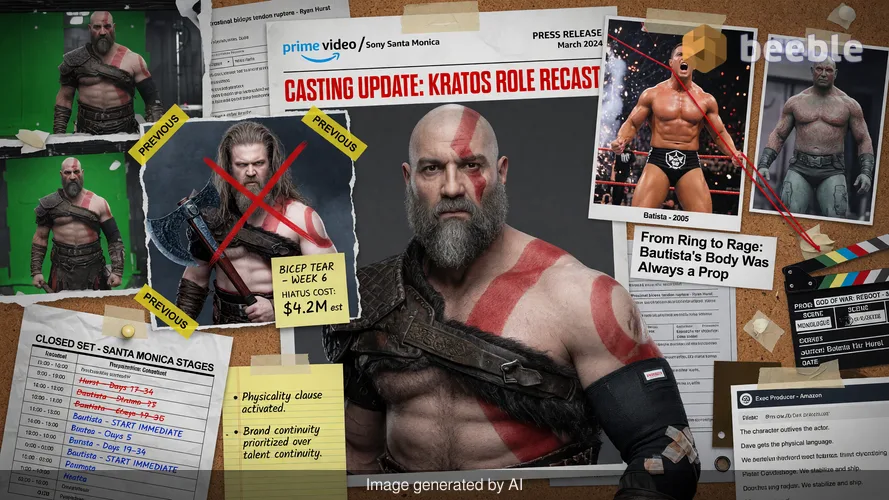
The specific hollow feeling of a mid-production casting change is a familiar sensation for the modern audience. We spend years visualizing a specific actor in a beloved role, only to have that mental image shattered by a cold press release. This emotional friction is the byproduct of a media environment where characters are more permanent than the people who play them. Behind this collective sigh lies the clinical reality of the Hollywood production machine. Amazon Prime Video and Sony Santa Monica operate under rigid financial timelines that leave no room for physical frailty. When Ryan Hurst suffered a bicep tear, the project hit a logistical wall. The studio faced a choice between a costly production hiatus and a total replacement of the lead actor. They chose the latter because the brand is the priority. The person is the variable.
Dave Bautista is the new face of Kratos, and his arrival marks a specific shift in how the industry treats physical performers. Audiences often feel a sense of whiplash when a wrestler transitions to serious drama. We remember the scripted violence and the pyrotechnics, which makes a quiet, nuanced performance feel like a subversion of expectations. Paradoxically, this career trajectory is the exact reason Bautista is the safest choice for a project of this scale. His body was a tool for the WWE long before it was a tool for Marvel or Amazon. He understands the commerce of physicality. His casting is a calculated move to stabilize a production that was previously at risk of collapse due to the human cost of these roles.
The logistics of the physical avatar
There is a visceral anxiety in watching an actor physically transform for a role. We see the dramatic weight shifts and the grueling workout montages on social media, which creates a parasocial pressure for the performer to maintain an impossible standard. This voyeurism masks the industrial demands of the physical avatar. In the era of the transmedia blockbuster, an actor does not just perform a character. They become a living advertisement for a multi-billion dollar ecosystem. The God of War series is not just a television show. It is a pillar in a wider strategy that includes the upcoming God of War Laufey game and a trilogy of remakes. The lead actor must remain physically consistent across years of filming and promotional cycles to protect the integrity of the brand.
Bautista has spent decades managing this specific kind of pressure. During his time in the Evolution stable in the WWE, his value was his mass. His body was his contract. Historically, wrestlers were the original prototypes for the modern IP star. They are accustomed to working through pain and maintaining a specific aesthetic for the sake of the narrative. This professional history makes Bautista uniquely resilient to the demands of playing Kratos. He knows that his physical presence is the foundation of the viewer's immersion. While Hurst was a creative choice that favored narrative grit, Bautista is a structural choice that favors production stability.
The commerce of the transmedia walled garden
A sense of exhaustion often accompanies the announcement of a new cinematic universe or a sprawling franchise expansion. The audience feels the weight of a growing digital to-do list, where watching a show is a prerequisite for understanding a game. This fatigue is a measurable outcome of the content walled garden strategy. Sony and Amazon are building a closed loop of entertainment where every entry point leads back to a purchase. From a creator's standpoint, this interconnectedness is a way to mitigate risk. If the TV show is a success, the sales for God of War Laufey will increase. If the game is a hit, it drives subscriptions to Prime Video.
Bautista is a proven commodity in this fragmented market. His role as Drax the Destroyer in the Guardians of the Galaxy franchise demonstrated his ability to anchor a large, complex universe without losing his individual appeal. He possesses a specific kind of gravity that grounds high-concept fantasy in something recognizable. This is essential for Kratos, a character who is a stoic god-killer with a history of profound grief. The audience needs to see the internal pain behind the muscles, or the entire architecture of the show fails. Bautista has mastered the balance of brute force and quiet vulnerability, which is the core requirement for this modern version of the character.
The architecture of a recast
There is a specific irony in the way we demand authenticity from our media while simultaneously expecting actors to be replaceable. We want the performance to feel real, but we accept the corporate necessity of the recast when the original vision becomes inconvenient. This is the illusion of choice in modern streaming. We believe we are following a creative journey, but we are actually participating in a risk-management exercise. The transition from Hurst to Bautista was a swift, clinical operation designed to minimize the impact on the bottom line. It was not a creative reboot. It was a home renovation where the contractor replaced a damaged support beam to keep the house from falling.
Beyond the screen, the industry is moving toward a future where the actor is a component rather than the attraction. The God of War series is the intellectual property; the actor is the temporary inhabitant. This reality is what makes the casting of a veteran like Bautista so resonant. He has lived through the era where the actor was the star, and he has adapted to the era where the IP is the king. He brings a level of professionalism that is necessary for a production that has already faced significant setbacks. His commitment to the role is not just about the acting. It is about the survival of the franchise.
The human scale of the god killer
We often feel a sense of relief when a production finally finds its footing after a period of instability. There is a desire to see the work succeed, if only to justify the time we have already invested in the brand. This relief is the final stage of the audience's emotional journey with a recast. We stop mourning the actor who left and start evaluating the one who arrived. Consequently, Bautista faces a challenge that is both artistic and logistical. He must inhabit a role that was originally tailored for someone else while making it his own. He has to convince the audience that he was always the intended Kratos.
As we look toward the release of the show and the launch of God of War Laufey in 2027, the focus shifts back to the human experience of the story. Kratos is a character defined by his struggle against his own nature and the dictates of the gods. In a way, the recasting of Bautista is a meta-reflection of that struggle. The production fought against the reality of injury and the pressure of the industry to keep the story alive. The result is a version of Kratos that is physically imposing and emotionally weathered. It is a reminder that even in a world of digital buffets and algorithmically curated content, the physical presence of a performer still matters. The machinery of Hollywood can replace a man, but the man still has to do the work.
Sources: Variety, Sony Santa Monica production reports, WWE corporate history archives, Prime Video executive interviews.



See you on the other side.
Our end-to-end encrypted email and cloud storage solution provides the most powerful means of secure data exchange, ensuring the safety and privacy of your data.
/ Create a free account
