


The plan to make advanced AI as common as electricity and just as mundane

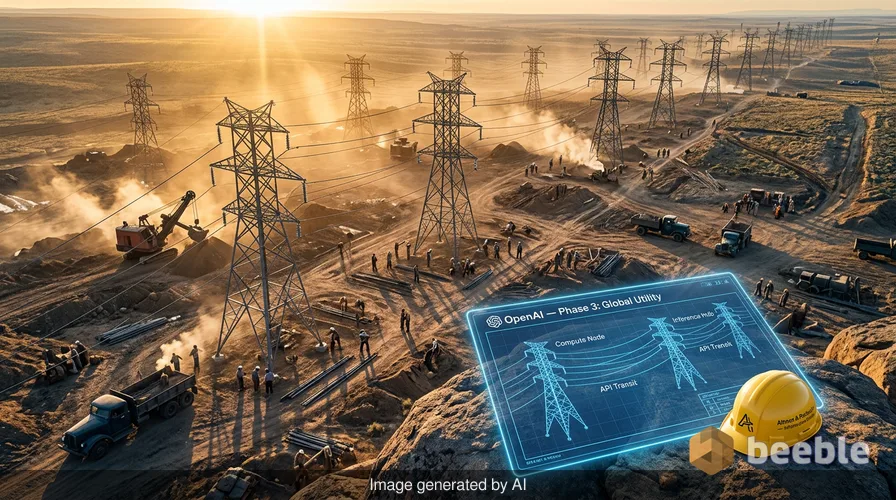
While the general public views artificial intelligence as a conversational toy or a creative assistant, the leadership at OpenAI views it as a raw industrial resource. Most people look at ChatGPT and see a chatbot that helps with emails or school essays. Sam Altman and Jakub Pachocki see the digital equivalent of high-voltage power lines. On Monday, June 8, 2026, the company released a plan for what it calls its third phase. This shift moves the focus away from the novelty of talking computers and toward the utility of a global infrastructure. OpenAI is no longer trying to prove that AI works. It is trying to make sure AI is everywhere, even if that means the technology becomes as boring and essential as a water heater.
OpenAI has operated in distinct chapters. The first phase focused on pure research to see if artificial general intelligence (AGI) was even possible. The second phase, which began with the release of ChatGPT in late 2022, was a global experiment in user behavior. This period allowed the company to see how humans interact with large language models in the real world. Now, the third phase aims to solve the problem of scale. The goal is to take frontier capabilities and turn them into tools that are affordable and easy for every person to use. Practically speaking, this means making the tireless intern of AI available to everyone on Earth at a price point that makes it a default choice for any task.
Building the researcher that never sleeps
The most disruptive part of the new plan is the creation of an automated AI researcher. Currently, the most advanced models are built by humans who spend thousands of hours testing algorithms and managing data. OpenAI wants to automate this process. This creates a cycle where the AI helps design the next version of itself. In everyday life, we see this in manufacturing where robots build other robots to increase precision and lower costs. By removing human bottlenecks in the research process, OpenAI expects the speed of development to accelerate.
Looking at the big picture, an automated researcher changes the economics of intelligence. If a machine can perform the labor of a thousand software engineers and data scientists, the cost of creating smarter systems drops. This is how the company plans to make AI abundant. When research is no longer limited by the number of human experts a company can hire, the ceiling for what the software can do rises. This effort is foundational to the goal of creating a system that can solve complex problems in medicine, physics, and climate science without constant human supervision.
The drive toward a personal AGI for every user
OpenAI is moving toward a model where every person has a personal AGI. This is a shift from a single, central brain that everyone shares to a decentralized fleet of assistants that understand individual user needs. For the average user, this means your AI will have the agency to complete tasks rather than just answer questions. It will manage your schedule, negotiate your bills, and handle your digital bureaucracy.
From a consumer standpoint, the personal AGI acts as a tireless intern that knows your preferences and history. However, this level of utility requires a trade-off in privacy and data access. To be truly useful, the system must have permission to see your emails, your bank statements, and your professional documents. The company claims these systems must remain under human control, yet the complexity of such an agent makes that control difficult to maintain. The goal is for the technology to assist people in pursuing their goals without the software becoming untethered from human intent.
Why the company is heading to the stock market
On the same day the blog post went live, OpenAI filed for an initial public offering. This move is a logical step for a company that needs a massive amount of capital to fund its third phase. Building a global infrastructure for AI requires hundreds of billions of dollars in hardware, energy, and data center space. Microchips are the digital crude oil of this era, and they are not cheap. By moving toward the public market, OpenAI can access the level of funding required to compete with other tech giants that have deeper pockets.
| Feature | Phase Two (Past) | Phase Three (Future) |
|---|---|---|
| Core Product | Chatbots and Image Generators | Automated Agents and Researchers |
| Accessibility | Subscription-based for power users | Ubiquitous and low-cost for all |
| Primary Goal | Product Discovery | Economic Integration |
| Scale | Millions of users | Every person and organization |
| Safety Approach | Internal red-teaming | International coordination and pauses |
The filing suggests the company is preparing for a future where AI is a systemic part of the global economy. This is a transparent signal to investors that the era of experimentation is over. The bottom line is that OpenAI needs a robust financial foundation to sustain its growth. Transitioning from a research-heavy startup to a public utility provider is a cyclical evolution seen in other industries like telecommunications and power generation.
The tension between speed and safety
OpenAI and its competitor Anthropic both recently addressed the need for caution. While OpenAI focuses on making AI abundant, Anthropic suggested that the world might need to slow down. The rapid pace of development is creating a gap between what the technology can do and what society can handle. Altman and Pachocki acknowledged this by calling for an international organization to monitor risks. They suggested this body should have the power to slow down the development of frontier models if safety protocols cannot keep up.
Curiously, this creates a paradox. OpenAI is filing for an IPO to accelerate its growth while simultaneously asking for a global regulator that might tell them to stop. This suggests that the risks are real and systemic. A good AI future is one where power is not concentrated in a few institutions. If a small number of companies control the most powerful AI, they control the upside of the entire economy. The plan emphasizes that many communities and countries must have the power to build and benefit from these tools. This is a shift toward a more decentralized and transparent model of development.
What this means for your daily digital life
For most people, the arrival of the third phase will be subtle. You will not necessarily see a giant leap in how smart the AI feels overnight. Instead, you will notice that it is integrated into more of the tools you already use. Practically speaking, your word processor, your bank app, and your phone's operating system will likely share a single, unified intelligence that handles the heavy lifting of digital life.
As the cost of intelligence falls, the price of digital services should follow. If an AI can do the work of a research department for pennies, the products that department creates should become cheaper. This is the overarching promise of the third phase. However, the labor market will face a shifting reality. If AI is a utility that everyone has, the value of routine digital tasks will drop to nearly zero. Humans will need to focus on tasks that require physical presence, emotional nuance, or high-level strategic decision-making.
Ultimately, the goal is to make AI so integrated into society that we stop talking about it as a separate thing. We do not marvel at the fact that electricity comes out of a wall socket; we only notice when it stops. OpenAI is betting that by 2030, we will feel the same way about AGI. It will be a resilient and streamlined part of the background, helping us navigate a world that is increasingly complex and fast-paced.
Sources: OpenAI Official Blog, Anthropic Research Publications, SEC Filing Records 2026.



See you on the other side.
Our end-to-end encrypted email and cloud storage solution provides the most powerful means of secure data exchange, ensuring the safety and privacy of your data.
/ Create a free account
