


The Protected Childhood and the Innovation Void: The Paradox of the Digital Border

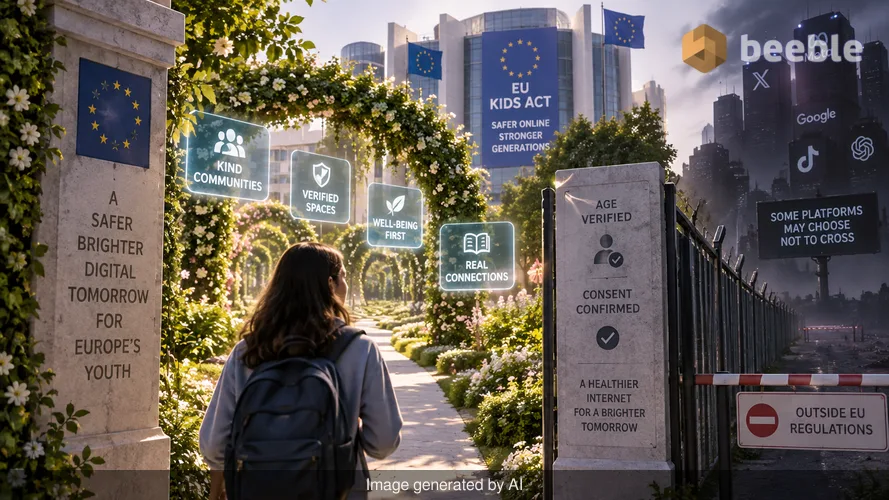
Brussels envisions a digital future where every teenager moves through a curated garden of safe interactions, a space where algorithms prioritize well-being over engagement and the toxic pull of the infinite scroll is a memory of a more chaotic era. This vision requires a level of technological filtering that effectively partitions the internet into national silos, unless a platform has the capital to build bespoke European infrastructures that algorithmically verify age and consent at every touchpoint. The promise of the EU Kids Act is a sanctuary for the developing mind, yet it inevitably creates a regulatory border that the most advanced technologies might simply choose not to cross.
The digital nursery and its high walls
On a rainy afternoon in a café near the Place de la Bastille, a group of fourteen-year-olds sits huddled around a single smartphone. They are not scrolling through a shared feed. Instead, they are navigating a series of identity verification pop-ups that require a parent’s digital signature just to access a new generative AI tool. The scene is a perfect microcosm of the friction the EU Kids Act introduces. The legislation, unveiled this week, mandates a total ban on social media for children under thirteen. For those between thirteen and fifteen, the Act requires the creation of mini accounts—highly supervised profiles with one-hour daily limits and a prohibition on addictive features like autoplay or engagement rewards.
From a sociological standpoint, these rules attempt to reverse the atomization of the digital experience. By inserting a parent back into the loop, the European Commission seeks to rebuild the traditional family hierarchy within the liquid modernity of the internet. The goal is to move away from the fast-food diet of digital communication, which offers quick hits of dopamine but lacks deep emotional nutrition. However, the reality on the ground is one of increased isolation. As the barrier to entry rises, the digital tools that define modern teenage habitus become harder to access for those in Europe compared to their peers in New York or Singapore.
The friction of the mini account
Stanislas Marchand, a former mobile gaming lead at the French unicorn Voodoo, observes these developments with a mix of approval and dread. While he welcomes the ban for the youngest users, he suggests the age limit should have reached sixteen for all restricted features. Marchand argues that social media platforms are engineered to maximize attention at the cost of mental health. In his view, the message is simple: these platforms are unsuitable for children in their current form.
Yet, the practical implementation of these mini accounts is where the strategy falters. The Act requires platforms to verify age, operate parent-controlled accounts, and prove their products are safe. For a company like Meta, these are surmountable technical hurdles. For a small European startup, these requirements are a systemic barrier to entry. Every new rule is a potential point of failure. The history of Big Tech compliance in Europe is a record of expensive fines that serve as a cost of doing business for the giants while remaining an existential threat to the small. The current enforcement record is patchy. Meta was fined for data transfers in 2023 and 2025. TikTok and X have faced similar penalties. These fines are often described as pocket change for firms with valuations in the trillions, but they represent a wall for the next Mistral.
An archipelago of regulation
Zooming out to a macro level, the EU Kids Act is the latest layer in what sociologists might call a regulatory archipelago. Each new piece of legislation—from GDPR to the Digital Markets Act—creates a distinct island of rules that is increasingly detached from the global digital mainland. Historically, Europe has relied on the strength of its single market to dictate global standards. This worked for privacy, but the stakes are different for artificial intelligence. AI is not just a service; it is the defining technology of the decade.
Europe currently has one significant AI company, Mistral. In contrast, the United States hosts OpenAI and Anthropic, firms that dwarf their European rivals in valuation and investment. The Kids Act expands its reach beyond social media to include video platforms like YouTube and Twitch, gaming environments like Roblox, and AI companions like ChatGPT and Claude. If the Act requires separate, costly European versions of these products, US labs may simply delay their launches in the bloc. Anthropic has already restricted some advanced models outside the United States. The result is a transatlantic divide where European users and developers are left with older, less capable versions of the tools that are reshaping the global economy.
The cost of a safe playground
Marchand warns that Europe must prepare for the consequences of this divide. He argues for urgent investment in homegrown AI capabilities to offset the impact of regulation. The complexity of launching a product in Europe is rising. Developers must integrate strict age-assurance filters at the operating system and app store levels. They must enforce daily limits and restrict contacts. These features are not just code; they represent a significant ongoing operational cost.
Frontier AI companies already face enormous computing expenses and uncertain paths to profitability. When these firms calculate their market entry strategies, the European Union is no longer the default choice. The risk is that the Kids Act protects children by excluding them from the very technologies they will need to understand to participate in the future workforce. This is a profound trade-off between safety and growth. Culturally speaking, Europe is choosing to be the world’s digital regulator, even if it means losing its place as a digital innovator.
A divide that crosses the ocean
Linguistically speaking, the discourse in Brussels has shifted from innovation to protection. The language of the Kids Act is clinical and defensive. It treats technology as a contagion to be contained rather than a tool to be mastered. This shift mirrors a broader societal anxiety about the loss of control in an era of rapid change. As the bloc moves to police the tech giants, it faces the risk of regulating itself out of the AI race. The transatlantic divide is not just a matter of economic statistics. It is a structural reality that determines who builds the future and who merely lives in it.
Paradoxically, the attempt to create a safer environment for children may leave them at a disadvantage. If a teenager in Berlin is limited to a mini account with restricted AI access while a teenager in San Francisco uses the latest models to learn coding or creative writing, the educational gap will grow. The digital border becomes a ceiling for European potential. Marchand’s fear is that the Act will further add to this divide, creating a two-tier digital world.
Reclaiming the human speed of life
The EU Kids Act is a bold attempt to reclaim human attention from the grasp of the attention economy. It recognizes that our social media feeds have become a hall of mirrors, reflecting and amplifying our biases and anxieties. By limiting the time spent in these digital spaces, Brussels is trying to force a return to the mundane, physical world. This is a noble pursuit, yet it must be balanced against the reality of a globalized, tech-driven society.
As we navigate these new rules, it is helpful to observe our own daily routines. We might notice how often we reach for a screen to avoid a moment of silence or how a digital notification can disrupt a visceral human connection. The Kids Act invites us to question whether the frictionless nature of modern life is actually a benefit. Ultimately, the question is not whether we should protect children, but whether we can do so without turning the European digital market into a quiet, safe, and increasingly irrelevant corner of the world. We must decide if the price of a digital nursery is a future where we are merely consumers of tools built elsewhere.
Sources:
- European Commission, Proposals for the EU Kids Act, September 2026.
- Zygmunt Bauman, Liquid Modernity, Polity Press.
- Australian Government, Social Media Minimum Age Legislation, December 2025.
- Court filings, 47 US States vs. Meta Platforms, Inc., 2025.
- European Data Protection Board, Enforcement Actions on Data Transfers, 2023-2025.



See you on the other side.
Our end-to-end encrypted email and cloud storage solution provides the most powerful means of secure data exchange, ensuring the safety and privacy of your data.
/ Create a free account
