


The Quantum Computer in Your Pocket is Decades Away, but its Effects are Already in Your Medicine Cabinet

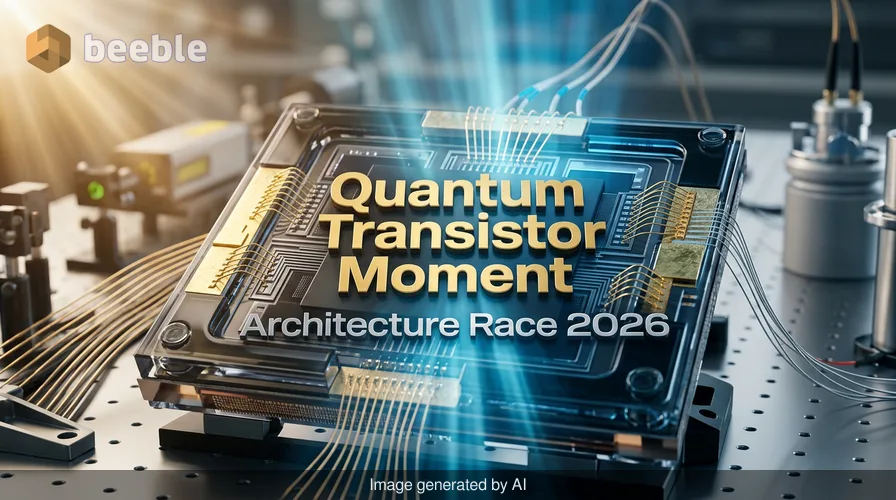
In 1947, the first point-contact transistor was cobbled together at Bell Labs using gold foil, a plastic triangle, and a slab of germanium. It was ugly, finicky, and roughly the size of a palm. To the casual observer of the era, it looked like a laboratory curiosity with no clear path to the average living room. Yet, that single device was the ancestor of every smartphone, laptop, and smart toaster in existence today. Looking at the big picture, we are currently living through the 'transistor moment' of quantum computing.
As of May 2026, the quantum landscape has shifted from experimental physics to industrial engineering. We are no longer just asking if these machines work; we are asking which specific architecture will win the race to become the industry standard. For the average user, these machines remain invisible, tucked away in specialized cooling vats or laser-shielded labs. However, the outcomes of their calculations are beginning to trickle down into tangible consumer realities, from the efficiency of the battery in your electric vehicle to the speed at which new vaccines reach your pharmacy.
The Superconducting Giants: IBM, Google, and the Race for Scale
Historically, the most prominent path toward a functional quantum computer has been superconducting qubits. This is the technology championed by the heavyweights: IBM, Google, and Rigetti. Under the hood, these systems use tiny circuits cooled to temperatures colder than outer space, allowing electricity to flow without resistance.
IBM, in particular, has treated its quantum roadmap like a rigorous construction project. By 2026, their focus has moved beyond simply counting qubits to perfecting the 'Heron' and 'Flamingo' processors—modular units that can be linked together like high-tech Lego bricks. This modularity is a resilient strategy; it acknowledges that building one massive, monolithic quantum chip is too difficult. Instead, they are building clusters of processors.
Conversely, Google has doubled down on error correction. The challenge with quantum computers is that they are incredibly fragile; even a stray photon or a slight change in temperature can cause a 'decoherence' event, effectively crashing the calculation. Google’s recent milestones in 'logical qubits'—where many physical qubits work together to protect one piece of data—suggest that the path to a reliable, error-free machine is finally opening up. For the consumer, this means we are moving away from 'noisy' results and toward the precise, industrial-grade reliability needed for heavy industry applications.
Ions and Atoms: The Precision Playmakers
While the giants focus on superconducting circuits, companies like IonQ and Quantinuum are taking a different approach: Trapped-Ions. Instead of etching circuits on a chip, they use individual atoms (ions) suspended in a vacuum by electromagnetic fields.
Essentially, these atoms are nature’s perfect qubits. Because every ytterbium atom is identical to every other one, there is none of the manufacturing variability found in superconducting chips. Practically speaking, this technology is currently leading the pack in terms of 'fidelity'—the accuracy of the computation. IonQ has recently moved toward rack-mounted systems that look more like traditional server hardware, signaling a push toward data-center integration.
Then there is the emerging field of Neutral Atom technology, led by Atom Computing and QuEra. This method uses lasers—often called 'optical tweezers'—to hold hundreds of neutral atoms in a 2D or 3D grid. It is an elegant, scalable approach that avoids the complex wiring required by superconducting systems. In everyday life, this tech is particularly well-suited for simulating physics, which is the foundational step for creating more efficient solar panels or stronger, lighter aerospace materials.
Mapping the Landscape: A Comparison of Quantum Architectures
| Technology | Key Players | Core Mechanism | Main Advantage | Primary Challenge |
|---|---|---|---|---|
| Superconducting | IBM, Google, Rigetti | Supercooled circuits | Fast gate speeds; mature manufacturing | Extreme cooling required; fragile signals |
| Trapped-Ions | IonQ, Quantinuum | Atoms in magnetic traps | High accuracy; long-lasting data | Slower operation speeds |
| Neutral Atoms | Atom Computing, QuEra | Atoms held by lasers | High scalability; large qubit counts | Susceptible to external noise |
| Photonics | Xanadu, PsiQuantum | Light particles (photons) | Works at room temp; fiber-optic compatible | Difficult to make photons 'interact' |
| Quantum Annealing | D-Wave | Energy minimization | Excellent for logistics/optimization | Not a 'universal' computer |
Light and Logic: The Dark Horses of Photonics and Annealing
Photonics represents perhaps the most disruptive potential in the sector. Companies like Xanadu and PsiQuantum are using light particles (photons) to carry information. Because light doesn’t generate heat and can travel through fiber-optic cables, these machines don’t necessarily need the massive, energy-hungry refrigerators that IBM uses. To put it another way, photonics could be the key to decentralized quantum computing—machines that are easier to house and operate in standard facilities.
On the other end of the spectrum is D-Wave, which specializes in 'Quantum Annealing.' Unlike the other companies trying to build a 'Universal' quantum computer (a machine that can do anything), D-Wave builds a specialized tool for optimization. If you think of a universal quantum computer as a Swiss Army knife, D-Wave’s machine is a high-powered sledgehammer designed for one specific task: finding the best solution among trillions of possibilities. Logistics firms are already using this to streamline shipping routes and manage volatile supply chains, which ultimately helps keep the price of goods down for the end consumer.
Why This Matters for Your Daily Life
It is easy to get lost in the jargon of 'qubits' and 'entanglement,' but for the average user, the 'So What?' filter is what matters most. Quantum computing isn't going to make your word processor faster or your video games look better; our current silicon-based chips are already excellent at those tasks. Instead, quantum computing acts as a tire pump for the slow leaks in modern industrial progress.
- Material Discovery: Most of our modern world is limited by the materials we have. We need better batteries for EVs that don't rely on scarce minerals, and we need more efficient ways to produce fertilizer (which currently consumes a massive percentage of global natural gas). Quantum computers are uniquely suited to simulate these chemical reactions at a level impossible for traditional computers.
- Financial Stability: On the market side, quantum algorithms are beginning to assist in risk assessment and portfolio optimization. While this sounds like a win for Wall Street, it also contributes to a more resilient global financial system, potentially smoothing out some of the cyclical volatility that affects retirement savings.
- The Cybersecurity Shift: This is the most pressing personal implication. Quantum computers will eventually be able to crack current encryption methods. As a result, we are seeing a systemic shift toward 'Post-Quantum Cryptography.' Your bank and your messaging apps are likely already upgrading their backend security to ensure your private data remains transparent to you but opaque to future quantum-armed hackers.
The Bottom Line: Moving Beyond the Hype
Zooming out, the road to a coherent quantum future is no longer a straight line; it is an interconnected web of competing technologies. We have moved past the era of 'quantum supremacy' headlines and into the era of practical utility. While we aren't at the point where you can buy a quantum laptop, we have reached the stage where the invisible backbone of modern life is being reinforced by quantum calculations.
From a consumer standpoint, the best approach is one of grounded curiosity. Observe how your favorite tech brands talk about 'quantum-secure' updates or how pharmaceutical companies announce breakthroughs in 'silico' (computer-aided) drug design. We are witnessing the birth of a new industrial era. Just as the 1940s engineers couldn't have predicted TikTok, we likely can't see the full scope of what a quantum-integrated world will look like. However, we can be certain that the foundational work being done by these companies today will be the digital crude oil of the next century.
Instead of waiting for a 'magic box' to appear on your desk, shift your perspective to notice the subtle ways the world around you is becoming more optimized. The future isn't a sudden explosion; it's a series of small, calculated steps forward in precision and power.
Sources:
- IBM Quantum Development Roadmap (2024-2033 Update)
- IonQ Investor Relations: 'The Path to AQ 64' Report
- Quantinuum Technical Brief: 'Logical Qubit Breakthroughs on H-Series Hardware'
- Department of Energy: Quantum Information Science Research Reports
- McKinsey & Company: 'Quantum Technology Monitor' Analysis



See you on the other side.
Our end-to-end encrypted email and cloud storage solution provides the most powerful means of secure data exchange, ensuring the safety and privacy of your data.
/ Create a free account
