


The Quantum Void: Why 'Nothing' is the Most Powerful Force in Tech

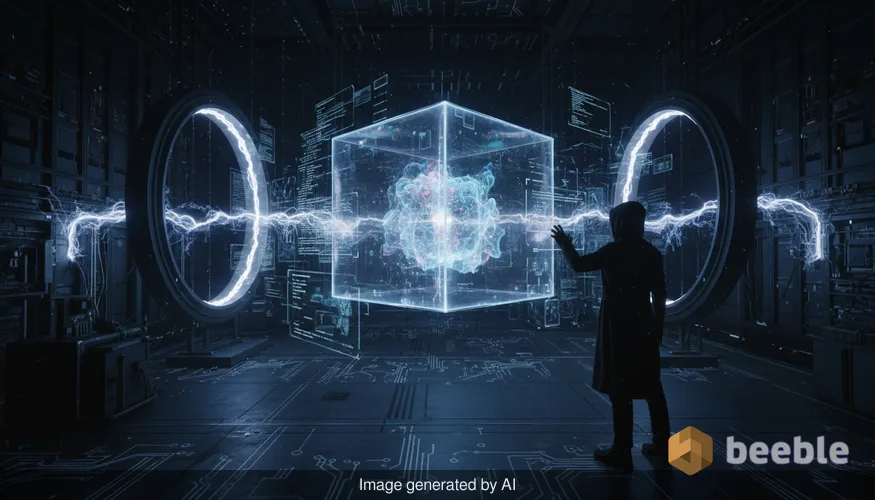
Imagine a perfectly sealed titanium box. You pump out every molecule of air until you achieve a hard vacuum. You shield it from all external electromagnetic radiation, and finally, you cool it down to absolute zero—the theoretical temperature where all thermal motion stops. In the world of classical physics, that box is now empty. It contains nothing.
However, according to the laws of quantum mechanics, your box is actually teeming with activity. It is filled with a restless, invisible sea of energy that never sleeps. This is zero-point energy (ZPE), the lowest possible energy state of a physical system. As we move deeper into the era of nanotechnology and quantum computing, understanding this "nothingness" is no longer just a pursuit for theoretical physicists; it is becoming a fundamental requirement for the next generation of engineers.
The Jitter That Defines Reality
To understand why a vacuum isn't empty, we have to look at the Heisenberg Uncertainty Principle. In simple terms, this principle states that we cannot know both the position and the momentum of a particle with absolute precision. If a particle were to come to a complete standstill at absolute zero, we would know both its position and its velocity (zero) perfectly. Nature, it seems, forbids this.
Instead, every field—whether it is the electromagnetic field or the Higgs field—undergoes constant, spontaneous fluctuations. Even in a vacuum, "virtual particles" are constantly popping in and out of existence. They borrow energy from the void, exist for a fraction of a second, and then vanish. This creates a background "quantum jitter" that persists even when all other forms of energy are removed. This is the zero-point energy: the baseline noise of the universe.
The Casimir Effect: Measuring the Invisible
For decades, zero-point energy was a mathematical curiosity. That changed with the discovery of the Casimir Effect. In 1948, Dutch physicist Hendrik Casimir predicted that if you place two uncharged metallic plates extremely close together in a vacuum, they will be pushed toward each other.
Why? Because the space between the plates is so narrow that it restricts the types of vacuum fluctuations that can occur there. Outside the plates, the fluctuations are unrestricted. This creates a pressure imbalance—a literal force generated by the vacuum itself. In the late 1990s, experimentalists finally measured this force with high precision, proving that the energy of the vacuum is a physical reality that can exert pressure on the material world.
Why Tech Giants Care About the Void
As our technology shrinks to the nanoscale, the Casimir Effect and zero-point fluctuations transition from theoretical concepts to engineering headaches. In the semiconductor industry, as transistors approach the size of a few atoms, these vacuum forces can cause components to stick together, a phenomenon known as "stiction."
Engineers at companies like Intel and TSMC must now account for these quantum forces when designing the architecture of next-generation chips. We are reaching a point where the "nothing" between components is just as influential as the components themselves.
| Application Area | Impact of Zero-Point Energy |
|---|---|
| Semiconductors | Causes mechanical failure in MEMS (Micro-Electromechanical Systems) due to stiction. |
| Quantum Computing | Contributes to "decoherence," where qubits lose their quantum state due to vacuum noise. |
| Nanotechnology | Defines the limits of how small and close mechanical parts can be placed. |
| Sensors | Enables the creation of ultra-sensitive gravitational and inertial sensors. |
The Energy Harvesting Myth vs. Reality
Because the vacuum contains an infinite amount of these fluctuations, zero-point energy has long been a favorite topic for science fiction and speculative "free energy" claims. The idea is tempting: if the vacuum is a battery that never dies, why can't we plug into it?
In reality, harvesting zero-point energy is a thermodynamic nightmare. Because ZPE is the lowest energy state, there is generally no "lower" place for that energy to flow. You cannot extract work from a system that is already at its minimum energy level without adding more energy than you get back.
However, researchers are exploring niche ways to manipulate these forces. By using specialized metamaterials, scientists have demonstrated the ability to create "repulsive" Casimir forces. This could lead to frictionless bearings or levitating nanomachines that never touch their housing, potentially revolutionizing everything from medical implants to aerospace sensors.
Quantum Computing and the Noise Floor
For the tech industry, the most immediate challenge posed by zero-point energy is in the realm of quantum computing. To maintain the delicate state of a qubit, researchers must shield it from all interference. While we can shield against heat and radio waves, we cannot shield against the vacuum itself.
Zero-point fluctuations contribute to the "noise floor" of the universe. This noise can cause a qubit to flip its state, leading to errors in calculation. Solving the problem of vacuum-induced decoherence is one of the primary hurdles to achieving fault-tolerant quantum computing at scale. The goal isn't to eliminate the energy—which is impossible—but to design error-correction algorithms that can filter out the inherent jitter of reality.
Practical Takeaways for the Tech-Forward
As we look toward the end of the decade, the influence of quantum field theory on practical engineering will only grow. Here is what professionals in the field should keep in mind:
- Watch the Materials Science: Breakthroughs in metamaterials are the most likely path toward controlling vacuum forces. These materials can "shape" the vacuum to reduce friction in micro-machinery.
- Quantum Literacy is Essential: For hardware engineers, understanding the ground state of fields is becoming as important as understanding classical thermodynamics was in the 20th century.
- Skepticism Toward "Free Energy": Always distinguish between the legitimate study of vacuum fluctuations and pseudoscientific claims of zero-point power modules. The physics of the former is solid; the engineering of the latter remains impossible under current laws of physics.
- The Scale Limit: We are approaching the "Casimir Limit" in mechanical miniaturization. Future gains in density will likely require shifting away from moving parts toward purely solid-state or optical architectures.
We used to think of the vacuum as a stage—a static background where the drama of matter and energy played out. Today, we know the stage is alive. The "nothing" in our boxes is a reservoir of potential, a source of friction, and perhaps, the ultimate frontier of human engineering.



See you on the other side.
Our end-to-end encrypted email and cloud storage solution provides the most powerful means of secure data exchange, ensuring the safety and privacy of your data.
/ Create a free account
