


The Quiet Arrival of the Private Room

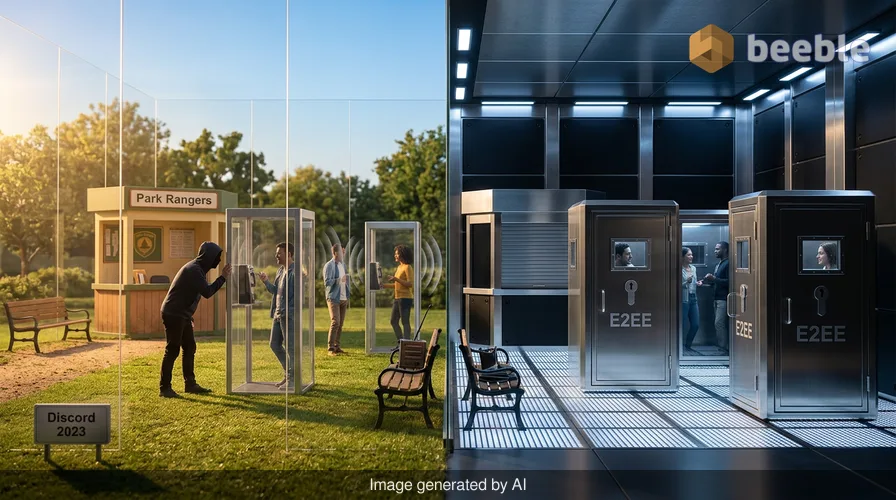
In the early days of digital hanging out, we treated Discord like a public park—a place where the walls were thin and the park rangers (the developers) could technically hear every conversation if they leaned in close enough. For years, the trade-off was simple: we sacrificed absolute privacy for the sake of low-latency, high-quality audio that didn’t lag during a high-stakes raid or a late-night study session. But as of this week, that social contract has been rewritten. Without a single app update to download or a toggle to flip, Discord has turned every voice and video call into a fortified vault.
The shift to end-to-end encryption (E2EE) for Discord’s hundreds of millions of users marks a profound transition in how we perceive our digital spaces. Historically, E2EE was the domain of specialized, high-security messengers used by journalists and activists; today, it is becoming the de facto expectation for the casual gamer and the weekend hobbyist alike. This isn't just a minor feature rollout; it is a fundamental re-engineering of the platform’s architecture, signaling the end of an era where "private" calls were merely a matter of trust rather than a mathematical certainty.
The Ghost in the Server
To understand the magnitude of this shift, we have to look at how Discord used to operate. In the legacy model, your voice was packaged into data packets, sent to a Discord server, decrypted so the server could process or route it, and then sent to your friends. Paradoxically, while we felt alone in our private DM calls, the server was always there as a silent participant. This architecture was pragmatic for a young company prioritizing performance over protocols—it allowed for easier moderation, lower CPU usage on your phone, and a more streamlined user experience.
In contrast, the new E2EE standard means that the "keys" to unlock your conversation never leave your device. Through this user lens, nothing has changed: the "bloop" sound of joining a call remains the same, and the interface is as intuitive as ever. However, behind the screen, the plumbing of the internet is being replaced. Where Discord once acted as a transparent window into our conversations, it has now transformed itself into a blind courier, delivering sealed envelopes that it cannot open, even if it wanted to.
Under the Hood: The DAVE Protocol
Technically speaking, Discord didn't just grab an off-the-shelf solution to achieve this. They implemented a custom-built protocol internally named DAVE (Discord Audio Video Encryption). Implementing E2EE for a one-on-one call is relatively straightforward; implementing it for a group call with twenty people, all with varying internet speeds and devices, is a feat of software engineering akin to performing a home renovation while the family is still living inside.
Discord utilized the Messaging Layer Security (MLS) standard, a robust framework designed to handle the complexities of group communication. This approach ensures that every time someone joins or leaves a call, the encryption keys are rotated seamlessly. Under the hood, this prevents "forward secrecy" issues—meaning if a malicious actor somehow got hold of a key today, they still couldn't use it to decrypt yesterday’s calls. From a developer's standpoint, this move eliminates a massive amount of technical debt associated with managing sensitive user data, essentially removing the liability of "knowing" too much about what users are saying.
The Great Privacy Divergence
Zooming out to the industry level, Discord’s move stands in stark opposition to the recent behavior of other tech giants. Earlier this year, we saw Meta pull the plug on Instagram’s E2EE messaging plans, and TikTok has signaled a retreat from encrypted standards as it navigates its new status as a U.S.-based entity. Historically, companies have feared that E2EE would hinder their ability to gather data for advertising or complicate their relationships with law enforcement; consequently, Discord’s decision to go all-in suggests a different business logic at play.
Discord is betting that privacy is no longer a niche demand but a baseline requirement for a resilient platform. By making encryption standard rather than an opt-in "Secret Chat" mode, they are acknowledging that fragmented privacy settings only serve to confuse the average user. While other platforms are becoming more opaque about how they handle user data, Discord is choosing a path of technical transparency. They are effectively saying that the most secure way to handle user data is to never have access to it in the first place.
The Cost of a Seamless Experience
Every major software update comes with a hidden cost, and for E2EE, that cost is usually felt in the hardware. In the past, encryption was often clunky, taxing the processors of older smartphones and causing batteries to drain faster. To avoid a bloated experience, Discord’s engineers had to optimize the DAVE protocol to be as lightweight as possible. This is the hallmark of modern agile development: the most complex features should be invisible to the person using them.
There is a certain irony in the fact that the most successful security updates are the ones nobody notices. If the average Discord user wakes up, joins a call, and notices that the audio is still crisp and the video is still smooth, then the engineering team has succeeded. We often celebrate disruptive tech, but in the world of infrastructure, the greatest achievement is a seamless transition that preserves the status quo of the user experience while radically upgrading the underlying security.
Reclaiming the Digital Living Room
Ultimately, this update is about more than just code; it’s about the evolution of digital literacy. For a long time, we have been told that the price of free software is a total lack of privacy—that if we aren't paying for the product, we are the product. Discord, which generates revenue through its Nitro subscription service rather than a purely ad-based model, has the unique freedom to reject that trope. This rollout proves that it is possible to build a ubiquitous, massive-scale platform that respects the boundaries of its residents.
On an individual level, we should take this as a prompt to observe our own digital habits. We spend so much of our lives in these "third places"—the digital living rooms where we vent about work, share our fears, and laugh with friends. The fact that these moments are now protected by math rather than corporate promise should give us a renewed sense of agency. It is a reminder that while the internet can often feel like a fragmented and fragile place, we still have the power to demand—and build—tools that treat our private lives with the respect they deserve.
Through this lens, the "bloop" of a Discord call isn't just the sound of a connection being made; it's the sound of a door being locked, finally ensuring that what happens in the digital living room, stays in the digital living room.
Sources
- Discord Engineering Blog: "DAVE: The Protocol Behind E2EE Voice and Video"
- Internet Engineering Task Force (IETF): RFC 9420 - Messaging Layer Security (MLS) Protocol
- Discord Product Documentation: End-to-End Encryption FAQ (Updated May 2026)
- International Association of Privacy Professionals (IAPP): Report on Social Media Encryption Trends 2025-2026
- WebRTC.org: Security and Encryption Standards for Real-Time Communication



See you on the other side.
Our end-to-end encrypted email and cloud storage solution provides the most powerful means of secure data exchange, ensuring the safety and privacy of your data.
/ Create a free account
