
The quiet arrival of the send button timer

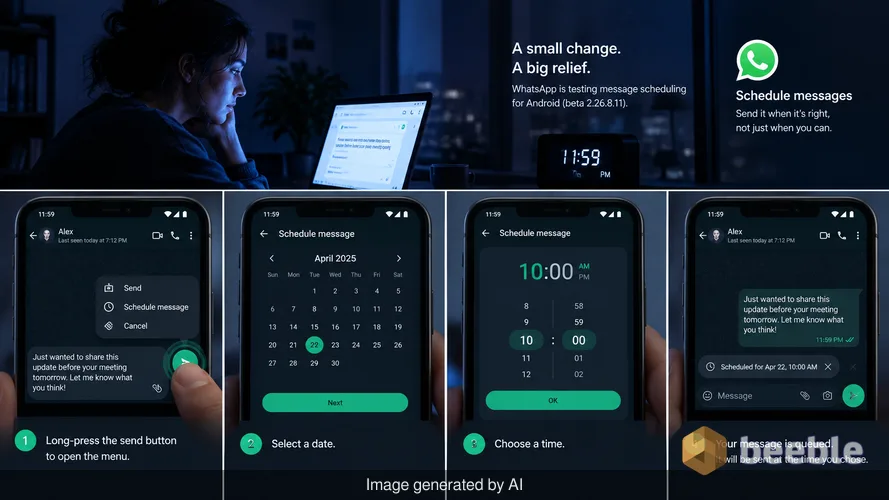
You wait. The blue light of the screen is the only thing illuminating your room. It is exactly 11:59 PM on a Tuesday. You have a message drafted for a colleague who lives three time zones away, but you do not want to wake them with a notification ping in the middle of their night. You also know that if you do not send it now, the thought will vanish by tomorrow morning. So you wait for the digits to flip. You stare at the cursor. This is the manual labor of the digital age. It is a tiny, silent tax on your attention that millions of people pay every day because their primary communication tool lacks a basic sense of time.
This friction is finally beginning to dissolve for the billions of people who use WhatsApp. According to recent sightings in the WhatsApp Android beta version 2.26.8.11, Meta is testing a message scheduling feature. The mechanism is simple. You long-press the send button to trigger a pop-up menu. You select a date. You choose a time. The app then places your message in a queue. It is a small change to a user interface that has remained largely static for years, yet it signals a significant shift in how we manage our digital availability.
The mechanics of the scheduled queue
Technically speaking, the feature follows a logic already familiar to users of Telegram or Google Messages. When a tester long-presses the send icon, a dialog box appears at the bottom of the screen. The software allows for a minimum delay of 10 minutes and a maximum lead time of two weeks. Once you confirm the time, the message sits in a dedicated management area where you can edit the content or reschedule the delivery. The system is compatible with individual chats and group conversations.
Behind the screen, this process is more complex than it appears to the casual observer. WhatsApp is built on the Signal Protocol, which ensures end-to-end encryption. This means that the content of your message is scrambled on your device before it ever hits a server. For a scheduled message to work while your phone is offline, the server must hold that encrypted package without having the keys to read it. The server acts as a digital locker. It holds the box until the specified timestamp and then pushes it to the recipient. This architecture is more difficult to implement than the cloud-based storage used by competitors like Telegram, where messages are often stored in a decrypted state on the provider's servers by default.
The weight of technical debt
One might wonder why a company with the resources of Meta took until late 2026 to implement a feature that its rivals launched in 2019. The answer often lies in the messy closet of technical debt. When an app reaches the scale of WhatsApp, every new button is a risk. A single change to the send button logic must work across thousands of different Android handsets, legacy operating systems, and varying network conditions. Engineers at Meta must ensure that the new scheduling code does not interfere with the core delivery pipeline that handles over 100 billion messages every day.
Historically, WhatsApp has been a minimalist platform. It prioritized speed and reliability over a bloated feature list. However, as the app moved from a simple SMS replacement to a de facto operating system for business in regions like India, Brazil, and Indonesia, the demand for professional tools grew. Users who use WhatsApp for work cannot always be "on." The lack of scheduling was no longer a design choice. It was a source of digital friction that forced users to remain tethered to their devices at odd hours. This update is a pragmatic response to the reality that our personal and professional lives are now permanently interconnected within a single interface.
Zooming out to the industry level
As we move from the single long-press on a smartphone screen to the broader software industry, we see how this update reflects a larger trend toward asynchronous communication. For the last decade, the tech industry pushed for real-time everything. We were sold the dream of instant connectivity, where every thought could be broadcast the moment it occurred. Paradoxically, this led to a fragmented attention span and a culture of burnout. We are now seeing a correction. Software developers are building "slow tech" features that allow users to decouple the act of writing from the act of sending.
This shift is a move away from the proprietary pressure of "active" status indicators. By allowing users to schedule their presence, developers are giving them back a sense of agency. When you schedule a message, you are no longer reacting to the app. You are using the app as a tool to manage your own time. Through this user lens, a simple timer is actually a boundary-setting device. It allows a manager to write instructions on a Sunday afternoon without intrusive behavior toward their employees. It allows a small business owner to automate customer replies during closing hours without paying for expensive third-party API integrations.
The evolution of the digital boundary
In everyday terms, this feature is about the death of the "Drafts" folder as a graveyard for unsent ideas. Most of us have dozens of unfinished thoughts sitting in various apps because the timing felt wrong. When the software handles the timing for us, the mental load of social coordination decreases. This is an example of a streamlined user experience that solves a human problem rather than a technical one. The code is invisible, but the relief is real.
Curiously, the introduction of scheduling also creates new social norms. If a friend receives a perfectly timed "Happy Birthday" text at exactly 12:00 AM, is the gesture less meaningful if a machine sent it? We are entering an era where our digital shadows are more active than we are. As AI agents and scheduling tools become ubiquitous, the line between a manual interaction and an automated one will continue to blur. We must decide if we value the thought behind the message or the physical act of tapping the screen at a specific moment.
Reclaiming control over the notification cycle
Ultimately, the arrival of message scheduling on WhatsApp is a sign that the industry is maturing. The focus is moving away from keeping users inside the app for as many minutes as possible. Instead, the focus is shifting toward making those minutes more efficient. A robust messaging platform should not require its users to be slaves to a clock. By delegating the task of delivery to the software, we reclaim a small portion of our cognitive space.
This update is not a disruptive revolution, but it is a necessary evolution. It reminds us that software is at its best when it acts as a quiet assistant rather than a demanding master. As you wait for the feature to roll out to your account in the coming weeks, observe how often you hold back a thought because the time is not right. Soon, you will be able to release that thought into the queue and put your phone away. The digit will flip on the server, the message will travel through the encrypted tunnel, and you will be asleep. That is the true promise of well-designed technology.
Food for thought
- Observe your habits: Next time you wait to send a message, ask yourself if the delay is for your benefit or the recipient's.
- Question the urgency: Does every message need to be sent instantly, or are we simply conditioned by the "instant" nature of the tool?
- Reclaim your time: Use scheduling tools to batch your communication so that your phone does not dictate your daily schedule.
Sources
- WaBetaInfo: WhatsApp beta for Android 2.26.8.11 release notes.
- Meta Engineering: The architecture of end-to-end encryption in distributed systems.
- Signal Foundation: Security specifications for the Signal Protocol and message queueing.
- Developer Documentation: Android long-press gesture implementation and UI/UX guidelines.



See you on the other side.
Our end-to-end encrypted email and cloud storage solution provides the most powerful means of secure data exchange, ensuring the safety and privacy of your data.
/ Create a free account