


The quiet death of the phone number as digital identity

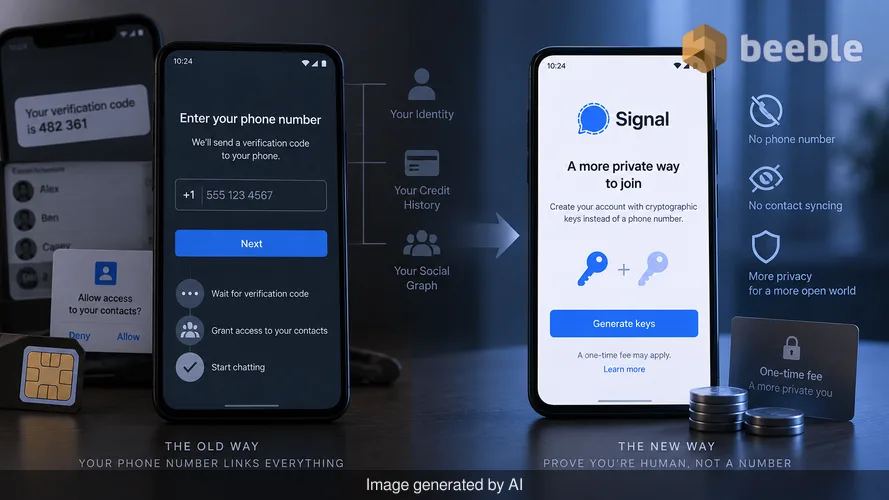
For a decade, the setup process for any modern communication app followed a rigid script. You downloaded the software, entered your mobile number, waited for a verification code to buzz in your pocket, and granted the app access to your contact list. This sequence felt like a standard exchange of credentials, but it was actually a profound surrender of privacy. Your phone number was the anchor of your digital self; it linked your physical identity, your credit history, and your social graph to every service you touched. Signal, an app that built its reputation on end-to-end encryption, was historically a participant in this system. Even as it protected the content of your messages, it still required that most basic of identifiers to exist.
That requirement is finally beginning to erode. With the release of the Android 8.28 beta, Signal is testing a registration flow that ignores the SIM card entirely. This shift represents more than just a new feature for privacy enthusiasts; it is a fundamental redesign of how we prove we are human to a machine. By replacing the phone number with a pair of cryptographic keys and a one-time entry fee, Signal is attempting to solve the industry-wide problem of account verification without the collateral damage of permanent tracking.
The friction of the legacy anchor
In everyday terms, providing a phone number to an app is like handing a house key to a stranger just so they can verify your name. The number follows you across jobs, addresses, and relationships. It is the primary tool used by data brokers to stitch together fragmented pieces of your life into a coherent, sellable profile. When Signal required this number, it created a paradox for users in sensitive environments. A whistleblower or a journalist could encrypt their data, but their very presence on the platform remained tied to a piece of hardware registered with a government-monitored carrier.
Under the hood, this dependency was a form of technical debt inherited from the early days of mobile software. Developers used phone numbers because they provided a built-in anti-spam mechanism. Because obtaining a new SIM card costs money and time, attackers could not easily create a million accounts to flood the network with junk. Signal staff member Greyson Parrelli confirmed this logic in recent forum posts, noting that the phone number was the primary barrier against automated abuse. Removing it required a new kind of friction to take its place.
The architecture of a numberless account
Users who download the 8.28.1 beta via GitHub or Obtainium see a new path during the onboarding process. Instead of a field for a mobile number, the app offers the option to create a numberless account. The technical foundation of this account rests on two new primitives: the Account ID and the Account Key. Parrelli describes these as the equivalent of a username and password, but they function more like the private keys used in cryptocurrency wallets.
This new system shifts the burden of security from the carrier to the user. There is no "Forgot Password" link here; there is no customer support desk that can verify your identity through a text message. If you lose your Account Key, the account and its encrypted history are gone forever. Signal explicitly encourages the use of password managers to handle these strings, treating the account less like a social profile and more like a secure vault. Through this user lens, the app becomes more resilient against SIM-swapping attacks, yet it becomes more fragile for the forgetful user.
The logic of the three dollar barrier
Technically speaking, the most controversial part of this update is the three dollar registration fee. This is a pragmatic response to the reality of running an open-source messaging service in an age of sophisticated botnets. If registration were free and numberless, an attacker could script the creation of millions of accounts to overwhelm Signal’s servers or harass users. The fee acts as a digital toll. It is high enough to deter mass-scale automation; it is low enough for a single human user to justify for a lifetime of private communication.
Signal employs a zero-knowledge proof system for these payments. This ensures that the transaction itself is not linked to the account being created. The service knows that someone paid three dollars, and it knows that a specific account has a valid proof of payment, but it cannot connect the two data points. This is a rare example of a tech company using a financial transaction to enhance anonymity rather than destroy it. Paradoxically, you are paying for the right to remain invisible.
The Google Play paradox and ecosystem lock-in
Zooming out to the industry level, this update highlights the pervasive grip of ecosystem lock-in. Currently, the numberless registration fee is processed through Google Play billing. This requirement forces a user who wants to escape phone-number tracking to rely on a Google account, which is itself a massive engine of data collection. It is a messy compromise that early beta testers have already criticized. For many, the goal of a numberless Signal account is to exist entirely outside the reach of Big Tech giants.
Signal plans to add other payment methods, but for now, the implementation illustrates the difficulty of building truly independent software. Even a privacy-focused non-profit must navigate the rules of the app store duopoly. The operating system is the city's infrastructure; you can build a secret room in your house, but you still have to use the city's pipes and electrical grid to keep the lights on. For users in regions where Google services are blocked or for those using de-Googled Android variants, this initial implementation remains inaccessible.
Identity without discoverability
In practice, a numberless account changes how you interact with the social world. When your account is tied to a phone number, anyone with that number can find you. Signal already allowed users to hide their numbers from their contacts, but the new system goes further. A numberless account is essentially a ghost until the user creates an optional username. Without that username, the account can only participate in conversations it initiates. It cannot be searched for; it cannot be accidentally discovered through a contact sync.
This design choice reflects a shift in UX philosophy. The tech industry spent the last decade focused on "frictionless" growth, making it as easy as possible for people to find and message each other. Signal is now intentionally reintroducing friction to protect the user's boundaries. They are also adding support for TOTP authenticator apps and have plans for hardware security keys through passkey standards. These layers of security replace the aging PIN system, providing a more robust defense against unauthorized access.
The path toward optional identifiers
Existing Signal users cannot yet discard their phone numbers. The current beta is a laboratory for new accounts, not a migration tool for old ones. Parrelli noted that the long-term goal is to treat the phone number as an optional attribute that a user can add or remove at will. This would allow a user to start with a phone number for easy contact discovery and then prune that identifier once their social circle has transitioned to their username or Account ID.
This modular approach to identity is a stark departure from the proprietary models used by Meta or X. In those ecosystems, your identifiers are assets for the company. On Signal, the identifier is becoming a temporary tool for the user. Historically, we have been forced to choose between the convenience of a linked identity and the safety of a disconnected one. Signal is attempting to build a middle path where the user controls the level of their own visibility.
Reclaiming the digital self
At its core, the move toward numberless registration is an admission that the mobile carrier system is no longer a trustworthy foundation for personal privacy. The phone number was a convenient shortcut for developers, but it turned into a permanent tracker for users. By breaking this link, Signal is challenging a de facto standard of the internet age. The transition is clunky, involving fees and reliance on app store billing, but the underlying shift in power is significant.
We should view our digital tools not as static products, but as evolving environments that we can influence. When a service like Signal introduces a way to exist without a government-issued ID like a phone number, it asks us to reconsider how much of ourselves we are willing to trade for a bit of convenience. We are moving toward a world where identity is something we generate and control through cryptography, not something we lease from a telecommunications giant. It requires more responsibility from the individual, but it offers a level of autonomy that was previously impossible in the mobile era.
Sources
- Signal Community Forum, "Phone number-less registration testing on Android," post by Greyson Parrelli.
- Signal Developer Documentation, "Account IDs and Account Keys technical overview."
- GitHub, Signal-Android Repository, Tag 8.28.1.
- Obtainium Documentation for Signal Beta distribution.
- Signal Blog, "Privacy at scale: The engineering behind zero-knowledge payments."



See you on the other side.
Our end-to-end encrypted email and cloud storage solution provides the most powerful means of secure data exchange, ensuring the safety and privacy of your data.
/ Create a free account
