


The quiet death of the twenty-tab travel plan

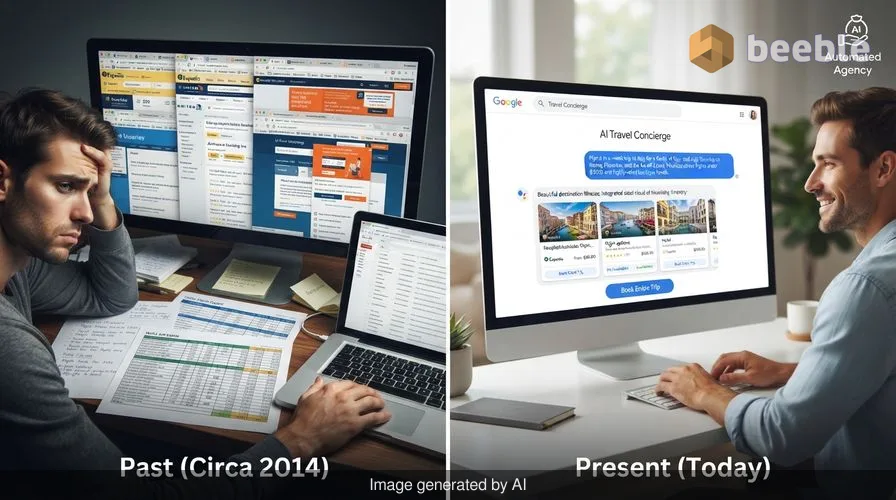
A decade ago, planning a summer vacation was a digital labor of love. It began with twenty open browser tabs, three separate spreadsheets, and a dozen confirmation emails scattered across a disorganized inbox. We navigated a fragmented web of airline portals, third-party booking sites, and local hotel pages. Each site had its own proprietary logic, its own dark patterns, and its own aggressive marketing pop-ups. We were the manual integrators of our own data. We took the information from tab A, cross-referenced it with the price in tab B, and finally made a purchase in tab C.
Today, this friction is disappearing. Google recently announced that its AI Mode now handles flight price tracking, hotel discovery, and direct booking through a conversational interface. Users can now describe a complex itinerary to a chatbot and receive a curated list of options sourced from over 300 airlines and travel sites. This update is more than a new feature. It marks a fundamental shift in the software industry. We are moving from the era of information retrieval to the era of automated agency. In this new reality, the search engine is no longer a library; it is a concierge.
The architecture of a conversation
Under the hood, this transition requires a massive overhaul of how software handles user intent. Historically, a search engine functioned as a simple index. You entered keywords, and the system returned a list of ranked documents. If you wanted to book a flight, you clicked a link and left the Google ecosystem to interact with the airline's own code. The airline controlled the user interface, the payment flow, and the customer data.
AI Mode changes this dynamic through the use of large language models that act as a sophisticated middleware. When a user asks to track flight prices for a trip to Tokyo in October, the AI does not just search for text. It interprets the request as a set of structured data requirements. It then queries vast databases of flight information through a series of Application Programming Interfaces, or APIs.
Think of these APIs as restaurant waiters. You, the user, are the diner. The airline's database is the kitchen. In the old web, you had to walk into the kitchen yourself to see what was cooking. Now, the AI waiter takes your order, talks to the kitchen, and brings the data back to your table in a neatly formatted conversational response. This process relies on a robust architecture that can handle real-time price fluctuations across hundreds of different providers simultaneously.
From links to logic flows
This shift reflects a broader industry trend toward reducing digital friction. Digital friction occurs whenever a user must stop their primary task to figure out how to navigate a software interface. By moving the booking process into AI Mode, Google eliminates the need for users to learn the unique UI quirks of every individual airline or hotel chain. The interface remains consistent, regardless of whether you are booking a budget flight or a luxury suite.
Technically speaking, this consistency is achieved by wrapping proprietary booking flows in a standardized Google-branded layer. When you select a hotel, you see a "Continue on Google" option. This button acts as a bridge. It allows you to select a room and review cancellation policies without ever leaving the conversational environment. You complete the transaction with Google Pay, a tool that already holds your encrypted financial data. The underlying hotel site still processes the booking, but the user experience is entirely mediated by Google.
Consequently, the technical complexity is hidden from the user. You no longer need to worry about whether a third-party site is secure or if its checkout button will work on your mobile browser. The AI handles the interoperability issues that used to plague the web. However, this convenience comes with a cost. As we offload the labor of searching and comparing to an AI, we also offload our visibility into how those choices are made.
The reality of ecosystem lock-in
Through this user lens, the benefits are obvious. The AI can track prices in 180 countries and send you an email the moment a fare drops. It can even calculate whether it is better to pay with cash or use your frequent flyer miles. This level of integration is only possible because Google has spent years building a walled garden. A walled garden is a closed ecosystem where the provider controls every aspect of the user journey.
In practice, this means that while you have access to information from 300 airlines, you are increasingly dependent on Google's algorithmic curation to tell you which flight is "best." The AI chooses which reviews to summarize and which price points to emphasize. This creates a new kind of technical debt for the user. We trade our digital autonomy for a streamlined experience. We stop being explorers of the web and start being passengers in a guided search experience.
Zooming out to the industry level, this move is a direct response to the rise of specialized AI agents. Companies like OpenAI and Perplexity are also building tools that can perform actions, not just answer questions. Google is using its massive existing infrastructure—its maps, its payment systems, and its relationships with travel providers—to maintain its dominance. The goal is to make the "open web" feel clunky and outdated by comparison.
Reclaiming the digital routine
Paradoxically, as software becomes more capable, the internal logic of that software becomes more opaque. When an AI tells you that a specific hotel is the best value for your points, you are trusting a black box. You do not see the specific API calls or the commercial agreements that might influence that recommendation. You see a friendly chat bubble.
On an individual level, it is important to recognize when a tool stops helping you find information and starts making decisions for you. The new AI Mode features are undeniably useful. They save time, reduce stress, and handle the tedious parts of travel planning that most people hate. Yet, digital literacy in 2026 is about more than just knowing how to type a prompt. It is about understanding the business rules and engineering choices that exist behind the screen.
Behind the screen, Google is transforming itself into the ultimate intermediary. By handling the tracking, the discovery, and the booking, they ensure that the user stays within their interface from the first spark of an idea to the final confirmation. This is a profound change in how we interact with the internet. We are no longer searching for destinations; we are asking a platform to build us a reality.
Ultimately, we should use these tools with a sense of hyper-observation. Watch how the AI summarizes a hotel review. Notice which flight options it places at the top of the list. Question why it suggests one payment method over another. The goal of modern software design is to make these interactions feel seamless, but a seamless experience is often one where the user has the least amount of control.
As we move toward a world of AI travel agents and automated itineraries, the most valuable skill is the ability to step back from the interface. We must remember how to verify facts, how to look past the curated summary, and how to navigate the messy, fragmented web that exists outside the walled garden. Technology is at its best when it serves as a tool for human intent, rather than a replacement for it.
Sources
- Google Developer Documentation on Search Generative Experience and AI Overviews.
- Travel Industry Report 2026: The Rise of Autonomous Booking Agents.
- API Integration Standards for Global Distribution Systems in Travel.
- UX Research Paper: The Impact of Conversational Interfaces on Consumer Choice.
- Google Workspace Updates: Flight and Hotel Integration Release Notes.



See you on the other side.
Our end-to-end encrypted email and cloud storage solution provides the most powerful means of secure data exchange, ensuring the safety and privacy of your data.
/ Create a free account
