


The quiet disappearance of the digital playground and the return to schoolyard noise

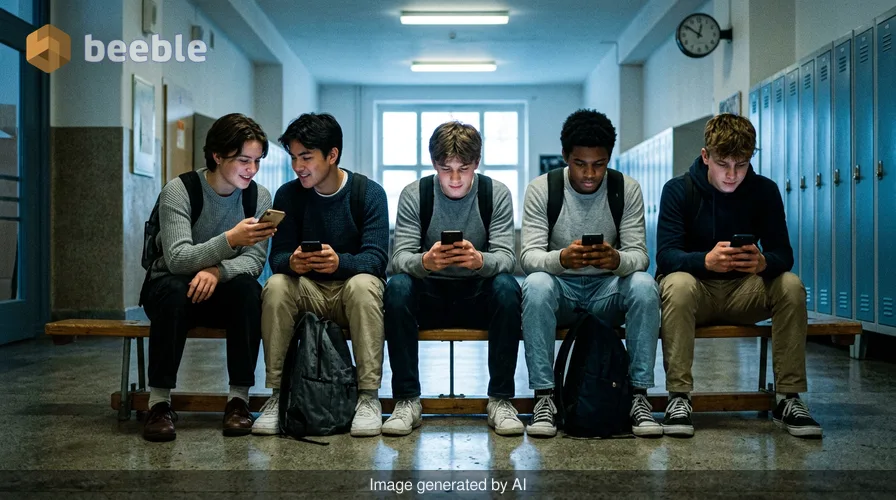
A group of teenagers sat on a wooden bench in a secondary school in Prague last Tuesday. There were five of them. They sat shoulder to shoulder, yet no one spoke. Every head was tilted at the same angle, eyes fixed on the glowing rectangles in their palms. Their thumbs moved in a rhythmic, synchronized dance of scrolling and tapping. Occasionally, one would let out a short, dry laugh and tilt their screen toward the person next to them. The other would glance for a second, nod, and return to their own digital world. This interaction was brief and silent. The hallway, which once echoed with the cacophony of adolescent gossip and shouted jokes, felt heavy with a peculiar kind of quiet. This is the modern school corridor before the first bell rings. It is a space where physical proximity no longer guarantees social presence.
This mundane scene is the catalyst for a systemic shift in the Czech educational landscape. Prime Minister Andrej Babis announced on Monday that the government has submitted a bill to ban mobile phones in schools starting in September 2027. The proposal is a direct response to the pervasive presence of screens in the lives of children. The ban covers the use of phones during lessons and breaks. Exceptions exist for health reasons or specific educational tasks, but the default state is now analog. Schools will lose the authority to allow recreational phone use during the day. This move is a legislative attempt to break the digital trance that has redefined the childhood experience.
The school as an archipelago of screens
Zooming out from that single bench in Prague, we see a broader sociological pattern. The modern classroom has become what we might call a social archipelago. Students occupy the same physical geography, yet they live on isolated islands of personalized content. Each child is anchored to a different algorithm, a different feed, and a different set of ephemeral notifications. This is digital atomization in its most visceral form. When children spend their breaks on phones, they opt out of the messy, unscripted negotiations of face-to-face play. They avoid the friction of eye contact. They skip the trial and error of verbal conflict resolution. The school is no longer a unified social theater.
This fragmentation has profound consequences for the collective habitus of the younger generation. Sociologists often look at the habitus as the set of ingrained dispositions and habits we acquire through our environment. When the environment is dominated by a hall of mirrors—where social media feeds reflect and amplify only what we already like—the ability to engage with the "other" withers. The Czech government is betting that by removing the mirror, they can force the archipelago to become a continent again. They want to restore the school as a shared space where children must look at one another because there is nothing else to look at.
The linguistic erosion of the playground
From a philological perspective, the silence in the hallways signals a shift in how language evolves among peers. Slang and social codes used to develop through vocal repetition and physical performance. Now, much of this evolution happens in the opaque world of group chats and meme culture. When children are constantly on their phones, the verbal discourse of the playground becomes thinner. The richness of tone, the nuance of sarcasm, and the importance of body language are replaced by emojis and acronyms. These are efficient but lack the emotional nutrition of spoken word.
In everyday terms, we are seeing the rise of a transactional communication style. Children talk to each other to exchange information or to react to a shared piece of media. They spend less time in the aimless, wandering conversations that build deep rapport. These wandering conversations are where identity is formed. By banning phones, the state is effectively trying to reintroduce a slower, more deliberate form of speech. It is an effort to protect the linguistic archaeological site of childhood from being paved over by the fast-food diet of digital interaction.
A global movement toward analog boundaries
The Czech Republic is not an outlier in this decision. This move follows a growing global realization that the attention economy is incompatible with the goals of public education. Poland recently joined countries like Italy, South Korea, and the Netherlands in implementing similar restrictions. The concern is systemic. It is about concentration, behavior, and the mental health of a generation that has never known a world without the internet. Australia and Britain are also taking tougher stances on social media access for children. This is a rejection of the idea that technology is a neutral tool.
Governments are beginning to see that the constant pings of a smartphone are a structural interference with the learning process. Concentration is a finite resource. When a child has a phone in their pocket, a portion of their brain is always waiting for the next notification. This is a state of continuous partial attention. It makes the deep work required for mathematics or literature almost impossible. The ban is a way to clear the air. It is a policy designed to create a protected space where the only thing competing for a student's focus is the teacher and the textbook.
Reclaiming the mundane beauty of boredom
One of the most radical aspects of the 2027 ban is the inclusion of school breaks. For many adults, the idea of a break without a phone seems like a minor inconvenience. For a child born into liquid modernity, it is a profound change. Boredom is an essential part of human development. It is the soil from which creativity and self-reflection grow. When every spare second is filled by a short-form video, the capacity to sit with one's own thoughts vanishes. The 2027 bill forces children back into the mundane reality of the physical world.
They will have to navigate the awkwardness of a quiet lunchroom. They will have to find ways to entertain themselves using their imagination or their peers. This is where the social contract is rebuilt. It is in these unscripted moments that children learn who they are outside of their digital profile. The ban is not just about grades or test scores. It is about the preservation of a specific kind of human experience that is currently at risk of extinction.
Food for thought
As we move toward 2027, the success of this policy will depend on more than just the law. It requires a shift in how we value attention in our own lives. We might consider how often we use our own devices as a shield against the world. Here are some points for reflection:
- Observe a public space this week and count how many people are engaged with their surroundings versus their screens.
- Reflect on the last time you felt truly bored and what you did to resolve that feeling without technology.
- Consider the difference between a conversation held over a screen and one held in person.
- Think about the social skills that are difficult to learn through an interface.
- Question if the constant connectivity of our lives is a choice or a systemic requirement.
Ultimately, the Czech government is attempting to legislate a return to presence. It is a bold experiment in social engineering. If it works, the school hallways of 2027 will sound very different from the ones today. They will be louder, more chaotic, and perhaps more difficult for teachers to manage. But they will also be more human. The return of the schoolyard noise is the return of the collective experience.
Sources
- OECD (2023) Report on Technology in Education.
- Zygmunt Bauman (2000) Liquid Modernity.
- Pierre Bourdieu (1977) Outline of a Theory of Practice.
- Czech Ministry of Education (2026) Draft Bill on Mobile Devices in Schools.
- UNESCO (2023) Global Education Monitoring Report on Technology.



See you on the other side.
Our end-to-end encrypted email and cloud storage solution provides the most powerful means of secure data exchange, ensuring the safety and privacy of your data.
/ Create a free account
