


The quiet end of the manual photo album

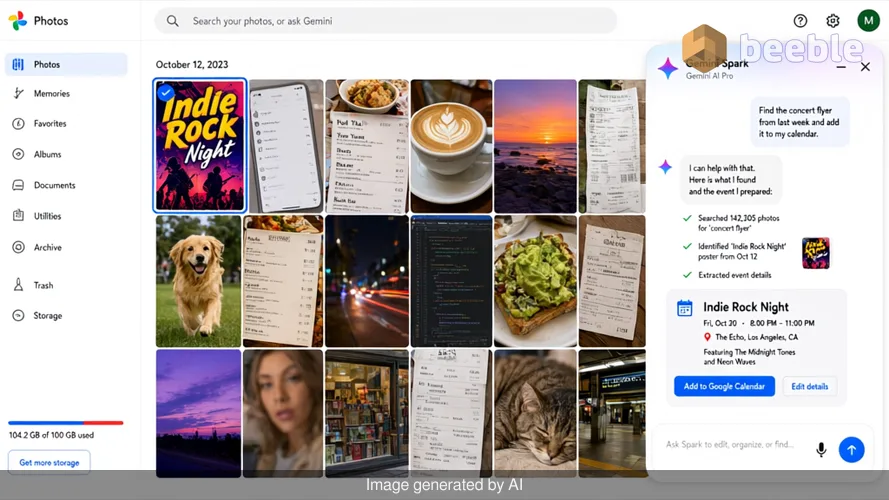
I recently spent twenty minutes scrolling through a vertical sea of nearly identical thumbnails to find one specific photo of a restaurant menu from three years ago. This is a common ritual in the modern era of digital abundance. Most of us possess libraries that exceed one hundred thousand items. We treat our phone storage like a digital junk drawer where we toss every receipt, sunset, and blurry screenshot with the vague hope that a search bar will rescue us later. The volume of our personal media has surpassed our ability to organize it.
This week, Google Photos lead Shimrit Ben-Yair announced that Gemini Spark is now capable of managing these massive libraries for Gemini AI Pro and Ultra subscribers. Users in the U.S. can now ask the agent to perform multi-step tasks like curating albums, editing specific images, or even turning a photo of a concert flyer into a calendar event. To use the feature, a subscriber connects Google Photos to Gemini and toggles the Spark icon in the app corner. It is a small UI change that signals a significant shift in how we interact with our own history.
The mechanism behind the spark
Under the hood, this integration is less about magic and more about the evolution of agentic workflows. Historically, Google Photos relied on computer vision to tag objects like "dog" or "beach" in your images. You could search for these terms, but the software was a passive librarian. Gemini Spark changes this dynamic by acting as a functional layer between the user and the Google Photos API. When a user asks Spark to "create a shared album of my favorite shots from last summer," the system does not just search for dates. It evaluates image quality, identifies recurring faces, and executes the commands to generate a new collection.
Technically speaking, this process requires the large language model to have a persistent understanding of your library's structure. The agent must parse the metadata of thousands of files to identify which photos belong to a specific event or aesthetic. This transition from a simple search engine to an active agent is a response to the growing problem of digital friction. We have more tools than ever, but the time required to use them effectively has become a new form of technical debt for the average person. The agent promises to pay down that debt by handling the tedious labor of sorting and filing.
The industry search for utility
Zooming out to the industry level, Google's move arrives at a time when AI companies are desperate to prove their value to consumers. OpenAI CEO Sam Altman recently admitted to Bloomberg that the industry has failed to communicate the benefits of AI effectively. This lack of clarity has resulted in a global backlash against tools that feel like solutions in search of problems. Google is attempting to solve this by embedding Gemini Spark into services that people already use every day.
This strategy is an attempt to find product-market fit through automation. While the ability to make a photo album is not a revolutionary breakthrough, the ability to do it through a single voice command addresses a genuine pain point for users with six-figure photo counts. The competitive pressure of the AI market forces companies to release these incremental upgrades immediately. They are building the plane while it is in the air. Consequently, the software landscape is becoming a patchwork of AI-infused features that often feel experimental rather than finished products.
Algorithmic curation and the loss of the human touch
In everyday terms, delegating our memories to an algorithm changes our relationship with our past. There is a specific kind of reflection that happens when you manually select twenty photos for a physical album or a digital folder. You look at the edges of the frame. You remember the context of the day. When Gemini Spark curates an album for you, that reflective process disappears. The algorithm prioritizes what it thinks is a "good" photo based on lighting, focus, and composition. It lacks the emotional context to know that a blurry, poorly lit photo of a friend might be more valuable than a crisp shot of a sunset.
From a developer's standpoint, this is a classic trade-off between efficiency and intent. Software designers often aim for a seamless experience, but every piece of friction removed is also a moment of human agency lost. Google is betting that users value their time more than the process of curation. This is the logic of the proprietary ecosystem. By making the management of Google Photos effortless through Gemini Spark, Google increases the cost of switching to a competitor. If your entire library is organized by a specific AI agent, moving those photos to a different service becomes a daunting task.
Digital self reflection for the agentic age
Ultimately, the integration of Gemini Spark into Google Photos is a sign that the era of manual digital organization is ending. We are moving toward a world where software is not a tool we use, but a partner that acts on our behalf. This shift requires us to be more conscious of the data we feed into these systems. If we stop organizing our own photos, we lose the ability to define what is important to us. We allow the code to decide which memories deserve to be at the top of the feed.
As these features roll out, it is worth considering how much control we are willing to trade for convenience. We should observe our own habits as we adopt these tools. Are we using Gemini Spark to clear the clutter so we can focus on the photos that matter, or are we simply letting the machine decide what we should remember? The answer to that question will define our relationship with technology in the years to come. Digital literacy in 2026 is about understanding that while the agent can find the photo, only the human can feel the memory.
Food for thought
- How often do you revisit photos that were not surfaced by an algorithm?
- Does the convenience of an automated album outweigh the personal value of manual curation?
- If an AI agent organizes your entire digital life, how much harder does it become to leave that specific ecosystem?
- What happens to your digital legacy if the proprietary agent managing it is eventually deprecated?
Sources
- Official post by Shimrit Ben-Yair, Lead of Google Photos, via X.
- Google Gemini Release Notes for September 2026.
- Bloomberg Technology interview with Sam Altman on AI communication.
- Google Developer Documentation for Gemini API and Google Photos Library API.



See you on the other side.
Our end-to-end encrypted email and cloud storage solution provides the most powerful means of secure data exchange, ensuring the safety and privacy of your data.
/ Create a free account
