


The quiet end of the six-digit PIN

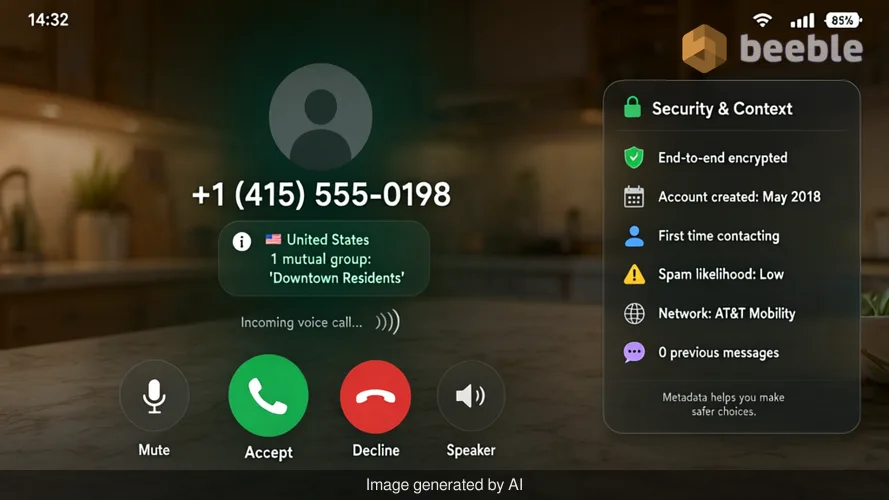
A phone vibrates on a kitchen counter. The screen shows a call from a number that is not in the address book. For years, this was a moment of digital friction that left the user with a binary choice: answer and risk a telemarketing pitch, or ignore and potentially miss an urgent update from a delivery driver. On Tuesday, WhatsApp introduced a small change to this interface. Now, beneath the unknown number, the app displays a snippet of context. It might note that the caller is from a specific country or that the user has one group in common with them. This tiny UI detail is the starting point for a broader overhaul of how we secure our digital identities.
Technically speaking, this update reflects a shift in how messaging platforms balance end-to-end encryption with user safety. In an encrypted environment, the service provider cannot see the content of your messages. However, they can see metadata—the data about the data. By surfacing these metadata connections to the user, WhatsApp attempts to bridge the gap between privacy and transparency. It is an effort to make the invisible visible, giving the user a better reason to tap the green button or the red one. This change is not an isolated event. It is part of a larger technical migration away from legacy security methods that have become increasingly easy for bad actors to bypass.
The alphanumeric upgrade for two-step verification
Historically, WhatsApp relied on a six-digit PIN as its secondary layer of protection. This was a pragmatic choice for a global user base. It is easy to remember and works across every type of hardware. Paradoxically, the simplicity of a six-digit code is now its greatest vulnerability. As computational power increases, the time required to brute-force a million possible combinations decreases. Attackers often use social engineering to trick users into revealing these short codes. By allowing users to choose a longer, alphanumeric password with special characters, WhatsApp is moving the goalposts for hackers.
Behind the screen, this change acknowledges that the "what you know" factor of security is failing. A six-digit PIN is a weak ingredient in the security recipe. A complex password requires more effort to memorize, but it significantly raises the cost for an attacker to gain unauthorized access. Through this user lens, we see a transition from convenience-first security to resilience-first security. The app no longer assumes that six digits are enough to protect a person's entire digital history. This shift mirrors a broader industry pattern where even basic consumer apps are adopting enterprise-grade authentication standards.
Moving from memory to hardware with passkeys
Zooming out to the industry level, the most significant change is the expanded support for passkeys. WhatsApp first introduced passkeys earlier in 2024, but users can now add more than one to their account. A passkey is fundamentally different from a password. While a password is a string of characters you store in your brain, a passkey is a cryptographic pair stored on your device. One half is public and sits on the WhatsApp server; the other half is private and never leaves your phone. You unlock it with Face ID, a fingerprint, or your device passcode.
In everyday terms, this removes the need for the user to act as a storage unit for secrets. Passkeys are built on FIDO2 standards, which are resistant to phishing. An attacker can build a fake login page, but they cannot trick your phone into handing over the private key. The move to support multiple passkeys is a response to the fragmented nature of our digital lives. Many people move between an iPad on iOS and a primary phone on Android. By allowing multiple passkeys, WhatsApp ensures that the user is not locked out if they switch devices. This is a rare moment where a proprietary app adopts an open-source standard to solve a common user frustration.
The architecture of ecosystem lock-in and cross-platform reality
Under the hood, managing multiple passkeys across different operating systems is a complex engineering task. Apple and Google have their own ways of handling biometric data and secure enclaves. WhatsApp must act as the orchestrator for these different hardware-backed security modules. This update is a recognition that users do not live in a single-vendor vacuum. Even as tech giants try to keep users within their own walled gardens, the apps we use daily must function as bridges between those gardens.
Consequently, the security model of the app is becoming more decentralized. In the past, security was a gatekeeper that lived on the server. Now, security is a distributed process that relies on the integrity of the user's hardware. This change has profound implications for how we think about device ownership. If your security is tied to your phone's biometrics, the physical device becomes the ultimate key to your digital life. This makes the loss of a device a much more significant event than it was a decade ago. It is a trade-off: we gain protection against remote hackers, but we increase our reliance on the physical objects in our pockets.
Subscription models and the evolution of the chat app
At its core, WhatsApp is also evolving from a simple utility into a multifaceted platform. The company recently launched a "Plus" subscription plan, following the lead of Telegram and Signal. This plan introduces features like profile customization and super reactions. From a developer's standpoint, this is an attempt to diversify revenue away from pure data or business messaging. It is a sign that the era of "free" software is reaching a limit. As the costs of maintaining global infrastructure and advanced security grow, companies are looking for ways to monetize their heavy users.
Curiously, these features arrive just as WhatsApp introduces usernames to hide phone numbers. This is a significant pivot for an app that was built entirely on the phone number as a unique identifier. Zooming out, we see the app trying to shed its legacy constraints. By decoupling the account from the phone number, WhatsApp becomes more like a traditional social network and less like a digital replacement for SMS. This transition requires a new security framework, as the phone number is no longer the sole anchor of a person's identity. The new security tools are the infrastructure necessary to support this more anonymous, more flexible version of the app.
Technical debt and the cost of security
Ultimately, these updates are an exercise in managing technical debt. The six-digit PIN was a solution that worked for the mobile web of 2014, but it is a legacy artifact in 2026. Replacing it is a disruptive process that requires educating millions of users. It is like a home renovation where you must replace the old wiring while the family is still living in the house. The developers cannot simply turn off the old PIN system, because that would lock out millions of users on older devices. Instead, they must layer new, more robust systems on top of the old ones.
In practice, this means the app becomes larger and more complex. Each new security feature adds a few more lines of code and a few more megabytes to the app size. This is the hidden cost of staying safe in a world where phishing attacks are automated and sophisticated. The seamless experience we expect as users is the result of thousands of engineering hours spent fighting a silent war against entropy. Every time we use Face ID to log in, we are benefiting from a vast stack of cryptographic protocols that were invisible to us just a few years ago.
Reclaiming control over the digital gate
Security is not a static destination. It is a continuous negotiation between the user, the developer, and the attacker. The new WhatsApp updates provide us with better tools for this negotiation, but they also require us to be more conscious of our habits. Choosing a longer password or setting up a passkey is an act of digital hygiene. It is an acknowledgment that our conversations and our metadata are valuable enough to protect with more than just a simple code.
On an individual level, these changes invite us to observe how we interact with the prompts on our screens. The next time you see a call from an unknown number with a note about a mutual group, take a moment to realize what is happening. The software is giving you a piece of the map so you can navigate the digital terrain with more confidence. We should not view security as a burden or a series of hurdles. It is the infrastructure that allows us to communicate in a fragmented and often hostile digital world. By adopting these new standards, we are not just protecting our chat history. We are participating in a global shift toward a more resilient and transparent web.
Sources
- FIDO Alliance: FIDO2 Project Specifications and Passkey Documentation.
- Meta Newsroom: WhatsApp Security Updates and Feature Announcements, August 2026.
- WhatsApp Engineering Blog: Implementing Passkeys Across iOS and Android Ecosystems.
- W3C Web Authentication (WebAuthn) Standard Documentation.



See you on the other side.
Our end-to-end encrypted email and cloud storage solution provides the most powerful means of secure data exchange, ensuring the safety and privacy of your data.
/ Create a free account
