
The Quiet Erosion of the Creative Monopoly
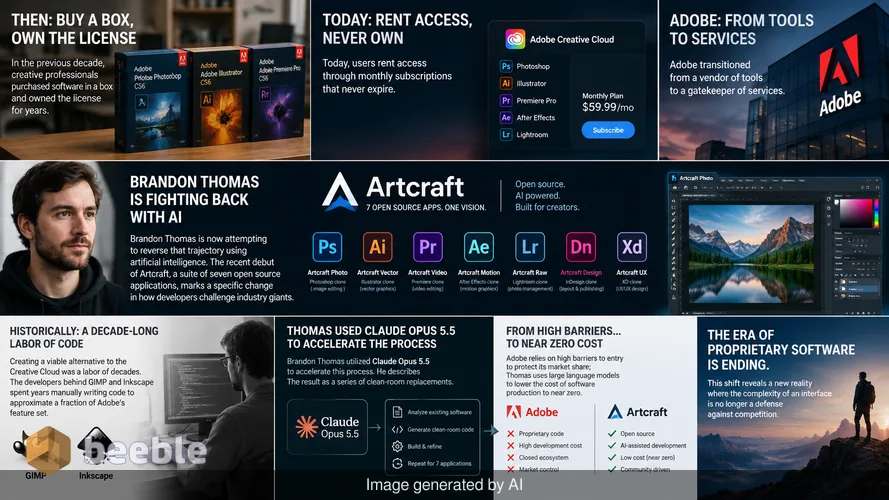
In the previous decade, creative professionals purchased software in a box and owned the license for years; today, users rent access through monthly subscriptions that never expire. Adobe transitioned from a vendor of tools to a gatekeeper of services; Brandon Thomas is now attempting to reverse that trajectory using artificial intelligence. The recent debut of Artcraft, a suite of seven open source applications, marks a specific change in how developers challenge industry giants. Thomas claims that the era of proprietary software is ending. He supports this claim with a collection of clones that mimic the user interface and core functionality of Photoshop, Illustrator, and Premiere.
Historically, creating a viable alternative to the Creative Cloud was a labor of decades. The developers behind GIMP and Inkscape spent years manually writing code to approximate a fraction of Adobe’s feature set. Brandon Thomas utilized Claude Opus 5.5 to accelerate this process. He describes the result as a series of clean-room replacements. Adobe relies on high barriers to entry to protect its market share; Thomas uses large language models to lower the cost of software production to near zero. This shift reveals a new reality where the complexity of an interface is no longer a defense against competition.
The catalyst of the cancellation fee
The motivation for this project is not purely ideological. Thomas cited a common user frustration: the predatory cancellation fee. Many users encounter these dark patterns when they attempt to leave a subscription service. Adobe makes the entrance to its ecosystem seamless; it makes the exit expensive and confusing. This friction often prevents users from exploring alternatives. Thomas experienced this digital friction personally and decided to build a way out. He is funding the development of these free tools through a separate revenue stream. He sells token-based access to the Artcraft visual AI model. This business model funds the open source project without requiring a subscription from the end user.
Digital literacy is often framed as the ability to use a specific tool. In the modern tech world, digital literacy is the ability to recognize when a tool has become a trap. Subscription models turn software into a utility that can be turned off if the bill is not paid. Users who spend years learning Photoshop find their skills are locked to a specific company’s pricing whim. Thomas proposes a return to ownership through open source code. He believes that if the community owns the tools, the corporate gatekeepers lose their leverage.
AI as the great reverse engineer
Under the hood, the development process for Artcraft differs from traditional software engineering. Thomas did not write every line of code by hand. He used AI to reverse engineer the functionality of Adobe’s suite. This method involves describing the behavior of a tool and letting the model generate the underlying logic. Developers previously spent months debugging a single filter; now, an AI model can suggest a functional implementation in seconds. Thomas claims he one-shotted Photoshop. This statement suggests that the core architecture was generated in a single successful prompt sequence.
Technically speaking, the choice of programming language is significant. Thomas built the Artcraft suite in Rust. This language offers the performance of C++ with better memory safety features. Adobe’s legacy codebases are decades old and contain vast amounts of technical debt. Thomas is building from scratch with modern abstractions. Consequently, these apps can run in a browser via WebAssembly. A user does not need to install a massive proprietary package to edit a photo. They simply open a URL and begin working. The software is lightweight and agile.
The legal boundary of trade dress
Zooming out to the industry level, the Artcraft project faces significant legal hurdles. Replicating the functionality of software is generally legal under clean-room design principles. Copying the appearance, or trade dress, is a different matter. Adobe’s interface is iconic. The layout of the toolbar, the specific shades of gray in the UI, and the naming of the menus are all part of the Adobe brand. If Artcraft mimics these too closely, it may face a trademark infringement lawsuit. Thomas is betting that the functional necessity of the layout protects his design choices.
Historically, courts have allowed competitors to use similar layouts if those layouts are functional. A car has a steering wheel and pedals in a specific place because that is how people drive. Thomas argues that a photo editor must have a layers panel and a crop tool in a specific place because that is how artists work. If he wins this argument, he sets a precedent for the total commoditization of software. The value of a program would no longer reside in its interface. The value would reside in the data and the user's ability to manipulate it.
From feature creep to functional parity
In everyday terms, most users only use a fraction of Photoshop’s features. Adobe continues to add new AI-powered tools to justify the subscription cost. This results in feature creep. The software becomes bloated and difficult to navigate. Artcraft aims for 100% feature parity, but it starts with the essentials. Thomas promised to reach parity within months. Commenters on Hacker News are skeptical of this timeline. They point out that professional tools like After Effects have thousands of edge cases and specific plugins.
Paradoxically, the shortcomings of the alpha version are less important than the speed of its creation. Even if Artcraft only reaches 80% parity, it provides a viable exit for a large segment of the market. The goal is de-enshittification. This term refers to the process of removing ads, tracking, and artificial restrictions from digital services. Thomas envisions a future where developers recreate every major proprietary platform. He mentions Google Search and smartphones as future targets. He believes that once the cost of writing code drops, the power of tech monopolies will evaporate.
The future of the digital toolset
Ultimately, the Artcraft experiment is a test of the value of proprietary code. If an individual can replicate a multi-billion dollar product in a year, the moat around that product is gone. Software is becoming a commodity like electricity or water. You do not care who provides it as long as the light turns on. Through this user lens, the brand of the photo editor matters less than the ability to save a file without a fee. Thomas is not just building an app; he is challenging the idea that software should be a service you rent forever.
On an individual level, this shift requires a new perspective on our digital habits. We often stick with clunky or expensive software because we fear the learning curve of a new tool. AI removes that curve by allowing the new tool to look and act exactly like the old one. We are entering an era where users can choose their software based on their values rather than their habits. If you value privacy and ownership, you choose the open source clone. If you value corporate support and cloud integration, you stay with the original. The monopoly ends when the choice becomes real.
To put it another way, the walls around the creative garden are falling. We no longer need to wait for a large corporation to grant us new features. We can describe the feature to an AI and build it ourselves. The Artcraft suite is the first major example of this new reality. It is an ambitious project that highlights the changing relationship between the developer, the user, and the code. Whether Thomas reaches 100% parity is secondary to the fact that he tried. He has demonstrated that the technical barriers are no longer insurmountable. The future of software is open, performant, and owned by the people who use it.
Sources
- Artcraft Development Logs and Alpha Release Notes
- Reddit r/software: Brandon Thomas Announcement Thread
- Hacker News: Discussion on AI-powered Reverse Engineering in Rust
- Anthropic Claude Opus 5.5 Technical Documentation
- Rust Language Foundation: WebAssembly and Performance Benchmarks
- U.S. Patent and Trademark Office: Guidelines on Software Trade Dress



See you on the other side.
Our end-to-end encrypted email and cloud storage solution provides the most powerful means of secure data exchange, ensuring the safety and privacy of your data.
/ Create a free account