


The Quiet Integration of Crypto into the Fabric of American Law

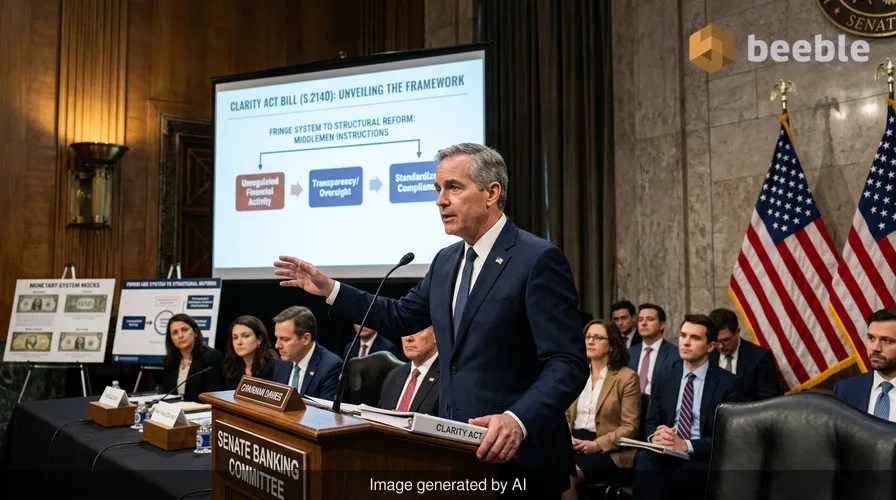
For years, the relationship between the average American’s digital wallet and the hallowed halls of the U.S. Senate has been defined by a mutual, suspicious distance. While early crypto pioneers viewed regulations as a threat to their digital sovereignty—the modern user often views them as a prerequisite for safety; whereas the original Bitcoin whitepaper imagined a world without middlemen—the Clarity Act envisions a world where the middlemen simply have clearer instructions. This landmark bill, unveiled late Monday by the Senate Banking Committee, represents a fundamental shift in how we perceive digital assets: no longer as speculative experiments on the fringes, but as structural components of a shifting monetary system.
The Stablecoin Tug-of-War: Interest vs. Utility
Historically, the allure of stablecoins was simple—they offered the stability of the dollar with the speed of the blockchain. However, as these assets grew, they began to mimic the behavior of traditional bank accounts. If you were holding a dollar-pegged token in a digital wallet and receiving a 5% reward just for letting it sit there, you weren't just using a payment tool; you were participating in a parallel banking system. This is where the Clarity Act draws a firm line in the sand.
On a macro level, the bill bans rewards on idle stablecoin balances that too closely resemble bank deposits. Paradoxically, it encourages rewards for transaction-based activity, such as using those same coins to pay for your morning coffee or settle a bill. This distinction is subtle but profound. From a consumer standpoint, the government is essentially saying that crypto should be a medium of exchange, not a shadow bank. Banks have voiced significant concern over this, fearing that if crypto exchanges can offer better perks for transactions, deposits will drain out of the traditional, regulated banking system. For the individual, this means the 'high-yield' digital dollar accounts of the past may soon vanish, replaced by 'cash-back' styles of crypto spending.
The End of the Digital Wild West
Behind the scenes of this trend, the concept of the 'Digital Wild West' is being systematically dismantled. The Clarity Act would require crypto brokers, dealers, and commodity exchanges to be treated as financial institutions under the Bank Secrecy Act. In practice, this means the days of signing up for a crypto platform with nothing more than an email address and a hope are over. You will be subject to the same anti-money laundering and 'Know Your Customer' checks as you are when opening a checking account at a local branch.
Through this economic lens, we see the government attempting to patch a perceived systemic vulnerability. Many crypto firms have long argued that they were tech companies, not financial ones, and therefore exempt from the expensive, labor-intensive due diligence that banks perform. The Senate is now asserting that if it looks like a bank and moves money like a bank, it must guard against illicit flows like a bank. For the everyday user, this might feel like more red tape, but it is the price of admission for crypto to move from the speculative shadows into the light of the mainstream economy.
A Safety Net for Innovation: The $50 Million Bridge
Financially speaking, one of the biggest hurdles for crypto startups has been the looming shadow of the Securities and Exchange Commission (SEC). Under previous administrations, the SEC frequently argued that almost every token sale was an illegal, unregistered security offering. This created a climate of fear that stifled smaller creators who couldn't afford a $10 million legal bill just to launch a project. The Clarity Act offers a pragmatic olive branch: a fundraising exemption for up to $50 million a year, with a $200 million lifetime cap.
This provision acts as a financial snowball for smaller firms, allowing them to raise capital and distribute tokens without the crushing weight of full SEC registration. To put it another way, the bill creates a 'sandbox' where innovation can happen under a reduced regulatory burden. While tokens tied to investment contracts are still under scrutiny, this exemption limits the SEC’s ability to retroactively label every project as a violation. For the retail investor, this might mean more diverse projects reaching the market, but it also places a greater burden of personal due diligence on the individual, as these exempt companies won't be filing the same exhaustive disclosures as a blue-chip stock.
Defining the 'De' in Decentralized
One of the most nuanced parts of the bill attempts to solve a philosophical riddle: when is a platform truly decentralized? In the crypto world, 'DeFi' (Decentralized Finance) platforms act as digital marketplaces where users trade directly with one another, theoretically without an intermediary. However, many of these platforms have 'god modes'—private permissions or special privileges held by the developers that allow them to block users or change the rules on a whim.
The Clarity Act establishes a tangible bar for decentralization. If a platform has the power to block you, or if it maintains hard-coded special privileges for its creators, the government will no longer consider it decentralized. Consequently, that platform will be treated as a traditional financial institution, required to report suspicious activity just like a bank. This is a symbolic blow to 'DeFi-in-name-only' projects. It forces a choice: either become truly, uncontrollably decentralized or accept the responsibilities of a regulated financial entity. For the user, this provides a much-needed reality check on the level of 'freedom' they are actually getting when they use these protocols.
Turning the Real World into Code
Zooming out to the broader horizon of the financial markets, the bill takes a significant step toward 'tokenization.' This is the process of taking a tangible asset—like a share of a tech company or a piece of commercial real estate—and representing it as a token on a blockchain. Many see this as the future of the stock market, where trades could happen 24/7 and settle instantly, rather than waiting days for old-fashioned clearinghouses to catch up.
The Clarity Act clarifies that putting a stock on a blockchain doesn't magically make it exempt from existing laws. It mandates that a tokenized security must be treated exactly like the underlying asset it represents. Curiously, this may be the most pervasive change of all. It paves the way for a world where your brokerage account and your digital wallet are the same thing. It suggests a future where the friction of moving money between different types of investments—from a savings account to a stock to a digital asset—becomes almost invisible.
Reclaiming Control in a Regulated Era
Ultimately, the Clarity Act is less about 'fixing' crypto and more about absorbing it into the existing global financial architecture. It represents a shift from the volatile, fragmented early days of the industry toward a more structural, interconnected future. While some may mourn the loss of the original, ungoverned spirit of blockchain, others will find comfort in the fact that their digital assets are finally being recognized by the law.
On an individual level, this legislation invites us to observe our own financial habits. We are moving toward a world where the 'glass bank vault' of the blockchain is no longer a fringe curiosity but a standard feature of modern life. As the lines between your bank and your blockchain app continue to blur, the most important asset you can hold isn't a specific token—it is a clear-eyed understanding of the rules that govern your money. Whether this bill provides the 'clarity' its name promises or simply adds a new layer of complexity, it serves as a reminder that in the world of finance, the only constant is evolution. We must remain mindful not just of what we are buying, but of the systemic structures being built around us while we sleep.
Sources
- Senate Banking Committee: Text of the Clarity Act of 2026.
- U.S. Treasury Department: Report on Illicit Finance in Digital Asset Markets.
- SEC Commissioner Statements: Guidance on Tokenized Securities and Fundraising Exemptions.
- Federal Reserve: Analysis of Stablecoin Impact on Traditional Bank Deposits.



See you on the other side.
Our end-to-end encrypted email and cloud storage solution provides the most powerful means of secure data exchange, ensuring the safety and privacy of your data.
/ Create a free account
