


The Quiet Integration of Your Digital Wallet into the Global Financial Machine

Most of us treat our banking apps and our crypto wallets like two separate rooms in a house. One room is for the 'real' world—paying the mortgage, buying groceries, and checking if the paycheck landed. The other room is for the digital frontier, a place of volatile charts and the occasional hope for a moonshot. We’ve been told for years that these two worlds are rivals, yet behind the scenes, the walls between them are being systematically dismantled.
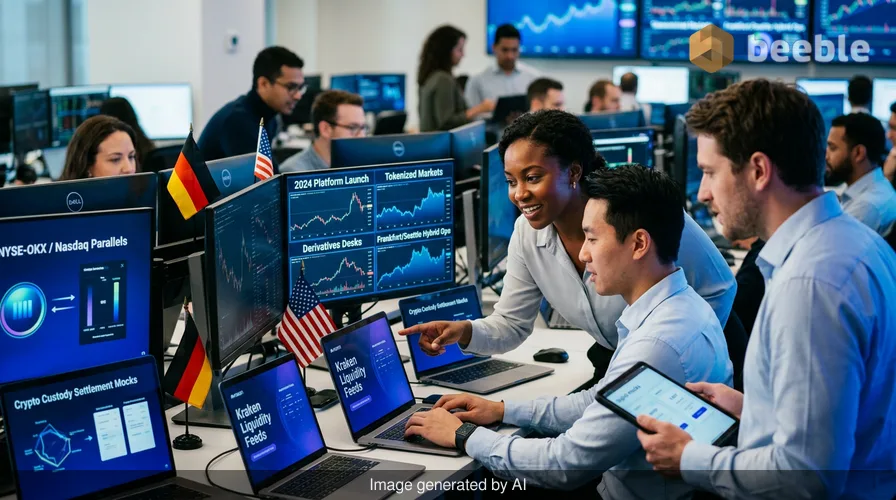
On a macro level, the news that Deutsche Boerse—the operator of the Frankfurt Stock Exchange—has purchased a $200 million stake in the crypto giant Kraken is not just a corporate acquisition. It is a symbolic bridge being built between the century-old pillars of European finance and the digital wild west. For the average person, this means the 'glass bank vault' of the blockchain is no longer just a hobbyist’s experiment; it is becoming a core component of the global plumbing that moves money around the world.
The Institutional Appetite for Digital Plumbing
Deutsche Boerse isn’t just buying a piece of a company; they are buying a seat at the table of the future. By acquiring a 1.5% stake in Kraken, the German exchange operator is deepening a partnership that began back in late 2025. Paradoxically, while many retail investors were nursing losses from market volatility, the world’s largest financial institutions were quietly laying the groundwork for a regulated, tokenized future.
This isn't an isolated event. We are seeing a pervasive trend where the gatekeepers of traditional finance (TradFi) are absorbing the innovators of decentralized finance (DeFi). Earlier this year, the parent company of the New York Stock Exchange invested in OKX, and Nasdaq teamed up with Kraken’s parent company. These aren't just speculative bets; they are structural shifts. These institutions are moving from a state of skepticism to one of integration, realizing that the blockchain offers a level of transparency and settlement speed that their legacy systems simply cannot match.
Why the 'Master Account' Matters to Your Coffee Run
In March, Kraken achieved something that would have seemed impossible a decade ago: it became the first digital asset bank to receive a master account at the U.S. Federal Reserve. To put it another way, a crypto-native company now has the same direct access to the central bank’s payment systems as JPMorgan or Citibank.
In everyday terms, this matters because it removes the 'middleman friction' that usually slows down your money. When you swipe a card to buy a coffee, that transaction travels through a fragmented web of clearinghouses and banks. By having a master account, a crypto-firm can theoretically settle transactions faster and more cheaply. However, this also brings systemic risks. When the digital world and the central banking world become this interconnected, a glitch in one can become a crisis in the other. The Federal Reserve's decision has already prompted concerns about financial stability, as the line between speculative crypto assets and the 'boring' stability of the dollar continues to blur.
The Illusion of the Digital Divide
We often think of crypto as a tool for opting out of the system, but the reality is that the system is opting in to crypto. Deutsche Boerse’s investment encompasses regulated crypto, tokenized markets, and derivatives. This means that in the near future, the stocks in your retirement account and the digital tokens in your wallet might live on the same infrastructure.
Through this economic lens, we can see that the 'decentralized' dream is being tempered by institutional reality. While the blockchain remains a transparent ledger, the access points—the exchanges and the banks—are becoming more centralized and regulated. This is a nuanced trade-off: we gain the security and liquidity of traditional markets, but we lose some of the permissionless freedom that defined the early days of Bitcoin.
Navigating the New Financial Architecture
As these two worlds merge, the psychological impact on the ordinary investor is profound. We are moving away from the era of 'get rich quick' schemes and into an era of 'integrated utility.' When a giant like Deutsche Boerse offers crypto custody via Clearstream, they are telling the world that digital assets are no longer transient fads; they are tangible assets that require professional-grade protection.
Ultimately, this shift forces us to look at our own financial habits. Are we still treating crypto as a casino, or are we beginning to see it as a legitimate piece of our broader economic life? The entry of institutional giants provides a layer of resilience to the market, but it also means the days of the 'digital wild west' are numbered. The frontier is being settled, paved, and taxed.
Food for Thought
Instead of watching the price charts today, consider the following reflections on your own financial autonomy:
- The Integration Check: If your traditional bank offered you the ability to hold Bitcoin alongside your savings account tomorrow, would you feel more secure, or would you worry about the loss of privacy?
- The Transparency Paradox: We value the transparency of the blockchain, yet we rely on opaque institutions like the Fed to keep the economy stable. How much 'visibility' are you willing to trade for 'stability'?
- The Future of Ownership: As markets become 'tokenized,' we may soon own fractions of real estate or fine art as easily as we own a share of stock. Does this democratize wealth, or does it simply create more ways for us to stay tethered to the market?
Sources:
- Deutsche Boerse Group Investor Relations and Press Releases (April 2026)
- Federal Reserve Board: Master Account Access Guidelines and Transcripts
- Nasdaq and NYSE Institutional Investment Reports (Q1 2026)
- Clearstream Crypto Custody Service Announcements



See you on the other side.
Our end-to-end encrypted email and cloud storage solution provides the most powerful means of secure data exchange, ensuring the safety and privacy of your data.
/ Create a free account
