


The quiet obsolescence of the capable smartphone

Imagine a morning where your phone anticipates the delay in your commute because it read your emails and cross-referenced the local transit map without you lifting a finger. The new Siri AI promises this level of effortless synchronization across every note you have ever written and every photo you have ever taken. It offers a vision of computing where the interface disappears and the machine finally speaks the language of human intent. You can ask about a dinner reservation buried in a thread from three weeks ago and Siri finds it. You can command your device to edit a photo and send it to a specific contact in one breath. The software feels limitless, intelligent, and deeply integrated into the rhythm of your daily life.
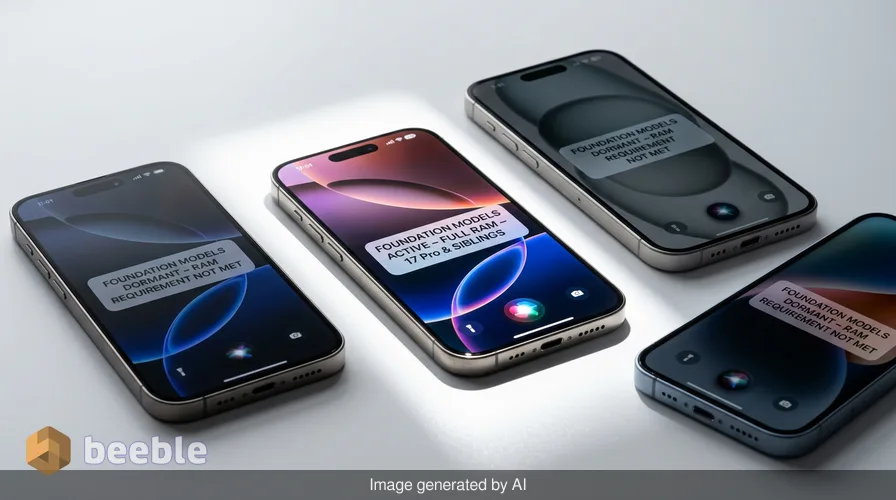
However, this functionality vanishes unless the user owns a handset with the latest Apple silicon. The system remains dormant unless the device meets the specific RAM requirements for the most powerful Foundation Models. Apple restricts the most expressive voices and accurate dictation to the iPhone 17 Pro and its siblings. Users are locked to a hardware cycle to access software that Apple originally framed as a universal evolution of the platform. This new intelligence is gated by the physical reality of the chip inside your pocket. Even if your current iPhone runs iOS 27 with speed and stability, it is technically excluded from the flagship feature of the season.
The silicon ceiling of Apple Intelligence
For years, the software industry operated on a principle of broad compatibility. A new version of iOS typically reached back five or six years, ensuring that a person with an older iPhone still felt part of the modern ecosystem. The rollout of the AI-powered Siri marks a departure from this tradition. Under the hood, the new Siri is not a simple script or a collection of voice triggers. It is a set of Apple Foundation Models that run locally on the device to ensure privacy and speed. These models are hungry for two things: neural engine cycles and volatile memory.
Apple confirms that only devices released since the iPhone 15 Pro possess the necessary architecture to run these models. This list includes the iPad and Mac models powered by M-series chips, along with the 2024 iPad mini. If you own an iPhone 15 or an iPhone 14 Pro, the Settings app will not show the Apple Intelligence & Siri section. Technically speaking, these older chips lack the specific throughput required to process large language model (LLM) tokens at a rate that feels natural to a user. A delay of even a half-second in a voice interaction breaks the illusion of intelligence. To maintain the user experience, Apple simply disables the feature on hardware that might struggle.
The memory bottleneck and the 12GB mandate
Historically, Apple has been conservative with RAM. While Android manufacturers chased 16GB or 24GB specifications, the iPhone thrived on efficient memory management. That efficiency reached a limit with the arrival of on-device generative AI. Modern AI models require a significant portion of the system memory to stay resident, meaning the data must be always ready for the processor to access it instantly.
Analyst Ming-Chi Kuo recently reported that Apple intends to increase memory in non-Pro iPhones to 9GB. Paradoxically, Apple mentions that its most powerful on-device AI models require at least 12GB of RAM. This creates a two-tier system within the same product generation. Owners of the iPhone 17 Pro, 17 Pro Max, or the iPhone Air will experience the full suite of Siri AI features. These include improved speech recognition and more accurate dictation. Users with the base model iPhone 18 may find themselves with a truncated version of the assistant if the 12GB threshold is not met. The code is no longer the equalizer it once was; the hardware now dictates the quality of the logic.
Foundation models and the privacy of the cloud
When a prompt is too complex for the local chip to handle, the system utilizes Private Cloud Compute. This is Apple's solution to the conflict between massive AI processing needs and the company's stance on user privacy. In everyday terms, your phone acts like a chef who handles the simple prep work in their own kitchen but sends the most complex dishes to a high-end, secure facility. Apple claims that this data is inaccessible to anyone but the user, including Apple. The cloud servers run on Apple silicon and use a hardened operating system that lacks a persistent storage layer.
From a developer's standpoint, this architecture is a masterpiece of technical debt avoidance. By offloading the heaviest weights to the cloud while keeping the personal context on-device, Apple avoids bloating the local storage with massive model weights. However, this also reinforces the ecosystem lock-in. The seamless handoff between the local A-series chip and the Private Cloud Compute servers relies on proprietary protocols. You cannot simply plug a different AI provider into this system. You use Apple's cloud or you lose the context-aware features that make the new Siri useful.
The fragmentation of the user experience
We are witnessing the end of the monolithic operating system update. For the first time in a decade, two people can hold the same version of iOS and have fundamentally different capabilities. One user has a phone that can summarize emails and generate images in a chat, while the other has a device that only offers a slightly prettier lock screen. This fragmentation is not a bug; it is a result of the rapid shift toward generative AI.
| iPhone Model | Siri AI Compatibility | Max Model Support (12GB RAM) |
|---|---|---|
| iPhone 15 Pro / Pro Max | Supported (Beta) | No |
| iPhone 16 Series | Supported | No |
| iPhone 17 Pro / Pro Max | Supported | Yes |
| iPhone 17 Air | Supported | Yes |
| iPhone 18 Pro | Supported | Yes |
| iPhone 18 (Base) | Supported | Uncertain (9GB vs 12GB) |
In practice, this creates digital friction for the average consumer. A person who bought an iPhone 14 just two years ago now finds their device deprecated in the eyes of the AI revolution. The software is no longer a transparent layer that serves the user. It is a carrot used to drive hardware upgrades. The "supercharged" Siri that was originally promised in previous iOS versions finally exists, but it arrived with a price tag that includes a new phone purchase.
Reclaiming the digital routine
Zooming out to the industry level, this shift represents a new era of technical gatekeeping. The complexity of these models means that the software is no longer just a recipe of instructions. It is a resource-heavy entity that demands specific, high-performance environments. While we found the Siri AI beta to be genuinely useful in our hands-on testing, we must question if the utility justifies the hardware churn. The assistant is faster and more accurate, but it also marks the moment where the iPhone became a two-tier product line.
Ultimately, the choice to upgrade depends on how much you value the removal of digital friction. If you spend your day digging through emails and struggling to find specific dates in your messages, the new Siri is a robust tool. If your relationship with your phone is more utility-based, the lack of AI might be a blessing in disguise. A phone without Apple Intelligence is a phone with fewer distractions and a longer-lasting battery. As these updates roll out this fall, look at your own software habits. Observe whether you actually need a machine to think for you, or if the "legacy" way of interacting with your device is still the most efficient path for your life.
Sources
- Apple Developer Documentation: Introducing Apple Intelligence and Private Cloud Compute (June 2026).
- Apple Newsroom: WWDC 2026 Keynote Highlights and iOS 27 Preview.
- Ming-Chi Kuo: Research Note on iPhone 18 RAM Specifications and AI Model Requirements.
- GitHub: Open-source benchmarks for local LLM execution on A-series silicon.



See you on the other side.
Our end-to-end encrypted email and cloud storage solution provides the most powerful means of secure data exchange, ensuring the safety and privacy of your data.
/ Create a free account
