


The Quiet Pivot from Prompting to Production

The Frustration of the Unreliable Assistant
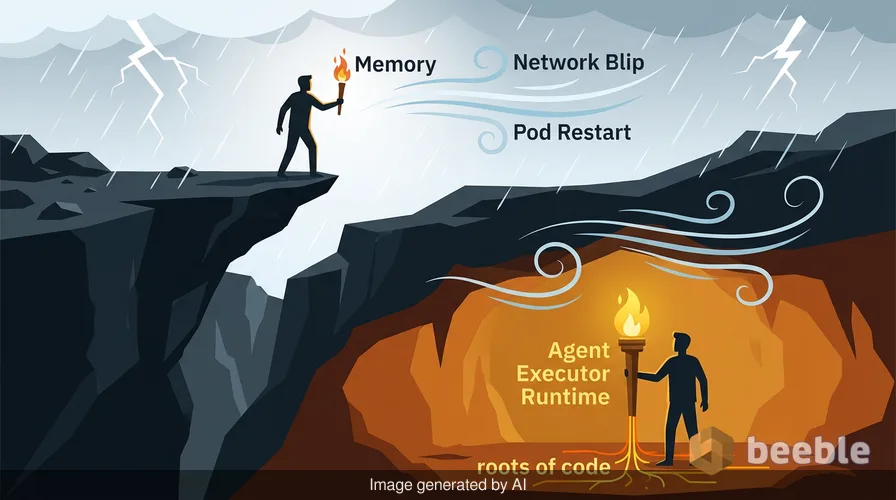
There is a specific, modern kind of irritation that occurs when you realize your digital tools have the memory of a goldfish. Imagine you are working with an AI agent to plan a complex, multi-city business trip. You have spent twenty minutes refining the itinerary, balancing budget constraints with flight durations, and just as the agent is about to finalize the booking—the little spinning wheel of death appears. A network blip occurs, or perhaps your browser refreshes, and suddenly the agent greets you with a cheerful, "Hello! How can I help you today?"
Through this user lens, the profound magic of artificial intelligence instantly evaporates, replaced by the crushing weight of digital friction. You are back at square one, staring at a blank chat box, forced to re-explain your life to a machine that, five seconds ago, was your most capable collaborator. In the early days of generative AI, we marveled at the machine's ability to write a haiku or summarize a PDF; today, we demand that it manages a three-week supply chain audit or a cross-departmental hiring workflow—the stakes have moved from novelty to necessity.
Historically, our interactions with software were transactional and immediate: you click a button, and the server responds. But the new era of agentic workflows is different. These are long-running, multifaceted tasks that might take minutes, hours, or even days to complete. When these agents fail because of a minor server hiccup or a routine pod restart in a data center, it is not just a bug; it is a breakdown of trust. This is the exact reliability gap that Google aims to bridge with its latest release, the open-source Agent Executor runtime.
The Prototype Trap and the Need for Durability
For the past eighteen months, the tech industry has been caught in a frantic prototyping phase. Developers have used frameworks like LangChain or AutoGen to build impressive demos that look seamless in a controlled environment but often prove clunky and fragile when exposed to the messy reality of enterprise operations. In a prototype, if an agent crashes, you simply hit refresh; in production, if an agent crashes halfway through a financial reconciliation process, you might end up with corrupted data or an auditing nightmare.
Technically speaking, the problem is one of state. Most current agent frameworks are stateless, meaning they don't naturally "remember" where they are if the execution environment is interrupted. Google’s Agent Executor addresses this by introducing durable execution. To put it another way, it acts as a digital black box recorder for AI agents. By utilizing event logging and snapshotting, the runtime ensures that if a system fails, the agent can resume exactly where it left off, rather than suffering from a form of digital amnesia.
This shift represents a pragmatic evolution in how we think about AI infrastructure. We are moving away from the "move fast and break things" mentality of early LLM experimentation toward a more resilient, industrial-grade approach. In practice, this means that a long-running workflow—one that might involve pausing for three days to wait for a human manager’s approval—can survive without losing its place in the sequence. It is the difference between a waiter who forgets your order the moment they walk into the kitchen and one who has a permanent, indestructible notepad.
Under the Hood: Sandboxing and Trajectory Branching
Beyond simple memory, the Agent Executor introduces several features that solve the "hidden" headaches of software development. One of the most critical is secure sandboxing. When you give an AI agent the power to execute code or interact with your company’s internal databases, you are essentially handing the keys to your house to a very smart, yet occasionally unpredictable, guest. If that guest decides to run a rogue script, the damage could be catastrophic.
By isolating agent components within a sandbox, Google provides a layer of protection that prevents a malfunctioning agent from affecting the overarching system. It is a necessary safety net for an era where agents are no longer just talking; they are doing. This is interconnected with the concept of session consistency, which ensures that even in a distributed cloud environment—where an agent’s tasks might be handled by different servers at different times—the experience remains unified and the data stays accurate.
Curiously, the most intriguing feature for developers might be "trajectory branching." I remember testing beta software years ago where the only way to test a different outcome was to wipe the entire database and start over. Trajectory branching allows a developer to save a checkpoint in an agent’s workflow and then test multiple "what if" scenarios from that exact point. It is like a video game save state for enterprise logic. Consequently, teams can optimize agent behavior and troubleshoot failures without the soul-crushing labor of re-running twenty-hour workflows from scratch.
Zooming Out to the Industry Level: The Kubernetes Playbook
If this strategy feels familiar, that is because we have seen it before. A decade ago, Google released Kubernetes to the world, transforming the way we manage containers and essentially becoming the de facto operating system for the modern cloud. By open-sourcing Agent Executor, Google is making a similar move. They are providing the engine for free, knowing that as enterprises adopt this runtime, they will naturally look to Google Cloud for the fuel: the Gemini models, the specialized AI chips, and the managed services that make scaling easier.
Paradoxically, the move toward open source in the agent space is not just about altruism; it is about survival. As Microsoft pushes its AutoGen framework and AWS promotes Bedrock AgentCore, the battle for the infrastructure layer of AI has become a war of ecosystems. Enterprises are rightfully wary of proprietary lock-in. They don’t want their most sensitive business logic trapped inside a single provider's black box. By offering an open-source runtime, Google is signaling that it prioritizes interoperability and transparency—a strategy designed to win the trust of CIOs who are tired of bloated, restrictive legacy contracts.
The Lingering Shadow of Governance
However, we must be careful not to mistake a better engine for a better driver. While Agent Executor solves the technical hurdles of reliability and state management, it does not solve the human hurdles of accountability. As AI agents become more autonomous, the question of who is responsible for their "decisions" becomes increasingly opaque. If an agent optimizes a supply chain but inadvertently violates an environmental regulation in the process, a durable runtime will tell you exactly how it happened, but it won’t tell you who to blame.
At its core, the challenge for modern leadership is to build layers of oversight that sit on top of this robust infrastructure. We are entering a phase where the "messy closet" of technical debt is being cleaned up, but the house rules—the policies, the ethical guardrails, and the legal frameworks—are still being written. A resilient runtime can recover from a network blip, but it cannot recover from a failure of corporate ethics or a lack of human-in-the-loop common sense.
Reclaiming Control in an Agentic World
Ultimately, the arrival of tools like Agent Executor signals that we are leaving the era of AI-as-a-toy and entering the era of AI-as-infrastructure. For the average user, this means the software we interact with daily will become more capable, less prone to annoying "resets," and better at handling the long, complex tasks of our professional lives. The invisible pipes of our digital city are being reinforced.
Yet, as these agents become more ubiquitous and streamlined, we should remain hyper-observant of how much agency we are offloading. It is tempting to let a perfectly reliable, durable agent handle everything from our emails to our investment portfolios. But as any software developer who has dealt with a crashing app knows, even the most robust system requires an architect who understands how it works under the hood.
We should welcome the reliability that Google’s new runtime promises, but we should also use this moment of technological stabilization to reflect on our own digital habits. Are we using these agents to augment our capabilities, or are we using them to outsource our judgment? As the code that runs our world becomes more resilient, the humans who guide that code must become more intentional. The engine is now ready; it’s up to us to decide where we’re driving.
Sources:
- Google Cloud Blog: "Introducing Agent Executor: An open-source runtime for AI agents."
- Avasant Research: "Enterprise AI Governance and the Hyperscaler Infrastructure War 2026."
- Open Source Initiative (OSI): "Definitions and Standards for AI Agent Interoperability."
- Broadcom SRE Reports: "Common Failure Modes in Long-Running LLM Workflows."
- GitHub Repository: GoogleCloudPlatform/agent-executor-runtime-docs.



See you on the other side.
Our end-to-end encrypted email and cloud storage solution provides the most powerful means of secure data exchange, ensuring the safety and privacy of your data.
/ Create a free account
