


The Quiet Return of the Unbundled App

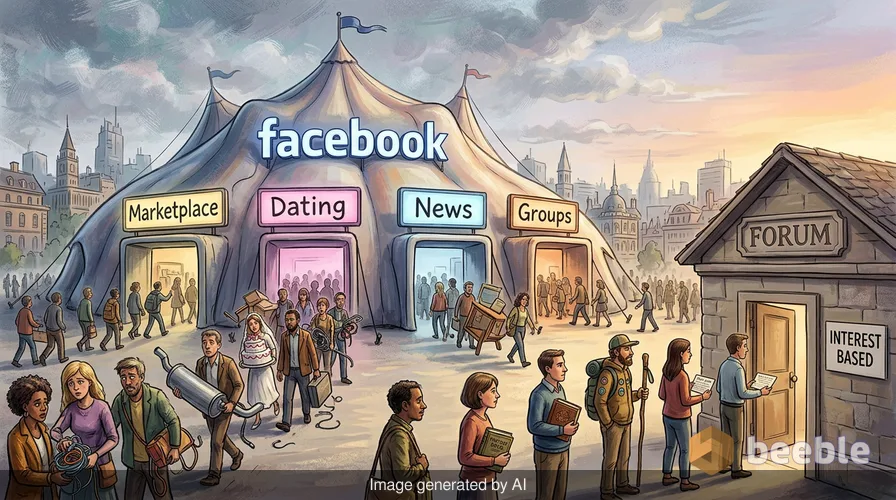
In the early days of the mobile web, our screens were a mosaic of specialized icons—one for your weather, one for your fitness tracker, and one for every niche corner of the internet you frequented. Then came the era of the 'Super App,' a period where tech giants sought to consolidate every human interaction into a single, massive piece of software. We watched as Facebook bloated into a digital Swiss Army knife, attempting to house your marketplace, your dating life, your news, and your high school reunions under one roof. Paradoxically, as the main Facebook app grew more all-encompassing, the specific experiences within it began to feel increasingly diluted and fragmented.
Meta’s quiet release of Forum, a dedicated application for Facebook Groups, marks a fascinating reversal of this trend. It is a tacit admission that the 'everything' feed has become too noisy for the 'something' specific. By stripping away the algorithmic clutter of the main feed—the random political rants from distant cousins and the sponsored posts for products you already bought—Forum attempts to reclaim the utility of the interest-based internet. It is a move that mirrors the industry’s broader pivot away from the 'Social Graph' (who you know) and toward the 'Interest Graph' (what you care about), a space currently dominated by Reddit.
The Ghost of 2017: A Legacy Reimagined
Historically, Meta—then simply Facebook—has been here before. In 2014, the company launched a standalone Groups app, only to deprecate it in 2017 when the corporate strategy shifted toward centralizing the user experience. Back then, the logic was simple: keep users within the primary ecosystem to maximize ad impressions and data collection. Under the hood, however, this centralization created a massive amount of technical debt. Integrating thousands of diverse group functionalities into a single feed meant that the UI became increasingly clunky, with important notifications getting lost in the shuffle of a billion-person town square.
Zooming out to the industry level, we see that the digital landscape of 2026 is vastly different from 2017. Users are no longer looking for a monolithic social experience; they are looking for answers. When a pipe bursts in the middle of the night or a specific software bug halts a developer’s workflow, people no longer turn to a general feed—they search 'how to fix [issue] reddit.' Meta has noticed this shift in user behavior and is attempting to position Forum as a robust alternative. Forum isn't just a UI skin; it is a strategic attempt to re-capture the 'high-intent' user who wants information, not just entertainment.
Anonymity and the Trust Paradox
In everyday terms, one of the primary reasons Reddit remains the gold standard for advice is its culture of pseudo-anonymity. You can ask for medical advice or career help without your boss or your grandmother seeing the query. Meta is attempting a delicate balancing act here. Users in Forum can adopt anonymized usernames, yet they must log in with their Facebook credentials. Technically speaking, this creates a 'controlled anonymity' where your identity is shielded from the public but transparent to group administrators and, of course, Meta’s data engines.
Through this user lens, we see a friction-filled compromise. On one hand, it prevents the 'wild west' toxicity often associated with truly anonymous boards; on the other, it maintains the ecosystem lock-in that defines Meta’s business model. You get the privacy of a pseudonym, but you don't get the freedom from your digital footprint. It is an attempt to manufacture the feeling of a niche community while keeping the city’s infrastructure—the Facebook account—firmly in place. This approach addresses a profound tension in modern UX design: the desire for privacy versus the need for accountability.
The 'Ask' Feature: AI as a Librarian
One of the most significant differences between the defunct 2017 Groups app and Forum is the integration of generative AI. The 'Ask' feature is essentially a sophisticated retrieval-augmented generation (RAG) tool. Instead of manually scrolling through years of legacy posts in a 'DIY Home Repair' group, a user can simply ask a question. Behind the screen, the AI crawls the vast repository of human knowledge stored within those groups to synthesize a coherent answer.
Think of this AI as a restaurant waiter. In the traditional Facebook app, you have to walk into the kitchen yourself, find the ingredients, and cook the meal (the answer). With Forum’s 'Ask' feature, you tell the waiter what you want, and they fetch the specific data from the kitchen of user-generated content. Consequently, this changes the nature of the content itself. Every post in a Facebook Group is no longer just a conversation; it becomes training data—a recipe in a massive cookbook that Meta’s AI uses to serve other users. While this is incredibly streamlined for the person seeking help, it raises questions about the labor of the community members who provided the 'real answers' in the first place.
The Infrastructure of Community
From a developer's standpoint, building Forum as a standalone app allows Meta to iterate much faster than it could within the 'bloated' main Facebook codebase. The main app is like a city's aging infrastructure—changing a single pipe requires tearing up the whole street. Forum, in contrast, is an agile extension. It can test new UI layouts, dedicated moderation tools, and AI integrations without the risk of breaking the core platform that billions of users rely on for their daily routines.
| Feature | Facebook App (Groups) | Meta Forum App |
|---|---|---|
| Focus | Multi-purpose / Social | Task-oriented / Community |
| Feed Priority | Algorithmic / Ads | Chronological / Topic-based |
| Identity | Real Name (mostly) | Anonymized Pseudonyms |
| Search/Utility | Keyword Search | 'Ask' AI Synthesis |
| User Intent | Passive Consumption | Active Participation |
In practice, this 'unbundling' reflects a broader industry recognition that one size no longer fits all. As our digital lives become more multifaceted, we need tools that respect the different 'modes' we operate in. When I am looking for a professional recommendation, I don't want to see a video of a dancing cat. Forum is a pragmatic acknowledgment that specialized tasks require specialized tools.
Reclaiming the Digital Tool
Ultimately, the release of Forum highlights a shift in how we are expected to interact with social software. For years, we were the product—our attention was the currency that tech giants traded. With Forum, Meta is trying to make us the 'user' again, offering a tool that provides genuine utility. However, this utility comes at the price of deeper integration into the Meta ecosystem. You cannot have the 'real answers' of Forum without the 'real identity' of Facebook.
As we navigate these changes, it is worth observing our own digital friction. Do we find ourselves reaching for Forum because it actually solves a problem, or because the main app has become a messy closet we no longer want to clean? Behind every 'seamless' transition between apps is a series of business decisions designed to keep us within a proprietary walled garden.
The lesson for the modern user is not to avoid these tools, but to understand the blueprint they are built upon. By recognizing that Forum is an attempt to turn our collective conversations into an AI-powered knowledge base, we can be more intentional about what we share and where we spend our attention. Tech updates are like home renovations—they are often necessary to keep the structure functional, but it is always the homeowner, not the architect, who has to live in the results. In the end, the most robust community isn't the one with the best app; it's the one where the technology remains invisible, and the human connection remains the priority.
Sources:
- Meta Newsroom: Developmental testing and public beta cycles for new community tools (May 2026).
- App Store Documentation: Forum—'A dedicated space for conversations' version history and metadata.
- Developer API Reference: Facebook Graph API v19.2 (documentation on Group endpoints and pseudo-anonymity flags).
- Geekout Newsletter: Industry analysis of unbundled app strategies by Matt Navarra.
- Software Engineering Daily: Retrospective on the 2017 deprecation of standalone mobile utility apps.



See you on the other side.
Our end-to-end encrypted email and cloud storage solution provides the most powerful means of secure data exchange, ensuring the safety and privacy of your data.
/ Create a free account
