


The quiet transition to a programmable ruble and the end of financial anonymity

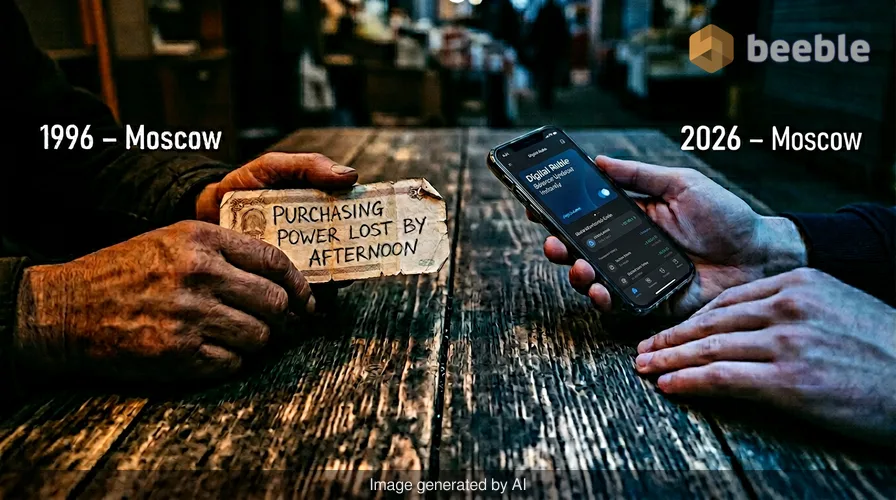
Thirty years ago, the sight of a physical banknote brought a sense of tangible security to the average Russian household; today, that security is migrating into a line of state-monitored code. In 1996, a citizen in Moscow waited in long queues for paper currency that lost its purchasing power by the afternoon; in 2026, that same citizen has a digital wallet that updates instantly. This shift is a fundamental redesign of how a nation tracks, moves, and controls its wealth. On a macro level, the Bank of Russia is pushing the digital ruble into the hands of the public by September 1, 2026. This date is the result of years of legislative preparation and technical testing. Governor Elvira Nabiullina has stated that systemically important banks and large retailers are prepared for this widespread launch.
While the technology is ready, the public remains hesitant. Paradoxically, the very people the government hopes will use this currency are the ones who understand it the least. This creates a gap between state ambition and consumer reality. To understand why this matters for your own wallet, we must look at how the nature of money has changed from a private tool of trade to a programmable instrument of policy.
The three forms of money in a modern wallet
For decades, we lived with two forms of money: cash and non-cash. Cash is the physical bill in your pocket. It is private, anonymous, and exists outside the digital grid. Non-cash is the balance in your bank account. It is convenient, but it depends on a private bank to manage the records. The digital ruble is the third form of money. It is a central bank digital currency, or CBDC.
Unlike the money in a standard checking account, the digital ruble is a direct liability of the central bank. If a commercial bank fails, your digital rubles remain safe because they live on the central bank’s infrastructure. In everyday terms, this is the difference between keeping your car in a neighbor’s garage and keeping it in a high-security government facility. The neighbor might lose the keys or go bankrupt; the government facility is the ultimate authority.
Technologically, the digital ruble functions like a glass bank vault. The central bank can see every transaction inside the vault, but only the owner has the key to spend the funds. This transparency is the core of the state's interest. It allows the government to track exactly where every ruble goes, from the treasury to the grocery store.
Why retailers and banks are lining up
Major Russian banks and retailers face a strict deadline of September 1 to accept this new currency. This is not a voluntary upgrade for the financial sector. The law passed in 2023 mandated that these institutions build the necessary bridges for digital ruble payments. For a retailer, the incentive is cost. The central bank plans to charge a small commission of 0.67 rubles—less than a single US cent—for completed payments.
Historically, credit card companies and private banks have charged much higher fees for processing transactions. These fees are often hidden from the consumer but are baked into the price of a loaf of bread or a gallon of milk. By lowering these transaction costs, the central bank is attempting to make the digital ruble more attractive to businesses.
Zooming out, this move is a structural shift toward a more efficient, state-controlled payment system. It bypasses traditional payment rails that might be vulnerable to international sanctions or private sector disruptions. For the business owner, it is a matter of lower overhead; for the central bank, it is a matter of systemic resilience.
The comparison of payment methods
| Feature | Physical Cash | Electronic Bank Deposit | Digital Ruble (CBDC) |
|---|---|---|---|
| Issuer | Central Bank | Commercial Bank | Central Bank |
| Privacy | High (Anonymous) | Medium (Bank-monitored) | Low (State-monitored) |
| Speed | Instant (Face-to-face) | Fast (Seconds/Minutes) | Instant |
| Fees | None | Variable (1-3%) | Very Low (Fixed) |
| Programmability | None | Limited | High (Smart Contracts) |
The missing ingredient of public trust
Despite the technical readiness, an independent report from The Moscow Times indicates that public interest is low. A survey by a state pollster found that many citizens do not see the point of a third form of money. They already have cards and phone apps that work. They have cash for privacy. The digital ruble feels like a solution in search of a problem.
Through this economic lens, we see a classic example of behavioral economics at play. People are loss-averse and habit-driven. If a payment system is not broken, they are unlikely to switch unless there is a clear, tangible benefit. The central bank offers low fees for merchants, but it has not yet provided a compelling reason for the average shopper to change their habits.
Furthermore, there is the psychological impact of financial surveillance. In the US, the debate over a digital dollar is highly contentious. Lawmakers have introduced bills to ban CBDCs, citing concerns about government overreach. While the Russian political environment is different, the underlying human desire for financial privacy remains the same. When people use cash, they are ghosts in the machine; when they use a CBDC, they are data points on a government dashboard.
Smart contracts and the future of business
The most profound change the digital ruble brings is not the payment itself, but the code attached to it. The Bank of Russia is considering the use of smart contracts for businesses. A smart contract is an agreement written in code that executes automatically when certain conditions are met.
In practice, this could change how companies do business. Imagine a construction company that only receives payment once a satellite confirms a roof is finished. Or a landlord who receives rent automatically the moment a tenant’s paycheck hits their wallet. There is no need for an escrow agent or a middleman to verify the transaction. The code is the escrow.
This programmability is what makes the digital ruble different from a digital version of a paper bill. It is “smart” money. It can be restricted to spend only on certain items, such as social benefits that can only be used for medicine or food. This level of control is a double-edged sword. It reduces fraud and ensures funds reach their target, but it also limits the freedom of the person holding the money.
The global context and the US perspective
While Russia moves toward a September launch, the United States is moving in the opposite direction. Earlier this year, the U.S. Senate advanced a bill to implement a ban on a domestic CBDC. The American political landscape views the digital dollar with skepticism. Critics argue it enables deep financial surveillance and threatens the traditional banking system.
Donald Trump recently refused to sign a bill that included a temporary ban on a U.S. CBDC, though his reasons were tied to broader political demands rather than a change in heart about digital currency. The contrast between these two nations is stark. Russia sees the digital ruble as a tool for national sovereignty and economic bypass—the U.S. sees the digital dollar as a potential threat to individual liberty.
Essentially, the world is splitting into different digital currency blocks. Some nations will embrace the efficiency and control of CBDCs, while others will cling to the privacy of older systems or the decentralization of private cryptocurrencies like Bitcoin.
Reclaiming financial mindfulness
Ultimately, the rollout of the digital ruble is more than a technical update to a banking app. It is a moment for every individual to reflect on what they value in their money. Is it the speed of the transaction? Is it the safety of a central bank guarantee? Or is it the anonymity of a physical bill that no one can track?
As we move toward September, the digital ruble will become a ubiquitous part of the Russian economy. Whether it succeeds depends on its ability to offer something more than just another way to pay. It must prove its utility to a skeptical public that is already comfortable with the status quo. On an individual level, the best way to navigate these changes is to stay informed about where your money lives and who has the power to see it.
Money has always been a collective belief system. We trust that a piece of paper or a digital number has value because everyone else agrees it does. As that belief system moves from the physical world to the digital one, the rules of the game are changing. Understanding those rules is the first step in maintaining control over your economic future. The digital ruble is not just a new currency; it is a new way for the state to interact with the citizen. The Bank of Russia has no plans to phase out physical cash immediately.
Sources
- Bank of Russia Financial Conference Briefing (July 2026)
- State Duma Legislation on Digital Ruble Participation (July 2023)
- The Moscow Times Public Interest Report and State Pollster Data
- U.S. Senate Banking Committee Legislative Updates (2026)
- Official Statements from Governor Elvira Nabiullina



See you on the other side.
Our end-to-end encrypted email and cloud storage solution provides the most powerful means of secure data exchange, ensuring the safety and privacy of your data.
/ Create a free account
