


The Race for Nuclear Power on the Moon is Finally Getting Real

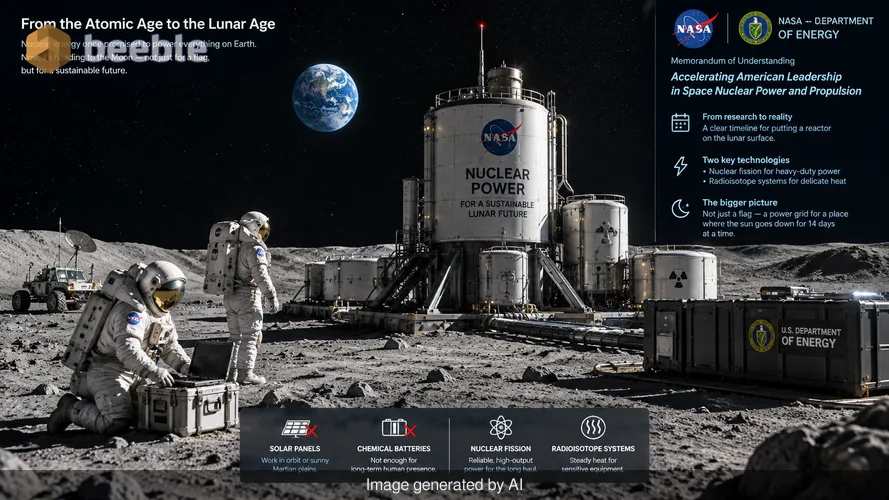
In the middle of the 20th century, the world viewed nuclear energy as the ultimate answer to every power problem, from home appliances to city-wide grids. While the atomic vacuum cleaners of science fiction never arrived, the dream of nuclear-powered exploration stayed alive in the background of laboratory research. Today, that research is moving toward the launch pad. The recent agreement between NASA and the U.S. Department of Energy (DOE) marks a shift from experimental physics to industrial infrastructure. By signing the memorandum titled Accelerating American Leadership in Space Nuclear Power and Propulsion, NASA Administrator Jared Isaacman and Energy Secretary Chris Wright have committed to a specific timeline for putting a reactor on the lunar surface.
Historically, space agencies relied on solar panels and chemical batteries to keep their machines running. This works well for satellites in orbit or rovers in sunny Martian plains, but it fails to meet the needs of a permanent human presence. The new deal focuses on two primary technologies: nuclear fission for heavy-duty power and radioisotope systems for delicate heat. Looking at the big picture, this is not just about planting a flag. It is about building a power grid in a place where the sun goes down for 14 days at a time.
Why solar power fails on the lunar surface
For the average user, solar power seems like a limitless resource. On Earth, we have an atmosphere that diffuses light and a relatively short night cycle. The Moon is different. A single lunar night lasts about 354 hours. If an astronaut depends on solar panels, they must also bring massive, heavy batteries to store two weeks' worth of electricity. This adds significant weight to a rocket, and in space flight, weight is the primary driver of cost.
Beyond the darkness, there are permanently shadowed regions near the lunar poles. These areas contain water ice, which is the most valuable resource for future fuel production. Solar panels are useless in these dark craters. Nuclear fission reactors solve this by providing a steady, predictable flow of electricity regardless of the time of day or location. Essentially, a reactor is a high-output furnace that does not need oxygen or sunlight to run. It allows a lunar base to operate with the same reliability as a small town on Earth.
The roadmap for Space Reactor-1 Freedom
Under the hood of this new agreement is a specific project known as Space Reactor-1 Freedom (SR-1). Scheduled for a 2028 launch, SR-1 is the first major step in moving nuclear propulsion from theory to flight. This mission serves as a testbed for the technologies that will eventually push humans toward Mars. Chemical rockets are excellent for getting off the ground, but they are inefficient for long-haul travel through the solar system. Nuclear thermal propulsion could cut travel times to Mars by half, which reduces the radiation exposure for the crew.
Following the SR-1 mission, the agencies plan to deploy Lunar Reactor-1 (LR-1). This is a fission surface power system designed to provide 40 kilowatts of electricity—enough to power several households or a sophisticated scientific outpost. The 2030 goal for a launch-ready reactor is aggressive, but it aligns with the broader push to establish a domestic nuclear-space industrial base. By standardizing these designs now, the government is creating a template that private companies can eventually use to build their own lunar hardware.
How fission differs from radioisotope power
It is helpful to distinguish between the two types of nuclear tech mentioned in the NASA-DOE deal. Fission is the process used in power plants on Earth. It involves splitting atoms to create a massive amount of heat, which is then converted into electricity. This is what will power habitats and rovers. The other technology, radioisotope power, is more like a very long-lived, warm battery.
NASA has used Multi-Mission Radioisotope Thermoelectric Generators (MMRTGs) for decades on missions like Voyager and Curiosity. These systems use the natural decay of plutonium-238 to generate a small amount of steady electricity and heat. The upcoming Dragonfly mission to Saturn’s moon, Titan, will use this technology to stay warm in a world where temperatures sit at -290 degrees Fahrenheit. While fission provides the muscle for heavy industry, radioisotope units provide the warmth that keeps delicate electronics from freezing in the deep cold of space.
Strengthening the domestic nuclear supply chain
The stock market often views space as a speculative playground, but the DOE’s involvement indicates a focus on heavy industry as the invisible backbone of modern life. Producing the specific types of fuel required for these reactors requires specialized facilities that have not existed at scale for years. The new agreement coordinates fuel production and testing between the two agencies to ensure the supply chain is resilient.
Practically speaking, this means the U.S. is reinvesting in High-Assay Low-Enriched Uranium (HALEU) production. This fuel is necessary for both space reactors and the next generation of small modular reactors (SMRs) being developed for use on Earth. As a result, the work done for the Moon will likely lower the technical hurdles for clean energy projects in remote terrestrial locations. The investment in space nuclear tech acts as a catalyst for terrestrial industrial modernization.
Safety standards in the new atomic era
Public perception of nuclear technology is often shaped by historical accidents, but the safety requirements for space-based reactors are unique. These systems are designed to remain dormant and non-radioactive during the launch phase. The reactor only activates once it has reached a safe orbit or the lunar surface. This ensures that even in the event of a launch failure, there is no risk of nuclear contamination.
NASA and the DOE are coordinating on launch integration and testing to meet rigorous standards. The goal is to create a streamlined approval process for nuclear launches while maintaining a transparent safety record. Because these reactors operate in a vacuum, they use different cooling methods than Earth-based plants. They often use liquid metals or gas to move heat—a design choice that makes them simpler and less prone to the pressure-related issues found in water-cooled systems.
What this means for the everyday consumer
At first glance, a nuclear reactor on the Moon seems distant from daily life. However, the history of space exploration shows that infrastructure breakthroughs eventually trickle down to the consumer level. The development of compact, reliable fission reactors will likely accelerate the deployment of small modular reactors here on Earth. These could eventually power data centers, remote mining operations, or even small towns with zero-carbon energy.
On the market side, this deal signals a long-term commitment to the space economy. As the cost of power on the Moon drops, the cost of scientific data and potential resource extraction also drops. Zooming out, we are seeing the transition of space from a place we visit to a place we work. The bottom line is that energy is the primary constraint on human activity. By solving the energy problem on the Moon, NASA and the DOE are removing the biggest hurdle to a multi-planetary economy.
Ultimately, the shift toward a "Nuclear NASA" era is a pragmatic response to the limits of solar power and chemical fuel. Instead of waiting for a breakthrough in battery chemistry that might never come, the agencies are using the most energy-dense fuel known to science. This move ensures that when humans return to the Moon, they will have the power to stay.
Sources:
- NASA Press Release: NASA and DOE Sign Memorandum of Understanding on Space Nuclear Power
- Department of Energy: Office of Nuclear Energy Progress Report
- NASA Space Reactor-1 Freedom Mission Overview
- Science: A Golden Age Summit Proceedings
- Dragonfly Mission Fact Sheet



See you on the other side.
Our end-to-end encrypted email and cloud storage solution provides the most powerful means of secure data exchange, ensuring the safety and privacy of your data.
/ Create a free account