


The Race to Free Intelligence Just Hit a Breaking Point

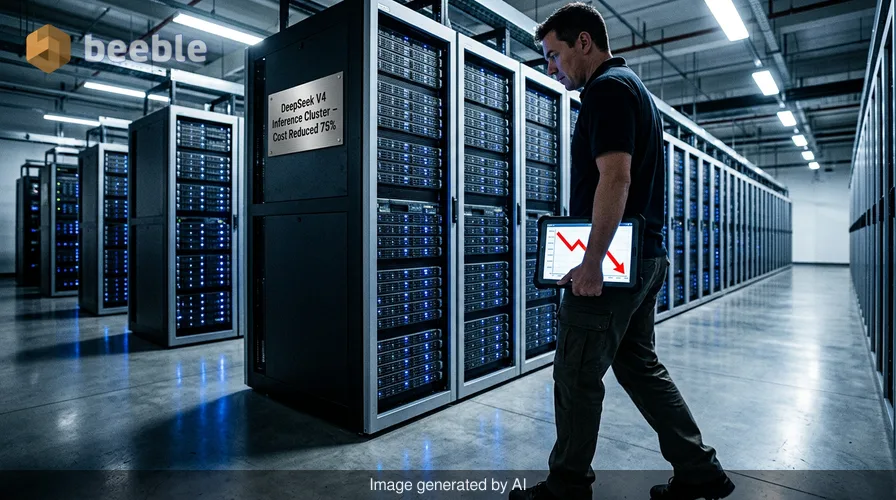
Have you ever wondered why that helpful AI chatbot in your pocket is usually free, while the 'pro' version costs as much as a monthly streaming subscription? Behind the sleek user interfaces and the glowing text boxes lies a massive, invisible marketplace where digital intelligence is bought and sold like oil or electricity. For the last few years, the price of this digital brainpower has been the primary barrier preventing AI from truly being everywhere. But that barrier just took a massive hit.
DeepSeek, a prominent Chinese AI startup, recently made waves by announcing a permanent 75 percent price reduction for its flagship V4 models. What was originally framed as a limited-time promotion has now become the new reality. Looking at the big picture, this isn't just a corporate discount; it’s a shot across the bow of every major tech giant from Silicon Valley to Beijing. It signals a fundamental shift in how we value the silicon-based minds that are increasingly managing our schedules, writing our code, and summarizing our emails.
The Math of a Digital Brain
To understand why a 75 percent discount is disruptive, we have to look under the hood at how AI companies charge for their services. In the industry, they don't sell by the hour or by the user; they sell by the 'token.' In simple terms, think of a token as a small fragment of a word. A thousand tokens is roughly equivalent to 750 words—about the length of a standard news article.
Before this price drop, DeepSeek’s top-tier model, the V4 Pro, cost between $0.0145 and $3.48 for every million tokens processed. While those numbers already look small to the average user, they add up rapidly for a company running millions of customer queries every hour. Now, those prices have plummeted to a range of $0.003625 to $0.87.
| Model Tier | Previous Price (per 1M tokens) | New Permanent Price (per 1M tokens) | Percent Reduction |
|---|---|---|---|
| DeepSeek V4 Pro (Entry) | $0.0145 | $0.003625 | 75% |
| DeepSeek V4 Pro (High-End) | $3.48 | $0.87 | 75% |
For a developer building an app, this is the difference between a project being a financial black hole and being a scalable business. To put it another way, if you viewed AI as a tireless intern, DeepSeek just announced that the intern is now willing to work a 40-hour week for the price of a single lunch.
Why This Matters for Your Daily Life
You might be thinking, "I don't buy tokens, so how does this affect me?" From a consumer standpoint, the impact is secondary but massive. Most of the apps we use—from travel booking sites to photo editors—are increasingly integrating AI. When the cost of that AI drops by three-quarters, two things typically happen: either the apps become cheaper for us, or they become significantly more capable.
Consider the "context length" mentioned in DeepSeek’s announcement. Their V4 models support a 1-million-token context length. In everyday life, this means the AI can "remember" and analyze the equivalent of several thick novels at once. Previously, asking an AI to analyze a 500-page legal contract or a massive software codebase was a luxury reserved for those with deep pockets. With these new prices, that level of deep analysis becomes a routine, low-cost feature that can be built into standard productivity tools.
Essentially, we are moving away from AI being a "special guest" in our software and toward it being the foundational plumbing. Just as we don't think about the cost of the electricity that powers our lightbulbs, we are approaching a world where the cost of generating a sophisticated response is so negligible that we stop weighing whether it's "worth it" to ask the machine for help.
The Geopolitics of the Price War
On the market side, this move is a clear attempt to undercut established heavyweights like OpenAI and Google. While OpenAI’s GPT-5 and Google’s Gemini 3.5 Flash offer incredible reasoning capabilities, they also come with a "Big Tech tax." DeepSeek is positioning itself as the robust, affordable alternative for companies that care more about the bottom line than brand prestige.
However, this aggressive pricing has sparked friction. Industry competitors, most notably Anthropic, have previously hinted at skepticism regarding DeepSeek's methods. There have been accusations of "distillation attacks"—a technical way of saying one company uses the output of a superior AI to train their own cheaper model, effectively "stealing" the expensive reasoning capabilities developed by others. Whether these claims are true or simply a result of competitive anxiety, the result for the user remains the same: high-quality intelligence is becoming a commodity.
This pricing strategy is also a resilient response to global trade tensions. By making their flagship model the most cost-effective choice globally, DeepSeek is attempting to cement its position in the international market, ensuring that developers from Mumbai to Munich choose Chinese infrastructure because it simply makes the most financial sense.
The Potential Downsides of Cheap Intelligence
Historically, when the price of a resource drops precipitously, consumption skyrockets. This is often called Jevons Paradox. If AI becomes nearly free, we might find ourselves drowning in AI-generated content. If it costs almost nothing to generate a million words of marketing copy or thousands of automated emails, our digital environments could become more cluttered and opaque.
There is also the question of sustainability. Building and running these models requires a staggering amount of energy and specialized hardware. When a company slashes prices by 75 percent, one has to wonder if they are actually making a profit or if they are simply burning through venture capital to capture market share. For the average user, this means the current "Golden Age" of cheap AI might be volatile. If the business model proves unsustainable, we could see prices swing back up or services suddenly disappear.
What This Means for You: The Practical Takeaway
Ultimately, the DeepSeek price cut is a signal that the AI industry is maturing. The initial "wow factor" of what AI can do is being replaced by the practical reality of what it costs to do it.
If you are a student, a freelancer, or a small business owner, here is how you should view this shift:
- Expect More for Less: In the coming months, look for the tools you already use—Word, Notion, or even your email provider—to roll out more advanced AI features without necessarily hiking their subscription prices. The cost of providing those features just fell through the floor.
- Evaluate Your Subscriptions: If you are paying for multiple high-end AI services, it may be time to look at third-party platforms that utilize these cheaper models. You might find you can get the same results for a fraction of the cost.
- Watch the Context: The "1-million-token context" is the real game-changer here. If your workflow involves massive amounts of data—like researching history, analyzing market trends, or managing large projects—the barrier to using AI as a high-level assistant has effectively vanished.
Looking forward, we should stop viewing AI as a futuristic miracle and start seeing it as a streamlined utility. The 75 percent discount from DeepSeek is a reminder that in the world of technology, the most disruptive innovation isn't always a new feature; sometimes, it’s just a more affordable bill. As the cost of digital thought continues to plummet, the real value will no longer be in who has the smartest AI, but in who knows how to use it most effectively.
Sources:
- DeepSeek Official Pricing and Documentation (May 2026)
- Engadget: DeepSeek Permanently Reduces Price of Flagship V4 Model
- Market Analysis: Global AI Tokenization Trends 2026
- Anthropic Industry Briefing: Large Language Model Distillation and Security



See you on the other side.
Our end-to-end encrypted email and cloud storage solution provides the most powerful means of secure data exchange, ensuring the safety and privacy of your data.
/ Create a free account
