


The Race to Save the Internet: Why Cloudflare and Google Are Bracing for 'Q-Day' by 2029

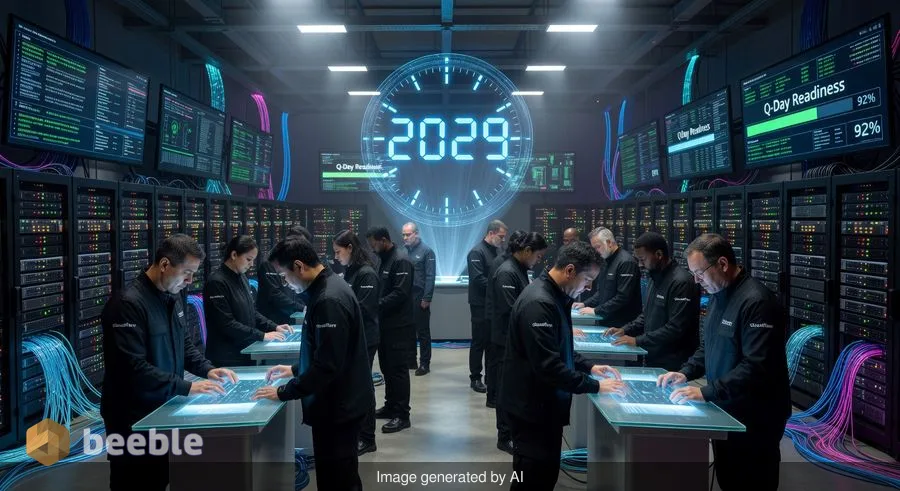
The Invisible Wall Protecting Your Digital Life
Ever wonder why you can trust your banking app or your private messages to stay private, even though they travel across thousands of miles of public cables and satellites? For decades, the internet has relied on a specific type of mathematical lock called encryption. It is the foundational layer of our digital world, acting like a high-tech envelope that only the intended recipient can open.
However, a new kind of computer is being built in labs around the world that doesn't just pick these locks—it vaporizes them. This is the threat of the quantum computer. While we once thought this was a problem for the 2040s, industry leaders like Cloudflare and Google just hit the panic button, moving their deadlines for a total security overhaul up to 2029.
What Exactly Is 'Q-Day'?
In simple terms, Q-Day is the hypothetical moment when a quantum computer becomes powerful enough to break the encryption that currently protects almost everything online. Looking at the big picture, this isn't just about hackers reading your emails; it’s about the systemic security of global power grids, healthcare records, and the entire financial system.
Until recently, the consensus was that we had plenty of time. But last week, the timeline shifted. Google announced a massive improvement in an algorithm designed to break the specific math (elliptic curve cryptography) used by most modern websites. Simultaneously, a company called Oratomic released research suggesting that a "neutral atom" quantum computer could crack standard security with just 10,000 qubits—a number far lower than previous estimates that reached into the millions.
The 'Harvest Now, Decrypt Later' Problem
One of the most unsettling aspects of this shift is a strategy known as "harvest now, decrypt later." Essentially, bad actors or state agencies can record encrypted data today, even if they can't read it yet. They are simply waiting for the day a quantum computer is powerful enough to unlock it.
Cloudflare has been fighting this by rolling out post-quantum encryption (PQE) for several years. In fact, over 65% of the human traffic passing through their network is already protected against this "harvesting" threat. But encryption is only half the battle. The other half—and the reason for the new 2029 deadline—is authentication.
Why Authentication Is the New Front Line
To understand the difference, think of encryption as the locked envelope and authentication as the ID card that proves you are who you say you are. If a hacker can spoof your ID using a quantum computer, they don't need to break the envelope; they can just ask the server to hand over the keys.
Google and Cloudflare are now prioritizing "quantum-secure authentication" because they suspect that by 2029 or 2030, a "moonshot attack" could allow a quantum computer to impersonate a major bank or a government agency. If that happens, the trust that holds the internet together would dissolve instantly.
The Shift to Neutral Atoms
Behind the jargon of qubits and algorithms lies a major shift in heavy industry. For years, the tech world focused on "superconducting" quantum computers, which require temperatures colder than deep space to operate. However, the recent breakthroughs involve "neutral atom" computers.
These machines use lasers to trap and manipulate individual atoms. They are proving to be more scalable and resilient than older designs. This is why Google is now diversifying its research and why Cloudflare is rushing to update its internal systems. It’s a classic case of a disruptive technology moving from the lab to a tangible threat much faster than the experts predicted.
How This Affects the Average User
From a consumer standpoint, you won't see a "Quantum Update" button on your phone. Most of this work happens under the hood. However, this shift will influence everything from the hardware in your next laptop to the way your bank handles your login.
| Feature | Current Security (Pre-Quantum) | Future Security (Post-Quantum) |
|---|---|---|
| Math Basis | Factoring large numbers / Elliptic curves | Lattice-based mathematics |
| Vulnerability | High (to future quantum computers) | Low (designed to resist quantum logic) |
| Data Privacy | At risk of "Harvest Now, Decrypt Later" | Protected against future decryption |
| Speed | Very fast | Slightly slower (requires more data) |
The Bottom Line
Ultimately, the internet is undergoing its most significant infrastructure upgrade since its inception. We are moving from a world where our digital locks were based on math that was "hard for a normal computer" to math that is "hard for any computer, even a quantum one."
Cloudflare’s decision to target 2029 for full post-quantum readiness is a sobering reminder that the future arrives faster than we expect. While you don't need to change your passwords today, you should be aware that the invisible backbone of modern life is being reinforced.
Practically speaking, the best thing a regular user can do is keep their software updated. As companies like Apple, Google, and Microsoft roll out these new security standards, they will be delivered through those routine system updates. In the digital age, staying safe doesn't require a PhD in physics—it just requires staying current.
Sources
- Cloudflare Official Blog: Post-Quantum Roadmap 2029
- Google Research: Quantum Algorithm Advancements for Elliptic Curves
- Oratomic Technical Report: Resource Estimates for Neutral Atom Computing
- IBM Quantum Safe: CTO Industry Outlook Report 2026



See you on the other side.
Our end-to-end encrypted email and cloud storage solution provides the most powerful means of secure data exchange, ensuring the safety and privacy of your data.
/ Create a free account
