


The Robinhood chain takeover and the silent migration of retail capital

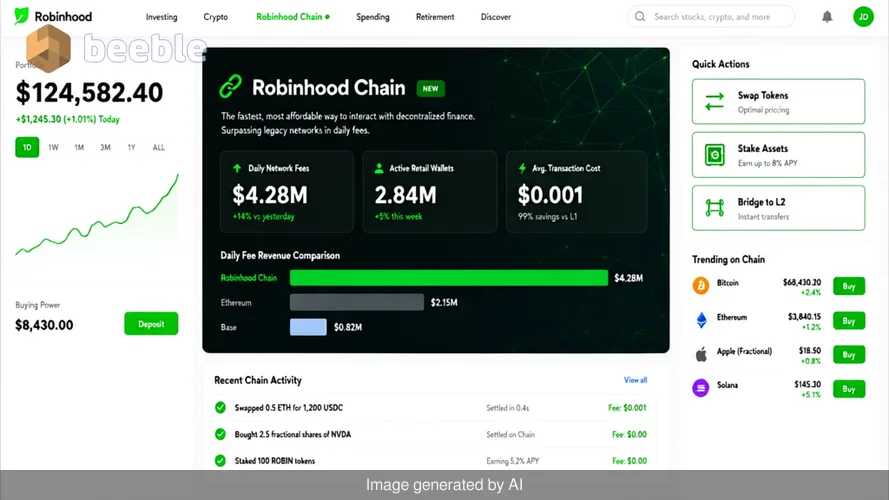
The familiar green interface of the Robinhood app used to be a simple window into the New York Stock Exchange. A user swiped up to buy a fractional share of a tech giant; the transaction disappeared into a black box of clearinghouses and institutional ledgers. Today, that window has transformed into a door. When Vlad Tenev turned on the Robinhood Chain on July 1, 2026, he did not just launch another piece of crypto infrastructure. He initiated a shift in how ordinary people interact with the concept of a bank. This new blockchain is now out-earning Ethereum and Base in daily fees; it is capturing the attention of a retail audience that formerly found decentralized finance too opaque to navigate.
The day the fee flipped
For years, Ethereum was the undisputed king of the hill in terms of network revenue. It was the glass bank vault where the world stored its digital wealth. Users accepted high transaction costs as a tax on security. However, the data from late August 2026 tells a different story about where the momentum is moving. Over a 30-day period, the Robinhood Chain pulled in $3.13 million in revenue. This figure placed it third among all blockchains, trailing only the institutional Canton network and the high-volume Tron network. In the same window, Base generated $2.89 million and Ethereum generated $2.47 million.
This is not a statistical anomaly. The gap is widening. On a recent 24-hour cycle, the Robinhood Chain collected $495,477 in fees. During that same period, Base collected $71,703 and Ethereum collected a mere $25,746. This shift indicates that the activity of the average retail trader is now a more potent economic force than the high-value transactions of decentralized finance purists. The migration is happening because the friction of the old system is gone. Users are trading memecoins and tokenized stocks on the same ledger without needing to understand the underlying cryptography.
Why retail habits are shifting to onchain rails
In everyday terms, this change is like moving from a traditional savings account to a high-yield digital wallet that pays you for every move you make. On a macro level, the old financial world relied on hidden spreads and delayed settlements; the Robinhood Chain relies on transparent transaction fees and instant finality. The apps built on this new network took in $1.84 million in revenue over the last day. This puts the network second only to Solana in app-level earnings.
This growth is driven by a new behavior pattern. Investors are no longer just holding assets; they are participating in a circular economy. The launchpad known as Pons is the primary engine of this growth. Pons generated a record $690,000 in revenue on a single Saturday. This revenue annualizes to roughly $64 million. The mechanics here are simple. When a user buys a token on Pons, a portion of the fee goes toward buying back and burning the PONS token. This creates a direct link between network utility and token value. The price of PONS rose 46% in a single day because the revenue growth was tangible.
The psychological appeal of the walled garden
Behavioral economics suggests that people value ease of use over pure decentralization. Historically, crypto was a digital wild west where one wrong click could lead to total loss. The Robinhood Chain functions more like a regulated playground. It provides the transparency of a blockchain—where every transaction is visible on a public ledger—but keeps the user experience within the guardrails of a trusted brand. This balance is attracting massive liquidity. Total value locked on the chain reached $727.15 million this week.
We see this reflected in the growth of real-world assets or RWAs. These are digital versions of traditional investments like gold, real estate, or treasury bills. Onchain RWA volume set records four days in a row. Each session cleared approximately $115 million. In July, that peak was only $60 million. The market cap for these assets on the Robinhood Chain now sits at $149.22 million. This trend shows that investors are comfortable moving their "real" money into this digital ecosystem. They see the blockchain as a more efficient way to hold a portfolio.
Zooming out on the fee structure
Financially speaking, the fee flip is a symptom of a larger structural change. Ethereum was built for developers and whales. It is a robust, decentralized foundation, but it is often too expensive for a person buying $50 worth of a new token. The Robinhood Chain is built for the volume of the masses. Consequently, the network collects millions of small fees rather than hundreds of large ones. This is the same volume-based model that made retail giants like Walmart successful in the physical world.
Paradoxically, the success of this chain proves that the average investor does not care about the philosophy of decentralization as much as they care about the cost of a trade. They want the benefits of the blockchain—speed, 24/7 markets, and transparency—without the "crypto bro" complexity. The stablecoin supply on the network gained 7.8% this week, reaching $769.44 million. This suggests that users are not just visiting the chain to speculate; they are parking their cash there. The network is becoming a primary financial hub.
The rise of tokenized stocks and pure memes
Behind the scenes of this trend is the convergence of culture and finance. The Robinhood Chain is where memecoins like Cashcat meet tokenized versions of blue-chip stocks. On an individual level, a trader might flip a meme for a quick profit and immediately move those gains into a tokenized S&P 500 index fund. All of this happens on one ledger. This eliminates the need to move money back to a traditional bank account, which often takes days to process.
Delta and AI are other infrastructure plays that are seeing a surge in price and volume. These tools help automate trading and provide data analysis, making the digital wild west feel a bit more like a professional trading floor. The DEX volume on the chain ran to $1.19 billion over 24 hours. Perpetual contracts added another $189.86 million. These are not numbers associated with a niche experiment. These are numbers that rival established financial institutions.
Reframing your digital wallet
Ultimately, the rise of the Robinhood Chain is a reminder that the technology behind our money is changing faster than our habits. In practice, you might still feel like you are just using an app on your phone, but you are actually interacting with a global, decentralized ledger. The invisible leak in your wallet—caused by slow bank transfers and high brokerage fees—is being patched by these more efficient networks.
As we look at the metrics moving up and to the right, it is worth questioning our own loyalty to traditional financial structures. If a two-month-old blockchain can out-earn the foundational network of the crypto world, the old rules of market dominance no longer apply. The power has shifted to the platforms that can make complex systems feel mundane.
Takeaways for the mindful investor
Rather than chasing the next 400% gain, consider the plumbing of your financial life. Observe how much you pay in fees to move your own money. The success of the Robinhood Chain suggests that the future of finance is not about choosing between "stocks" and "crypto." It is about choosing the most efficient network for your capital. Ask yourself if your current bank or brokerage provides the same level of transparency as a glass bank vault. If the answer is no, you are likely paying for their lack of innovation. The fee flip is not just a news headline; it is a signal that retail investors are finally demanding a better deal for their dollars.
Sources:
- Robinhood Chain Network Explorer (Revenue and Fee Data, August 2026)
- DefiLlama (Blockchain Revenue and TVL Comparisons)
- Pons Protocol Financial Summary (August 2026)
- DEX Screener (Volume and Token Price Data)
- Token Terminal (Active User and App Revenue Metrics)



See you on the other side.
Our end-to-end encrypted email and cloud storage solution provides the most powerful means of secure data exchange, ensuring the safety and privacy of your data.
/ Create a free account
