


The same AI model making your videos is now building your car

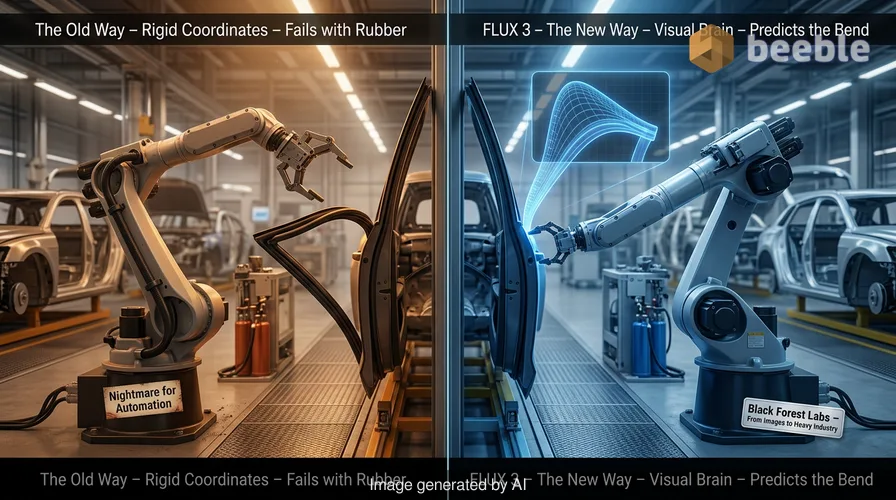
A technician at an Audi assembly line in Germany watches a robotic arm press a flexible rubber seal into the frame of a car door. For decades, this specific task was a nightmare for automation. Rubber is floppy, unpredictable, and changes shape the moment a machine touches it. Most factory robots are good at moving heavy steel plates to exact coordinates, but they fail when they have to feel their way through a soft material. The robot finishing the Audi today is different. It does not follow a rigid script of coordinates. Instead, it uses a visual brain to predict how the rubber will bend before it even makes contact. That brain is FLUX 3, the latest release from Black Forest Labs.
Black Forest Labs is the startup that quietly took the lead in the image generation world over the last two years. While big names like Google and OpenAI grabbed the headlines, this team of researchers in Germany built the tools that most independent AI artists actually use. With FLUX 3, they are moving beyond still pictures. This new system creates high-definition video and audio together. More importantly, the company is using the same underlying logic to teach robots how to interact with the physical world. This shift turns AI from a creative partner for digital art into a tireless intern for heavy industry.
A digital world with its own gravity
Most video generators work like a very fast flipbook. They predict what the next frame should look like based on the one before it, often losing track of logic along the way. This is why AI videos frequently show people with disappearing limbs or coffee cups that melt into tables. FLUX 3 takes a different path. Black Forest Labs trained the model on images, video, and audio simultaneously within a single system. This is a multimodal approach. The model does not just learn what a car looks like. It learns how a car moves, how the engine sounds, and how light reflects off the metal as it turns a corner.
Because the model learns from video and audio at the same time, the results are naturally synced. If a user asks for a video of a person hammer-drilling into concrete, the sound of the drill matches the vibration on the screen perfectly. The clips reach up to 20 seconds in length. In tests where humans compared different AI models, FLUX 3 won against Runway Gen-4.5 in 77% of cases. It beat Luma Ray 3.2 in 93% of comparisons. These numbers suggest that the system has a better grasp of reality than its competitors. It understands the overarching rules of physics, such as weight and timing, which makes the generated motion look heavy and real rather than floaty and dreamlike.
Why robots struggle with soft objects
To understand why this matters for your next car, you have to look at the invisible backbone of modern manufacturing. Traditional robots are essentially giant, very expensive calculators. If you tell a robot to move to point A, it goes there with millimeter precision. This works for welding a steel frame because steel does not move. However, if the robot picks up a rubber door seal or a bundle of wires, the material flops over. The points the robot was supposed to hit are no longer where they should be. The machine gets confused and the assembly line stops.
FLUX-mimic is the version of this AI built for the factory floor. Black Forest Labs worked with a company called mimic robotics to attach a small translator to the FLUX 3 engine. This translator takes the model’s internal sense of movement and turns it into physical arm motions. When the robot looks at a door seal through its camera, it uses the FLUX engine to imagine the next few seconds of the task. It predicts how the rubber will react to pressure. As a result, the robot can adjust its grip in real time. Audi is currently testing this to solve complex tasks that used to require human hands. The system reacts in about 101 milliseconds. For comparison, the human eye takes about 100 to 400 milliseconds to blink. This speed allows the machine to be as resilient as a person when things do not go exactly according to plan.
The rocky path from open source to profit
The history of Black Forest Labs explains why they are pushing into robotics now. The founders came from Stability AI, the group that released the original Stable Diffusion. When they launched the first FLUX models in 2024, they became the heroes of the open-source community. Their models were free to download and worked better than the paid tools from multi-billion-dollar tech giants. They provided a scalable alternative for people who wanted to run AI on their own hardware without corporate oversight.
However, the AI market is volatile and expensive to maintain. While the original FLUX was a massive hit, the second version released in late 2025 did not capture the same excitement. A competitor from Alibaba called Z-Image Turbo eventually took the crown for the best open-source model because it was faster and required less memory. Black Forest Labs needed a comeback that proved their technology was more than just a toy for making internet memes. By moving into video and robotics, they are looking for more stable revenue from industrial partners like Audi. This is why FLUX 3 is not fully open yet. The video and action tools are only available through paid APIs and specific corporate partners. The version that regular users can download and run on their own computers is not scheduled for release until late 2026.
What this means for your next purchase
For the average person, this tech shift has two tangible effects. First, the quality of digital content is about to hit a new ceiling. We are moving away from the era of grainy, five-second AI clips. Within the next few months, you will likely see marketing campaigns and short films that use FLUX 3 to create scenes that are indistinguishable from real footage. This includes high-fidelity audio that makes the experience immersive. This lowers the cost of production for small creators, but it also makes the digital world more opaque as the line between real and synthetic disappears.
Second, the use of FLUX-mimic in factories suggests a change in how physical goods are made. If robots can handle soft, flexible parts, car manufacturers can automate more of the assembly process. This typically leads to more consistent build quality and fewer errors in the final product. It also means that the digital crude oil of our time — large datasets of video — is now being used to fuel physical machines. Your next smartphone or car might be more durable because a neural network practiced the assembly process a million times in a simulation before the first part ever touched the factory floor.
A perspective on the invisible machine
Practically speaking, we should look at FLUX 3 as a bridge. It connects the world of pixels to the world of physical objects. For a long time, AI was a brain without a body. It could write poems and paint pictures, but it could not tie a shoelace or fold a shirt. By training a model to understand video, Black Forest Labs has given that brain a sense of how the physical world works. This is a foundational step toward robots that can help us in our daily lives rather than just sitting behind a screen.
Ultimately, the real story here is not just about a better video generator. It is about the decentralization of manufacturing skill. When an AI learns how to fit a door seal at an Audi plant, that knowledge is digital. It can be copied and sent to a factory on the other side of the planet instantly. We are watching the early stages of a world where machines learn by watching us, rather than being programmed by us. Instead of worrying about the hype, observe the small things in your environment. Look at the seams in your clothing or the seals on your appliances. These are the front lines where AI is beginning its most practical work.
Sources:
Black Forest Labs Technical Announcement (July 2026)
Audi Manufacturing Progress Report
mimic robotics Integration Brief
Artificial Analysis Image Arena Data



See you on the other side.
Our end-to-end encrypted email and cloud storage solution provides the most powerful means of secure data exchange, ensuring the safety and privacy of your data.
/ Create a free account
