


The Search for More Electricity Is Sending Our AI Into Low Earth Orbit

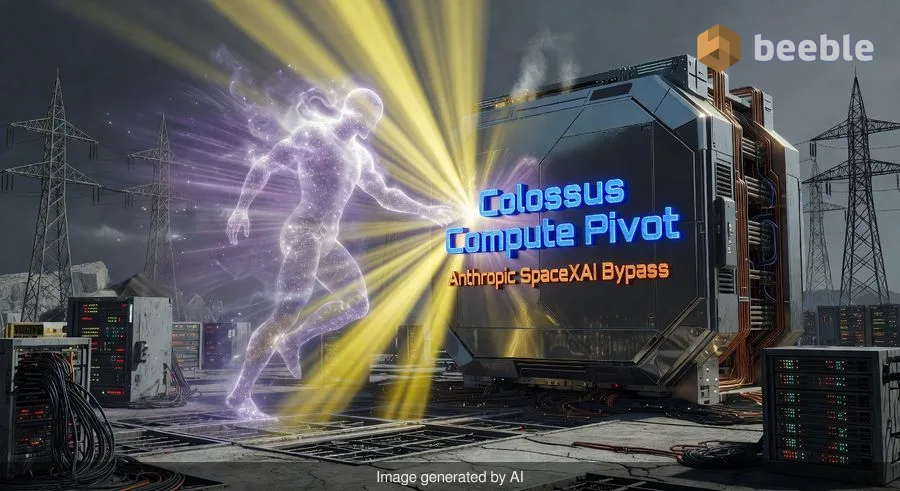
While we often imagine Artificial Intelligence as a weightless, ethereal presence living in our pockets, the reality is far more industrial. For years, the narrative has been that software is eating the world. However, in the spring of 2026, we are witnessing a pivot where the world—specifically its power grids and land—can no longer keep up with the appetite of the software. The recent announcement that Anthropic has secured access to the Colossus 1 supercomputer through SpaceXAI is not just another corporate partnership; it is a signal that the digital frontier has hit a physical wall on Earth.
Historically, tech companies fought over talent and users. Today, the most volatile currency in the tech sector is 'compute.' Behind the jargon, compute refers to the raw processing power required to train the massive models that power your daily interactions with AI. By partnering with SpaceXAI, Anthropic is effectively bypassing the terrestrial bottlenecks that have begun to slow down the entire industry. Looking at the big picture, this move suggests that to build the next generation of 'intelligence,' we have to stop looking at data centers as office buildings and start treating them as heavy industrial infrastructure.
The Colossus 1 Engine Room
To understand why this matters, we have to look under the hood at Colossus 1. This isn't just a large server room; it is a systemic shift in how we build machines. Featuring over 220,000 NVIDIA GPUs, including the cutting-edge GB200 accelerators, Colossus represents an unprecedented concentration of power. To put it another way, if a standard laptop is a single candle, Colossus 1 is a supernova.
For the average user, these numbers feel abstract. Practically speaking, this level of hardware allows AI models to 'think' through much more complex problems simultaneously. Anthropic’s plan to use this capacity for Claude Pro and Claude Max subscribers means that the lag you sometimes experience during peak hours—or the refusal of a model to handle a massive 500-page document—is about to become a relic of the past. By plugging into a cluster of this scale, Anthropic is essentially giving its 'tireless intern' a trillion more desks to work at simultaneously.
The Terrestrial Bottleneck
Curiously, the biggest challenge facing AI today isn't coding; it's cooling and cables. We are reaching a point where building a new data center on Earth is a logistical nightmare. You need hundreds of acres of land, a massive supply of fresh water for cooling, and, most importantly, a direct line to a power grid that is already struggling to support electric vehicles and aging urban infrastructure.
In many parts of the world, local governments are beginning to view data centers with skepticism. They are seen as opaque boxes that consume vast amounts of local resources while providing relatively few local jobs. This shifting sentiment has made it increasingly difficult for companies like Anthropic to scale as fast as their ambitions require. The bottom line is that we are running out of 'easy' places to put these digital furnaces.
Why the Future is Orbital
This is where the partnership takes a turn toward the disruptive. Anthropic isn't just renting ground-based servers; they are looking at the stars. The proposal to develop multiple gigawatts of orbital AI compute capacity sounds like science fiction, but from a consumer standpoint, it is a pragmatic solution to a terrestrial energy crisis.
In space, the constraints of Earth are reversed. On the ground, solar power is intermittent and limited by the atmosphere. In Low Earth Orbit (LEO), the sun is a constant, foundational source of energy. Furthermore, the problem of heat—which requires billions of gallons of water to manage on Earth—can be handled in the vacuum of space through massive radiator systems that don't compete with local water tables.
SpaceX is the only organization with the launch cadence to make this a tangible reality. By using the Starship platform to loft massive server arrays into orbit, they are effectively building a decentralized power plant and data center in one.
| Feature | Terrestrial Data Centers | Orbital Compute (Proposed) |
|---|---|---|
| Power Source | Grid-dependent (Fossil/Renewable) | 24/7 Unfiltered Solar |
| Cooling | Water-intensive / Air HVAC | Radiative Cooling (Vacuum) |
| Land Use | High (Competitive with Housing/Ag) | None (Orbital Slots) |
| Latency | Low (Milliseconds) | Medium (Speed of Light limits) |
| Scalability | Limited by local infrastructure | Near-limitless space |
What This Means for Your Subscription
You might wonder how a satellite in orbit affects the chatbot on your phone. To put it simply, it’s about the 'ceiling' of what AI can do. Currently, AI models are often 'pruned' or made smaller so they are cheaper to run. This sometimes leads to 'hallucinations' or a lack of nuance in complex tasks.
With the massive compute overhead provided by Colossus 1 and eventually orbital arrays, Anthropic can afford to run 'heavier' models. For a Claude Max subscriber, this could mean the difference between an AI that summarizes a meeting and an AI that can autonomously cross-reference your entire company's historical archives, identify a supply chain risk, and draft a resilient mitigation strategy in seconds. The robust nature of this hardware allows the software to be more intuitive and less prone to the 'fuzziness' we see today.
Conversely, there is the question of cost. Launching hardware into space is expensive, even with SpaceX’s streamlined economics. However, as terrestrial power prices climb due to systemic demand, the 'green' and 'infinite' nature of space-based solar might actually make orbital compute the more cost-effective choice in the long run.
Behind the Corporate PR
While the announcement is filled with optimism, we should maintain a healthy dose of skepticism regarding the timeline. Engineering a supercomputer that can survive the volatile radiation of space and the physical stress of launch is a monumental task. Traditionally, space hardware is 'frozen' in time because you can't easily send a technician up to swap out a broken GPU. SpaceX will need to prove that their orbital platforms are as resilient as their ground-based counterparts before we see Claude fully migrating to the stars.
Furthermore, the 'so what?' filter reminds us that as AI becomes more interconnected with orbital infrastructure, the digital divide could widen. Countries and companies with space-faring capabilities will hold the keys to the most advanced 'thinking' machines, creating a new form of decentralized but exclusive power.
The Big Picture for the Everyday User
Ultimately, the Anthropic-SpaceXAI deal tells us that the AI revolution is entering its 'heavy lifting' phase. We are moving past the era of clever prompts and into the era of planetary-scale engineering. For you, the user, this means that the tools you use will likely become more reliable and capable, but the machinery behind them will become increasingly invisible—and increasingly distant.
As we move forward, observe how your digital habits shift. Are you delegating more complex, high-stakes reasoning to these models? If so, you are participating in a system that is currently outgrowing the planet's ability to power it. The shift to orbital compute isn't just a tech flex; it’s a necessary evolution to keep your digital assistants running without dimming the lights in your neighborhood.
From a consumer perspective, the next time your AI provides a stunningly accurate medical insight or a perfect piece of code, remember that it might soon be powered by a solar array orbiting 300 miles above your head. The invisible backbone of modern life is no longer just cables under the street; it’s becoming a constellation in the sky.
Sources:
- SpaceXAI Technical Specifications: Colossus 1 Deployment Overview (2025-2026).
- Anthropic Public Statement: Expanding Claude Capacity via Compute Partnerships.
- International Energy Agency: Report on Data Center Power Consumption Trends (2026 Update).
- NVIDIA Hardware Roadmap: GB200 and the Future of Large-Scale Inference Clusters.



See you on the other side.
Our end-to-end encrypted email and cloud storage solution provides the most powerful means of secure data exchange, ensuring the safety and privacy of your data.
/ Create a free account
