


The silent death of the email inbox

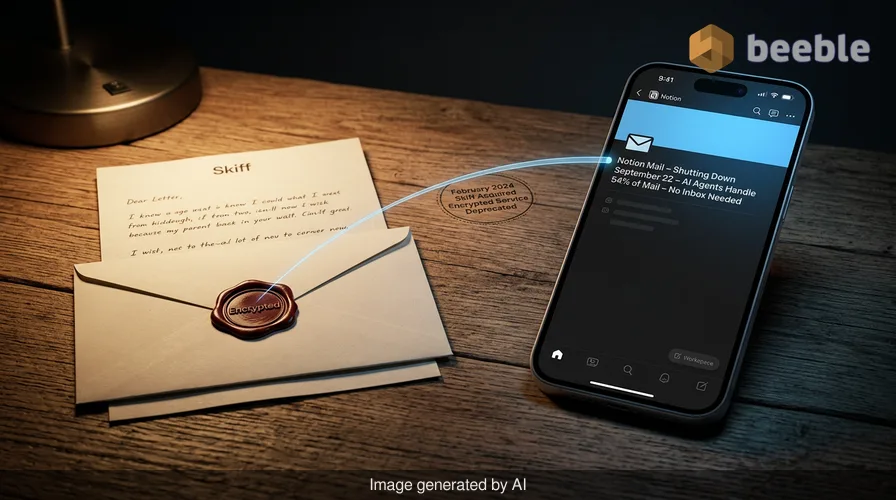
I remember the day Notion bought Skiff. It was February 2024, and the news sent a ripple through the privacy community. Skiff had built a beautiful, end-to-end encrypted alternative to Gmail that served two million users. For those of us who spent years carefully migrating our digital lives away from big tech data harvesting, Skiff was a resilient choice. Then, Notion acquired it. Within months, the encrypted email service was gone, replaced by a promise that its team would build something better inside the Notion ecosystem.
That something was Notion Mail. When it launched in April 2025, it was a Gmail client. It was sleek and fast, but it was a bridge to a legacy world. It stripped away the privacy-first architecture of Skiff and replaced it with deep integration into Notion’s workspace. Today, June 29, 2026, Notion announced that the bridge is being dismantled. Notion Mail will shut down on September 22. This move is a signal of a larger trend in software design. The company claims that more than half of its users manage their mail through AI agents without ever opening an inbox.
This shift is a departure from how we have interacted with the internet for thirty years. We are moving from a world where we look at data to a world where we delegate it. This change has profound implications for how we work and who owns our attention.
The transition from human to agent
Historically, the email inbox was a list of tasks and conversations that required human triage. We opened the app, scanned the subject lines, and decided what was worth our time. Notion is betting that this manual process is a legacy habit. Their data suggests that users prefer to let a Large Language Model (LLM) act as a filter. Instead of reading fifty emails, a user reads one summary generated by an agent.
Technically speaking, this change turns the email client into a headless service. An agent connects to the Gmail API, reads the incoming messages, and extracts the relevant information. It places that information into a Notion database or a project page. The user never sees the original blue-and-white Gmail interface. In this model, the inbox is a database for the machine, not a destination for the person.
This transition has a pragmatic logic for a company like Notion. Maintaining a high-quality mail client for web, desktop, and iOS is expensive. It requires constant updates to handle fragmented email standards and security protocols. If users are happy to interact with their mail through an automated assistant, the physical interface of the inbox becomes an unnecessary expense. Consequently, Notion is choosing to build the brains of the operation rather than the window.
The API as a restaurant waiter
To understand how this works under the hood, it is helpful to think of APIs as restaurant waiters. In a traditional email app, you are the customer who sits at the table and reads the menu. The waiter (the API) takes your request to the kitchen (the Gmail server) and brings back the data. You then consume that data yourself.
In the agent-centric model, the AI is a personal assistant who goes to the restaurant for you. The agent talks to the waiter, looks at the menu, and decides what you would like to eat based on your past preferences. The agent brings a pre-chewed summary of the meal back to your desk. You never have to step foot in the restaurant. This is efficient, but it assumes the agent knows exactly what you need. It also assumes the waiter and the kitchen are always honest about the ingredients.
Paradoxically, this makes the underlying Gmail connection more important even as the Gmail interface disappears. Notion noted that user email history will stay in Gmail. This is a form of ecosystem lock-in that is surprisingly transparent. Notion provides the intelligence layer, but Google remains the storage unit. If you stop paying for Notion, your data is still there, but your workflow is broken. You are left with a massive pile of raw data and no agent to sort it for you.
From encryption to extraction
Through this user lens, the death of Skiff-influenced products is a story of shifting values. Skiff was built on the principle that the provider should not be able to read your mail. It used zero-knowledge encryption to ensure privacy. When Notion acquired Skiff, that philosophy was the first thing to go. Notion Mail was a standard Gmail client, which means the emails were unencrypted on Google's servers.
Now, the shift to AI agents moves even further away from the Skiff ideal. For an AI agent to work, it must read your mail. It must process the text, understand the context, and predict your needs. This is the opposite of encryption; it is extraction. We are trading the security of a locked box for the convenience of a personal secretary who reads our mail before we do.
Ultimately, this reflects a broader trend in the software industry. Users are increasingly willing to trade privacy for a reduction in digital friction. The clunky process of sorting an inbox is a form of friction that many people are eager to eliminate. Notion is simply following the path of least resistance. They are leveraging the human resources from the Skiff acquisition to build a system that prioritizes automation over autonomy.
The HIPAA cliff and technical debt
There is a technical reality that complicates this clean transition to agents. Notion’s support page mentions that organizations relying on HIPAA coverage must transition off Notion Mail by June 30, 2026. That is tomorrow. This tight deadline suggests that the backend infrastructure for the mail client is being decommissioned rapidly.
In a regulated environment, an AI agent reading sensitive health data is a liability. Maintaining a HIPAA-compliant email interface is a complex engineering task that requires strict auditing and data residency controls. It is likely that the technical debt of maintaining this compliance for a shrinking user base was a factor in the decision to kill the app.
When a company shuts down a product with such a short lead time for regulated users, it often indicates that the underlying code is no longer sustainable. The developers who joined from Skiff are likely now focused on the agent architecture. Keeping the old mail client alive would require them to split their attention between the legacy product and the new AI-centric vision. In the world of agile development, the legacy product usually loses.
Reclaiming the digital routine
The death of Notion Mail is more than just a product cancellation. It is the end of a specific lineage of software that tried to make email better through design. Skiff tried to make it more private; Notion Mail tried to make it more integrated. Both failed to change the fundamental nature of email. Now, Notion is giving up on the interface entirely and letting the machines handle it.
We should look at our own digital habits and ask if we are ready for this hand-off. When we stop opening our inboxes, we lose a certain level of control over our information diet. We trust an algorithm to tell us what is important. While this saves time, it also makes our digital lives more opaque. We no longer see the raw data; we only see the curated result.
This is a moment to reflect on our relationship with our tools. If you were a Skiff user who moved to Notion Mail, you have seen your workspace transform several times in two years. This instability is a reminder that proprietary software is a service, not a possession. We do not own our tools; we rent them until the provider decides they are no longer profitable.
As Notion Mail prepares to shut down its web and mobile apps in September, the lesson is clear. The era of the artisanal email client is ending. In its place is a more automated, more integrated, but less transparent way of communicating. Whether this is an improvement depends on how much you value your time versus how much you value your direct connection to your data.
Sources
- Notion Support Documentation: Notion Mail Shutdown and Migration Guide
- 9to5Mac: Notion Mail and Skiff Integration History
- Notion Official X Account: Announcement of AI Agent Focus
- Skiff Acquisition Press Release (February 2024)
- Gmail API Developer Documentation



See you on the other side.
Our end-to-end encrypted email and cloud storage solution provides the most powerful means of secure data exchange, ensuring the safety and privacy of your data.
/ Create a free account
