


The silent death of the single-purpose app

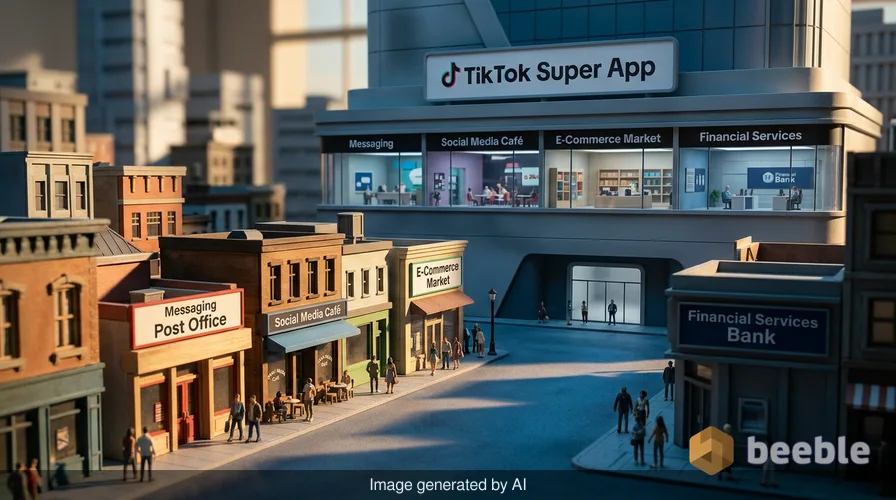
You likely remember the early days of mobile software when every icon on your home screen did exactly one thing. You opened a blue bird to read short thoughts; you opened a camera icon to see photos; you opened a browser to search for a hotel. This fragmentation was the defining characteristic of the first smartphone decade. It represented a modular approach to digital life where users owned their journey by choosing specialized tools for specific needs. Today, that modularity is disappearing as TikTok transitions from a short-form video feed into a monolithic digital environment that aims to encompass your entire daily routine.
Technically speaking, TikTok is moving toward the super app model popularized by WeChat in China. A super app is a single software platform that integrates messaging, social media, e-commerce, and financial services into a unified interface. While Western tech companies historically focused on individual apps that linked to one another, TikTok is now building a walled garden that attempts to solve every user problem without a single exit click. This shift is not a sudden accident of design. It is a calculated architectural expansion that changes how we interact with the internet.
The architecture of commerce and the end of the browser
Historically, if you saw a product you liked in a video, you would close the app and search for it on Amazon or Google. This action created digital friction; it gave you a moment to reconsider the purchase and required the app to hand off your data to a competitor. In 2023, TikTok removed this gap by launching TikTok Shop in the United States. By integrating the checkout process directly into the video feed, the company turned entertainment into a direct sales funnel. Data from eMarketer shows that TikTok Shop grew its U.S. sales by 407% in 2024. The platform captured 18.2% of total social commerce that year; current projections suggest this share will reach 24.1% by 2027.
Under the hood, this integration relies on a complex stack of APIs and payment gateways that keep the user within the proprietary environment. We used to use the web as a connective tissue between different stores; we now treat a single app as the entire marketplace. This change benefits the platform by providing a closed loop of consumer behavior data. When a user buys a product within the app, TikTok tracks the discovery, the consideration phase, and the final transaction without losing visibility to a third-party site. This level of vertical integration is what allows the platform to challenge established giants like Amazon and Shein.
Search as a discovery engine for the physical world
Zooming out to the industry level, the most significant threat to the old order is TikTok’s assault on Google’s core business. For decades, Google Search was the starting point for navigating the world. If you wanted to find a restaurant or a local shop, you typed keywords into a search bar and viewed a list of links. Today, younger users increasingly treat TikTok as their primary search engine. The platform has responded by building a robust local discovery system that surfaces maps, reviews, and opening hours directly on video pages.
In everyday terms, this means the software has evolved from a time-waster into a utility. When you search for a restaurant on TikTok, you see the food, the atmosphere, and the menu in a video format before you see the address. Paradoxically, the visual nature of the app makes it more functional for certain types of local search than a traditional text-based engine. By adding detailed business information and star ratings, TikTok eliminates the need for users to verify information on Google Maps or Yelp. The app is no longer just a place to watch videos; it is a map of the physical world.
The fintech expansion and the quest for a digital wallet
Software companies eventually realize that the most powerful way to lock in a user is to hold their money. In March, reports emerged that TikTok applied for financial technology licenses in Brazil to offer lending and payment services. The company is seeking two specific authorizations. The first would allow the platform to provide prepaid accounts for users to store funds and make payments. The second would authorize it to act as a direct credit provider. This move transforms a social media company into a financial institution.
Through this user lens, the integration of fintech is the final piece of the super app puzzle. If TikTok can store your money and offer you credit, it becomes the primary interface for your economic life. You earn rewards, you receive payments, and you spend that capital on TikTok Shop or TikTok GO without ever interacting with a traditional bank. This strategy mirrors the path of Alipay and WeChat Pay, which effectively replaced cash and credit cards in many parts of the world. From a developer's standpoint, building a payment layer is the ultimate way to reduce transaction friction and increase the lifetime value of a user.
From viral videos to travel and leisure
In May, the company expanded its reach even further with the launch of TikTok GO in the United States. This feature allows users to discover and book hotels or local experiences without leaving the app. Instead of just watching a travel vlog and dreaming of a vacation, you can now check the availability of a hotel featured in the background of a video. TikTok has positioned itself as a one-stop platform for the entire travel lifecycle. You discover the destination through an algorithm, you research the activities through search, and you complete the booking through an integrated travel module.
This level of integration highlights the death of the referral. In the old web, content creators were the top of a funnel that led to third-party booking sites like Expedia or Airbnb. Now, TikTok is the funnel, the filter, and the destination. The company is also aggressively pursuing sports fans through its "TikTok GamePlan" product. By partnering with the MLS, MLB, and creating a dedicated FIFA World Cup hub, the platform ensures that users do not need to check ESPN or Google for scores. If you can watch highlights and check the live score in the same place, the incentive to leave the app disappears.
The technical debt of the everything app
There is a risk to this rapid expansion that developers call feature creep. As TikTok adds games, shopping, hotel bookings, and banking, the software becomes increasingly bloated. What started as a lightweight video player is now a massive, complex operating system running inside another operating system. This complexity often leads to a clunky user experience where the primary function of the app is buried under layers of commerce and utility. Maintaining such a multifaceted ecosystem requires an enormous amount of engineering resources to prevent the platform from collapsing under its own weight.
Historically, Western users have resisted the super app model because they prefer the transparency of specialized tools. We like knowing that our banking app is secure and our social app is for fun. TikTok is betting that the convenience of a seamless experience will eventually outweigh the desire for modularity. As the platform integrates more scripted entertainment and microdramas through its Minis section, it moves into direct competition with Netflix and YouTube. It is a battle for the single most valuable resource in the digital economy: the user's attention span.
Navigating the new digital monoculture
Ultimately, the evolution of TikTok represents a shift in how software companies view their relationship with the public. We are moving away from an internet of interconnected nodes and toward an internet of massive, self-contained silos. When one app handles your entertainment, your shopping, your travel, and your banking, the company gains a level of control that was previously impossible. This ecosystem lock-in makes it difficult for users to switch to competitors or even imagine a digital life outside of the platform.
As we move deeper into this era of the super app, it is important to observe our own software habits. We should question whether the convenience of a one-stop shop is worth the loss of a diverse, fragmented web. Digital literacy in 2026 is about recognizing when an app is trying to become your entire world. While TikTok provides an undeniably streamlined experience, the cost of that efficiency is often a loss of control over our own data and choices. The next time you find yourself booking a hotel or checking a sports score inside a video app, ask yourself if the friction you saved was the only thing you lost.
Sources
- eMarketer: U.S. Social Commerce Forecast and TikTok Shop Growth Analysis.
- Reuters: Brazil Central Bank Filings for ByteDance/TikTok Fintech Licenses.
- TikTok Newsroom: Launch of TikTok GO and FIFA World Cup Hub Documentation.
- Major League Soccer (MLS) and Major League Baseball (MLB): Official Partnership Announcements.
- Brazil Central Bank: Financial Institution License Requirements and Public Records.



See you on the other side.
Our end-to-end encrypted email and cloud storage solution provides the most powerful means of secure data exchange, ensuring the safety and privacy of your data.
/ Create a free account
