


The Silent Death of the Social Media Free Pass

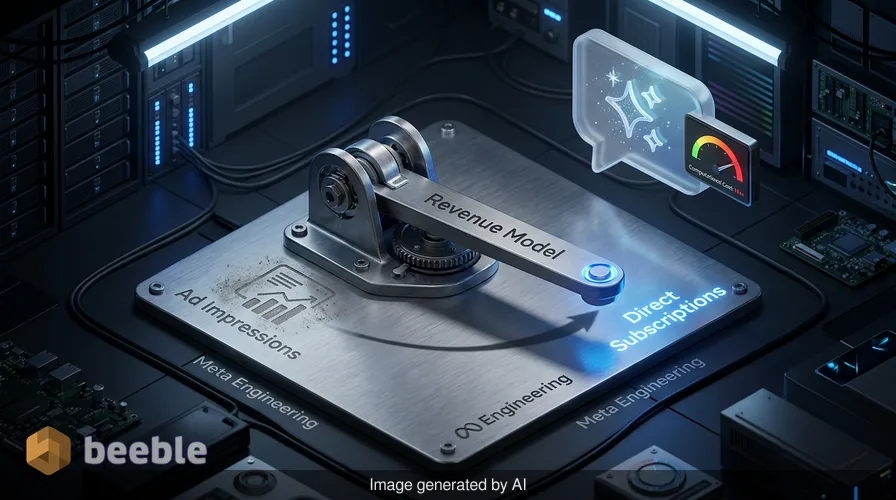
For over a decade, the login screens of our most ubiquitous apps whispered a comfortingly simple lie: "It’s free and always will be." We traded our data and our attention for a digital town square, accepting the invisible machinery of targeted advertising as the de facto tax for staying connected. But as the sun sets on the first era of social media, that foundational contract is being rewritten in real-time. Meta’s recent global rollout of Facebook Plus, Instagram Plus, and the overarching Meta One subscription suite isn't just a minor update to a user interface—it is a profound pivot in how the software industry plans to survive its own success.
Historically, Meta’s engineering and business logic were perfectly aligned: maximize engagement to maximize ad impressions. However, we have reached a tipping point where the computational costs of the next generation of features—specifically the generative AI integrated into every chat bubble and search bar—have outpaced what traditional advertising can sustain. Paradoxically, the more powerful our software becomes, the more expensive it is to keep the lights on, forcing a shift from a product fueled by data to a product fueled by direct monthly transactions.
The $145 Billion Invoice
To understand why you are now being asked to pay $3.99 for Facebook Plus or $2.99 for WhatsApp Plus, we have to look at the staggering numbers behind the screen. Meta has projected a capital expenditure of up to $145 billion this year alone. To put that in perspective, that is roughly the cost of building 15 Large Hadron Colliders or several dozen high-end semiconductor fabrication plants. This capital isn't being spent on better servers for your vacation photos; it is being funneled into the massive data centers required to run Llama-based AI models.
Under the hood, the transition from a standard social feed to an AI-driven ecosystem represents a massive architectural leap. A traditional database query—like fetching a friend’s latest post—is computationally cheap. In contrast, generating a high-fidelity image or providing a nuanced AI response requires an order of magnitude more processing power and electricity. Consequently, the "free" user becomes a significant financial liability in an AI-first world. By introducing these tiers, Meta is attempting to transform a fragmented user base into a reliable stream of recurring revenue, essentially crowdsourcing the astronomical costs of their hardware expansion.
Deconstructing the "Plus" Experience
On an individual level, the value proposition of these new subscriptions feels strangely nostalgic yet fundamentally disruptive. Instagram Plus and Facebook Plus offer what many power users have long craved: enhanced analytics, story rewatch statistics, and expanded audience reach. For the casual user, these might feel like bloated additions to an already complex interface, but for the modern creator, they are essential tools for navigating the opaque nature of algorithmic curation.
| Subscription Tier | Monthly Price (Estimated) | Key Features |
|---|---|---|
| WhatsApp Plus | $2.99 (€2.77) | Custom themes, premium stickers, custom ringtones |
| Instagram Plus | $3.99 (€3.70) | Story rewatch stats, expanded reach, profile customization |
| Facebook Plus | $3.99 (€3.70) | Advanced analytics, reach boosts, exclusive UI options |
| Meta One (Standard) | $7.99 (€7.40) | Bundle of all Plus features + basic Meta AI enhancements |
| Meta One Premium | $19.99 (€18.50) | Full AI suite, priority support, business-grade tools |
Through this user lens, the WhatsApp Plus offering is particularly curious. While Facebook and Instagram have always been content-heavy, WhatsApp remained a utility—a digital pipe for communication. Adding a $2.99 tier for custom ringtones and app themes feels like a return to the early 2000s era of personalized wall-papers, yet it serves a pragmatic purpose: it tests the user's willingness to pay for personalization in a space that was once considered a public utility.
Meta One: The New Walled Garden
Beyond the individual apps lies the "Meta One" umbrella, which signals a move toward an ecosystem lock-in that would make the cable companies of the 90s envious. Testing currently in Singapore, Guatemala, and Bolivia, Meta One is designed to be the central hub for the company's subscription products. It is the logical conclusion of years of backend integration—the moment where the separate silos of Instagram, Facebook, and WhatsApp finally dissolve into a single, unified billing identity.
From a developer's standpoint, Meta One is an exercise in streamlining. Maintaining separate billing infrastructures and subscription logic across three different platforms is a recipe for technical debt. By consolidating these under a single brand, Meta creates a seamless transition for the user while reducing the engineering overhead required to manage millions of recurring payments. However, this integration also makes the platform more resilient against user churn; once you are subscribed to the "One" ecosystem, the friction of leaving becomes significantly higher.
The AI Compute Crisis
Zooming out to the industry level, Meta’s move is a clear signal that the era of "subsidized software" is ending. For years, venture capital and high ad margins allowed companies to offer robust tools for free, treating the cost of servers as an invisible infrastructure expense. But AI has changed the math. Large Language Models (LLMs) are the most resource-intensive consumer products ever built. Every time a user asks Meta AI to summarize a thread or generate a sticker, a tiny fraction of a cent is spent on electricity and GPU time.
While the old Meta could ignore these micro-costs when they were offset by massive ad auctions, the new Meta cannot. The subscription push is a pragmatic response to the fact that AI-integrated software is simply too expensive to give away. If the ad-supported model was like a free city park, the new Meta One model is more like a private club where the membership dues pay for the high-end maintenance of the automated features.
The Evolutionary Shift in Software Ownership
Ultimately, this transition reveals a deeper shift in our relationship with our digital tools. We are moving from a world of proprietary software that we "use" to a world of proprietary services that we "rent." The feature creep we see today—the addition of rewatch stats or premium stickers—is the bait, but the hook is the underlying AI capability that will soon become indispensable for work and social life.
In everyday terms, we are witnessing the "SaaS-ification" of the social experience. Just as we moved from buying CDs to subscribing to Spotify, or buying Photoshop to renting Creative Cloud, we are now entering an era where our social identity and communication history are behind a recurring paywall. It is a seamless evolution, perhaps even inevitable, but it marks the end of the web as a wide-open, free frontier.
As we navigate this new landscape, it is worth asking: what happens to those who choose not to pay? Will the free version of these apps become the "legacy" experience—a clunky, ad-saturated, and AI-impoverished version of the modern web? While Meta’s shares may rise on the news of diversified revenue, the average user is left to ponder the true cost of their digital life. We have long known that if you aren’t paying for the product, you are the product. Now, in the age of Meta One, we are discovering that even when you are the product, you might still have to pay for the privilege of existing in the machine.
Sources:
- Meta Newsroom: Internal updates on global subscription testing (2024-2026).
- CNBC Technology Report: Analysis of Meta One pricing and regional testing strategies.
- AFP Media Reports: Detailed breakdown of Facebook Plus and Instagram Plus feature sets.
- Meta Investor Relations: 2024-2025 Capital Expenditure guidance and AI infrastructure roadmap.
- Developer Documentation: Meta AI API cost structures and Llama 3/4 deployment specs.



See you on the other side.
Our end-to-end encrypted email and cloud storage solution provides the most powerful means of secure data exchange, ensuring the safety and privacy of your data.
/ Create a free account
