


The Silent Evolution of the British Pound and What It Means for Your Bank Balance

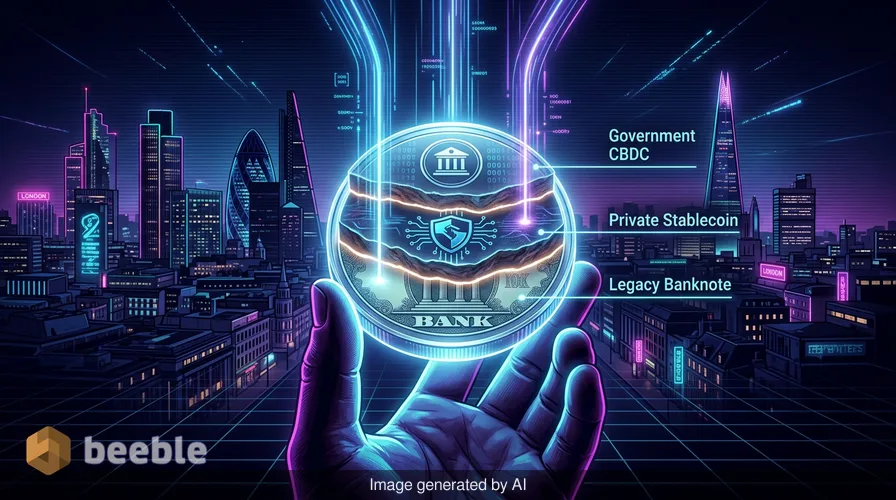
In 1996, the average Briton carried six coins and three banknotes just to buy a simple loaf of bread; in 2026, that same transaction is more likely to trigger a silent relay of encrypted code through a smartphone. This shift represents more than just a change in consumer convenience—it is a fundamental restructuring of how value moves through our society. The Bank of England’s latest roadmap suggests that the future of the pound is no longer just about digital numbers on a screen—it is about "tokenized" money that carries its own instructions; it is about a multi-layered ecosystem where bank deposits, private stablecoins, and government-backed digital currencies live side-by-side.
Speaking at London’s City Week 2026, Sarah Breeden, Deputy Governor of the Bank of England, outlined a vision that effectively bridges the gap between the stuffy boardrooms of Threadneedle Street and the high-tech frontier of decentralized finance. For years, the conversation around "crypto" was relegated to the fringes of speculative betting—a digital Wild West where fortunes were made and lost on the back of memes. Today, the central bank is signaling that the underlying technology is too pervasive and too potentially useful to remain on the sidelines.
The Three Pillars of Your Future Wallet
Breeden’s address was not a call for a revolution, but rather a blueprint for an orderly evolution. The Bank of England envisions a "multi-money" system. In everyday terms, this means that the way you pay for your morning coffee or your monthly rent might soon involve three distinct types of digital assets, all working under the hood of your familiar banking app.
First, there are tokenized bank deposits. To put it another way, these are the digital versions of the money you already have in your Barclays or HSBC account. The difference is that they are recorded on a blockchain-like ledger, allowing them to move instantly and operate with "smart contracts." Second, we have regulated stablecoins—digital assets issued by private companies but strictly overseen by the government to ensure they are always backed one-to-one by actual pounds. Finally, there is the potential retail Central Bank Digital Currency (CBDC), often nicknamed the "Digital Pound," which would be a direct claim on the Bank of England itself, much like a physical five-pound note in your pocket.
Paradoxically, while the technology sounds futuristic, the goal is to make it feel entirely mundane. The central bank wants a system where you don’t have to care which "type" of pound you are using; you just need to know that it is safe, accepted everywhere, and moves at the speed of light.
Why Your Bank Balance Needs an Upgrade
Behind the scenes of this trend is a frustration with the aging plumbing of traditional finance. Zooming out, the current system for moving money between banks is a bit like a game of telephone played with carrier pigeons. When you send a payment, it often passes through multiple intermediaries, each taking a tiny slice of the pie and adding a few hours—or days—of delay.
Distributed ledger technology (DLT) acts like a glass bank vault. In this system, everyone involved can see that the money exists and that the transaction is valid, but only the owner has the key to move it. By moving the pound onto this ledger, the Bank of England believes we can slash these hidden costs.
Financially speaking, the real magic happens with "smart contracts." Imagine you are buying a second-hand car from a stranger. Currently, you either pay first and hope they hand over the keys, or they give you the keys and hope your bank transfer actually clears. With tokenized money, the payment can be conditional. The "smart" pound sits in a digital escrow and only releases to the seller the exact millisecond the digital logbook for the car is transferred to your name. It removes the need for trust because the code handles the verification.
The Wholesale Engine and the Retail Reality
While the talk of "digital pounds" in our wallets grabs the headlines, the most profound changes are happening in the wholesale markets. On a macro level, the Bank of England and the Financial Conduct Authority (FCA) recently opened a consultation to look at how big banks trade bonds and equities.
Historically, the "plumbing" of global finance has been opaque and fragmented. Large institutions spend billions every year just reconciling records to make sure they all agree on who owns what. By tokenizing these assets—turning a million-pound bond into a digital token—settlement becomes instantaneous. This isn't just a win for the big banks; it's a structural shift that eventually lowers costs for the retail investor. When the cost of managing a pension fund or an ISA drops because the underlying technology is more efficient, those savings eventually trickle down to the individual level in the form of lower fees.
The Psychology of Digital Trust
As a behavioral economist might observe, the biggest hurdle to this digital transition isn't the code—it's us. Money, at its core, is a collective belief system. We trust a piece of plastic or a paper note because we believe everyone else will accept it.
Transitioning to a world of tokenized deposits and stablecoins requires a new kind of trust. There is a deeply rooted anxiety that digital money is somehow less "real" or that it grants the government too much visibility into our spending habits. Breeden was careful to emphasize that a retail CBDC would coexist with traditional money, providing competition and choice rather than a mandatory replacement.
Curiously, we already live in a largely cashless society, yet the idea of a "digital pound" feels more invasive to many than a standard credit card. This is the nuanced challenge the Bank of England faces: they must prove that these new forms of money are as resilient and private as the cash we are slowly leaving behind. Market corrections in the crypto space have often acted like a forest fire, clearing out the dead wood of unregulated, risky projects. By stepping in now, the Bank of England is attempting to plant the seeds of a more stable, regulated forest before the next growth cycle begins.
A New Era of Financial Competition
Through this economic lens, the Bank’s move is also a play for British competitiveness. Post-Brexit, the UK is eager to position itself as a global hub for financial technology. If London can provide the clearest, safest regulatory framework for tokenized assets, it will attract the world’s capital.
For the average person, this competition is a good thing. When banks have to compete with regulated stablecoins for your business, they are forced to innovate. We might see higher interest rates on deposits, better digital tools, and the end of the "three to five business days" waiting period that has plagued international transfers for decades. The ubiquitous nature of digital payments means that even a tiny increase in efficiency can have an overarching impact on the national economy.
Navigating the Shift: Key Takeaways
As we move toward this multi-money future, it is important to look past the technical jargon and focus on how our relationship with money is changing. Here is some food for thought as you watch this transition unfold:
- Efficiency vs. Privacy: Consider the trade-off. Are you willing to use a more efficient, "programmable" pound if it requires a different kind of digital footprint?
- The Definition of "Bank": In a world of stablecoins and tokenized deposits, your "bank" might eventually be a tech company or a decentralized platform. How does that change your expectation of security?
- Financial Mindfulness: As money becomes more invisible and automated (via smart contracts), it becomes easier to lose track of spending. How will you maintain a tangible connection to your finances when the "swipe" disappears entirely?
Ultimately, the Bank of England isn't trying to replace the pound; they are trying to give it a digital nervous system. Whether this leads to a more transparent, efficient economy or simply adds another layer of complexity to our lives remains to be seen. Practically speaking, the goal is a system where the money works for you, rather than you working to understand how the money moves.
Sources
- Bank of England: Speech by Sarah Breeden, City Week 2026, "The Future of Retail Payments."
- FCA and Bank of England: Joint Consultation Paper on the Regulation of Stablecoins and Tokenized Assets (May 2026).
- Bank of England Discussion Paper: The Roadmap for a Digital Pound and Tokenized Deposits.
- International Monetary Fund (IMF): Report on the Macroeconomic Implications of CBDC Adoption in Developed Economies.



See you on the other side.
Our end-to-end encrypted email and cloud storage solution provides the most powerful means of secure data exchange, ensuring the safety and privacy of your data.
/ Create a free account
