


The silent hollowing of expertise and the risk of a model-only economy

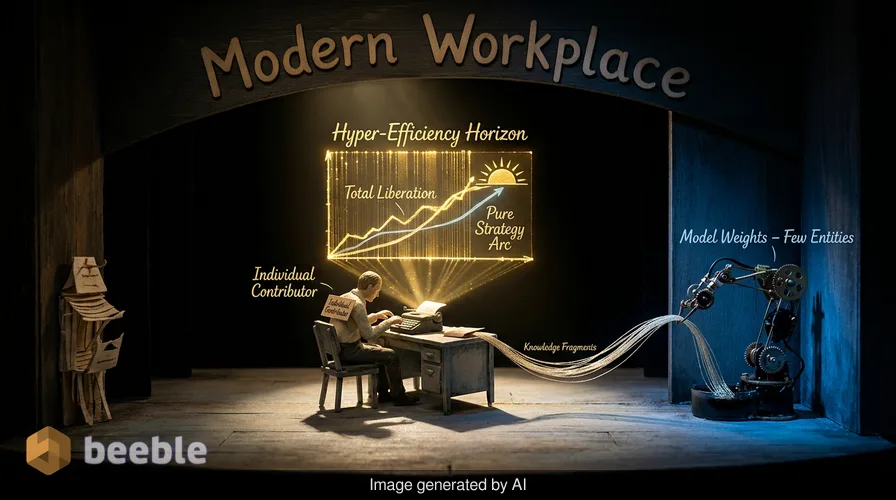
The modern workplace is a theater of quiet extraction where the rhythmic click of the mechanical keyboard is replaced by the silent hum of the prompt. The promise of generative artificial intelligence offers a shimmering horizon of hyper-efficiency where every employee operates with the insight of a thousand specialists and every task is completed in seconds. This digital dream suggests an era of total liberation from mundane labor where the human mind is finally free to focus on pure strategy and creative vision. However, this transition requires the constant feeding of private intellectual capital into public models unless organizations establish hard boundaries around their proprietary logic. The efficiency gain algorithmically dilutes the worth of the individual contributor and inevitably concentrates wealth in the hands of the few entities that own the weights of the model.
The warning from the summit
Microsoft CEO Satya Nadella shared a blunt assessment of this trajectory on X this past Sunday. He warned of a future where a handful of AI providers capture the majority of economic value while traditional industries lose ownership of their knowledge. Nadella described a scenario where every company cedes value to models that consume everything they see. He stated that there is no societal permission for an AI future that hollows out entire industries. His words reflect a growing concern among technology leaders that the current path of AI development mirrors the destructive phases of early globalization.
On a macro level, the comparison to globalization is a sobering one. During the first phase of global integration, industrial economies saw a massive hollowing out through outsourcing. On the surface, GDP numbers remained stable or even grew. Behind the scenes, the displacement was real and the social consequences remain pervasive in the present day. Nadella argues that AI could repeat this pattern by outsourcing human cognition rather than manual labor. If every company uses the same central brain, the unique expertise that once defined a business becomes a commodity. The knowledge is no longer a localized asset; it is training data for a third party.
The risk of the dumb data pipe
Snowflake CEO Sridhar Ramaswamy echoed this sentiment earlier this year. He suggested that the largest software companies are at risk of being reduced to mere data sources. In his view, the creators of large models want a world where enterprise data is easily available to them. Everything else in the ecosystem is just a dumb data pipe that feeds a central brain. This creates a systemic vulnerability for businesses that have spent decades building proprietary workflows and specialized knowledge bases.
Curiously, this trend creates a professional archipelago. In this state, companies live densely packed in the digital ecosystem but are increasingly isolated from their own value. They provide the raw material—the data—but the intelligence that processes that data belongs to someone else. Ramaswamy noted that Snowflake must operate with the fear that users will bypass specialized tools in favor of all-inclusive AI agents. When a single agent has access to data from everywhere, the individual software provider loses its relevance. The product is no longer the tool itself; it is the access to the model that has already absorbed the tool.
Context as the final fortress
Box CEO Aaron Levie identified a similar problem in a LinkedIn post this January. He noted that AI models now perform high-level knowledge work across law, strategy, and research. This ubiquity raises a fundamental question about differentiation. If every company has access to the same expert intelligence, the playing face is level, but the heights are missing. Levie argued that context is the only remaining way for a company to distinguish itself.
In everyday terms, context is the messy, unquantifiable human element of a business. It is the history of a specific client relationship, the weird quirks of a local market, and the collective memory of a team. While a model can draft a legal brief, it does not know why a specific clause matters to a particular family-owned business. Paradoxically, as high-level intelligence becomes cheaper, the value of mundane human context becomes higher. The struggle for companies is to retain this context without letting it be hoovered up into the general training set.
The erosion of professional habitus
Through this lens, we can see the impact on the individual level. Pierre Bourdieu used the term habitus to describe the ingrained habits and dispositions that we gain through experience. A master carpenter does not just know how to use a saw; they have a visceral feel for the wood. In the knowledge economy, this habitus is the intuition of a seasoned editor or the pattern recognition of a veteran doctor.
As AI models absorb the outputs of these professionals, the habitus is digitized. The model learns the pattern but the human stops practicing the skill. This leads to professional atomization. Individuals are no longer part of a lineage of craft; they are operators of a system that simulates that craft. This shift is symptomatic of liquid modernity, where career paths are no longer solid structures but shifting, ephemeral streams of tasks. When the expert's intuition is available via a five-dollar-a-month subscription, the expert becomes an unnecessary expense. This is the hollowing out that Nadella fears. It is not just the loss of jobs, but the loss of the human capacity to generate new knowledge without a machine intermediary.
The philology of intelligence
Linguistically speaking, our definition of intelligence is undergoing a profound change. We once used the word to describe a human capacity for understanding and reasoning. Now, the discourse has shifted so that intelligence is a resource to be mined, refined, and distributed like electricity. This semantic shift has practical consequences. When we treat intelligence as a utility, we forget that it requires a source.
If the models eat everything they see, they eventually reach a point of diminishing returns where they are trained on their own synthetic outputs. This creates a hall of mirrors effect. The language becomes more polished but less resonant. The insights become more standardized but less nuanced. A world where everyone uses the same model is a world where the collective patchwork quilt of human knowledge stops growing. We are left with a stagnant pool of optimized mediocrity.
Food for thought
To navigate this shift, we must look at our daily routines and the systems we build. Instead of focusing solely on the speed of output, we can prioritize the preservation of unique context.
- How much of your daily work relies on your specific history and relationships versus general knowledge?
- Are you building a proprietary system of learning, or are you simply feeding a model that you do not own?
- Can you identify the moments in your professional day where your human intuition provides a value that a model cannot replicate?
- What happens to your industry if the barrier to entry for your specific expertise drops to zero?
Reclaiming the human presence
Ultimately, the challenge is to use technology as an anchor rather than a replacement. We have seen how previous waves of technological change promised connection but delivered isolation. The current AI era threatens a similar paradox: it offers infinite knowledge while stripping us of our knowing. We must be intentional about the boundaries we set between our collective intelligence and our personal expertise.
There is a subtle power in the things that cannot be digitized. The awkward silence in a meeting that reveals a hidden conflict, the handwritten note that builds a decade of loyalty, and the specialized jargon of a local trade are all forms of resistance against commodification. We should observe our routines and identify these human remnants. Reclaiming context is the only way to ensure that we are more than just data pipes in a larger machine. We must remain the architects of our own meaning, even in a world that wants to generate it for us.
Sources
Nadella, S. (2026). Social media post regarding AI and industrial value. X.
Ramaswamy, S. (2026). The risk of the data pipe. Snowflake Executive Podcast.
Levie, A. (2026). Differentiation in the age of AI. LinkedIn Professional Insights.
Bauman, Z. (2000). Liquid Modernity. Cambridge: Polity Press.
Bourdieu, P. (1977). Outline of a Theory of Practice. Cambridge University Press.



See you on the other side.
Our end-to-end encrypted email and cloud storage solution provides the most powerful means of secure data exchange, ensuring the safety and privacy of your data.
/ Create a free account
