


The silent migration from syntax to strategy: how AI redefines the human coder

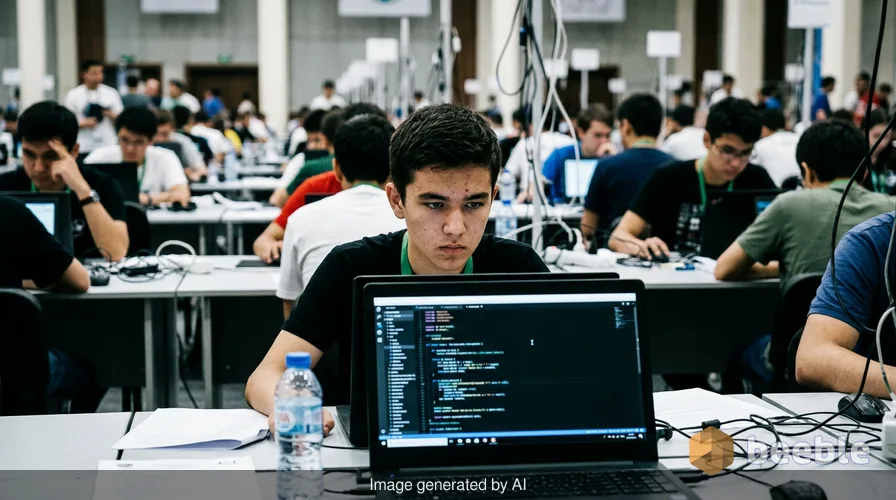
A seventeen-year-old sits in a vast hall in Tashkent, Uzbekistan. His eyes are fixed on a cursor that blinks with rhythmic indifference. Around him, 385 other young programmers from 97 different countries occupy similar stations. The air in the room has a visceral quality, thick with the silent friction of focused thought. This was the scene at the International Olympiad in Informatics, where the world’s elite young minds faced six algorithmic problems over ten hours. Historically, a significant portion of this time was a physical battle with syntax. A contestant had to ensure every semicolon and bracket was perfect. Today, that physical labor is secondary to a deeper, more systemic process of reasoning.
Qiwen Xu, a gold medalist from China, represents a generation that views code through a changing lens. He observed that he and his peers spent hours turning their abstract solutions into working programs. In his view, artificial intelligence is poised to absorb the bulk of that implementation work. This shift is not a loss of skill. It is a migration of effort. As AI becomes a ubiquitous assistant, the value of a programmer resides less in their ability to speak a machine language and more in their ability to conceptualize a solution. Culturally speaking, we are witnessing the linguistic evolution of computer science, where the focus moves from the narrow pragmatics of syntax to the broader philosophy of logic.
The quiet room in Tashkent
The International Olympiad in Informatics has always been a high-stakes arena for algorithmic design. Participants must analyze complex problems, design data structures, and test their work against hidden constraints. In the past, the barrier to entry was the code itself. If a student could not master the specific grammar of C++ or Java, their logical brilliance remained trapped in their head. The competition in Tashkent highlighted a new reality. The ability to write a loop or a sort function is now a baseline commodity. The real differentiator is what Xu calls reasoning that goes beyond AI.
This trend reflects a broader sociological pattern. In the same way that the calculator did not destroy mathematics but rather moved it toward higher levels of abstraction, generative AI is pushing programming into the realm of pure architecture. For the competitors in Tashkent, the machine is no longer just a tool for execution. It is becoming a mirror for their own thought processes. Xu now uses AI to study different approaches to a single problem. He treats the model as a colleague that provides a different perspective on the same data. This is an example of how the modern habitus of a programmer is shifting from a solitary craftsman to a strategic director.
Syntax as a shrinking barrier
Linguistically speaking, programming languages have always functioned as an archaeological site of human logic. Every new layer, from assembly to Python, was designed to make the human intent more transparent to the machine. AI is the most recent and perhaps final layer of this transparency. When Myriam Faltin, a competitor from Switzerland, discusses her process, she emphasizes intuition. She notes that knowing which algorithm to use and when to use it requires a visceral understanding that a machine cannot yet replicate. This intuition is the result of thousands of hours spent in the trenches of difficult problems.
Paradoxically, the easier it becomes to generate code, the harder it becomes to understand why the code works. This is where the risk of atomization lies. If young programmers rely solely on AI to bridge the gap between their thoughts and the screen, they may lose the structural foundation required to debug a failure. Professor Tan Sun Teck, the president of the IOI, is clear on this point. He believes that the basic foundation of computer science is more important now than ever. Without the fundamentals, a programmer has no way to revise or guide the AI. The tool becomes a black box, and the human becomes a passive observer rather than a creator.
The systemic shift toward reasoning
On a macro level, this shift is influencing national policies and economic strategies. In Uzbekistan, the government views AI talent as a pillar of their digital strategy. Deputy Minister Rustam Karamjonov describes a focus on preparing people for a world where AI is a constant presence. This is a recognition that the labor market of the future will not reward those who can follow a recipe. It will reward those who can invent the recipe. The transition from manual coding to AI-assisted reasoning is a symptom of what sociologists call liquid modernity, where the specific technical tools we use are transient, but the underlying logic remains an anchor.
In everyday terms, this means that the education of a programmer is moving away from the rote memorization of libraries and frameworks. It is moving toward computational thinking. This involves the ability to formulate a real-world problem in a way that a computer can solve. It is a form of translation. The programmer must look at a messy, fragmented reality and find the systemic patterns within it. Professor Tan suggests that this training should begin in primary school. By the time a student reaches the level of an international Olympiad, their mind should function like a sophisticated architect, regardless of the tools they use to lay the bricks.
The paradox of the automated foundation
There is a curious irony in the way young programmers interact with technology today. They use the most advanced logic engines in history to solve problems, yet they still value the grit of manual practice. Myriam Faltin points out that intuition develops by spending time on difficult problems without looking for a quick fix. In an era of instant gratification, the IOI remains a space where the slow, painstaking process of deep thinking is celebrated. The competition hall is a theater stage where these young minds perform their social identity as problem-solvers.
Zooming out, we can see that the fear of AI replacing programmers is based on a misunderstanding of what programming is. If programming was merely the act of typing, the fear would be justified. However, programming is a social and cognitive act. It is the process of defining what a system should do and ensuring it serves a human purpose. AI can generate the text of a program, but it cannot define the purpose. The contestants in Tashkent demonstrate that even as the machine takes over the mundane tasks, the demand for human judgment increases. The skill of the future is the ability to navigate the transition from a vague idea to a precise logical structure.
A new habitus for the digital age
Behind the scenes of this trend is a transformation in how we define technical expertise. Historically, the expert was the person who knew the most facts or the most commands. Today, the expert is the person who can synthesize fragmented information into a coherent whole. This is a profound shift in the programmer's habitus. It is no longer about the depth of a single silo of knowledge. It is about the interconnectedness of logic, ethics, and system design. The young people at the IOI are not just learning to code. They are learning to think in a world where the machine is an extension of their own cognitive process.
Ultimately, the experience in Tashkent suggests that AI is not a replacement for the human mind but a catalyst for its evolution. The competition was not a test of who could use AI the best, as AI is currently restricted in these settings to ensure a level playing field of pure reasoning. Instead, it was a showcase of the very skills that make AI possible in the first place. These students are the architects of the algorithms that will eventually power the next generation of AI. Their ability to solve six problems in ten hours is a resonant reminder that the human capacity for complex thought remains the primary engine of progress.
Reclaiming the human core
As we look at the changing skills of young programmers, we must reflect on our own relationship with technology. We are all, in some sense, programmers of our own lives, using digital tools to navigate our daily routines. The lesson from the IOI is that the tool should never obscure the foundation. Whether you are writing a complex algorithm or simply managing your digital communication, the value lies in your own reasoning. We should strive to be more like the contestants in Tashkent: deeply grounded in the basics, yet open to the inspiration that new technology provides.
Take a moment to observe your own daily interactions with automated systems. Notice when you defer to the machine and when you exert your own judgment. The goal is to move beyond the frictionless, fast-food diet of automated solutions and reclaim the visceral experience of solving a problem from first principles. By focusing on the reasoning behind the action, we ensure that we remain the directors of the technology we create. The cursor will always blink, but the mind behind it must remain sharp, nuanced, and distinctly human.
Food for thought
- How much of your daily work is syntax—the routine execution of tasks—and how much is strategy?
- If a machine could perform all your technical tasks tomorrow, what unique human judgment would you still provide?
- Do you understand the basic logic of the tools you use, or have they become black boxes in your daily routine?
- In what ways can you use AI to challenge your own perspectives rather than just confirming your biases?
Sources
- International Olympiad in Informatics 2024 official results and problem sets.
- Euronews report on the IOI 2024 competition in Tashkent, Uzbekistan.
- Pierre Bourdieu’s theory of Habitus and social stratification.
- Zygmunt Bauman’s concepts of Liquid Modernity and human interaction.
- Interviews with IOI President Tan Sun Teck and Uzbekistan Deputy Minister Rustam Karamjonov.



See you on the other side.
Our end-to-end encrypted email and cloud storage solution provides the most powerful means of secure data exchange, ensuring the safety and privacy of your data.
/ Create a free account
