


The Silent Paralysis of National Sovereignty in a High-Speed Brussels

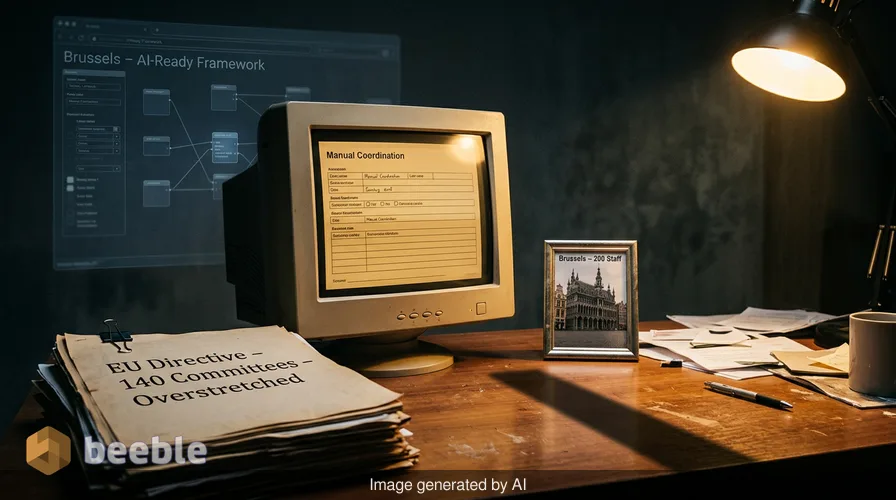
A single desk in a ministry in Vilnius or Valletta often holds the same weight as a twenty-person department in Brussels. According to a 2019 report by the Danish think tank Europa, staffing levels for national representations in the EU capital range from 69 to 200 people. While Western European powers like Germany and France maintain teams of 150 to 200 representatives, smaller or Eastern European states like Lithuania, Portugal, and Latvia operate with fewer than 90. This numerical gap is a structural divide that determines who writes the rules and who merely reads them. On a macro level, the European Union has transitioned into a state of liquid modernity where legislative speed outpaces the traditional administrative habitus of its member states.
The administrative archipelago
Sociologically speaking, the European Union functions as an archipelago where institutions are densely packed but the national capitals remain isolated by their own bureaucratic limitations. In Brussels, the European Commission is already moving toward an AI-ready framework to manage an increasingly complex workload. In contrast, many national ministries still rely on manual coordination and legacy systems that fail to catch the nuance of fast-moving files. This is a systemic failure of synchronization. When a new directive arrives in a national capital, it often enters a department that is already overstretched by the 140 different committees and working parties active in Brussels. The result is a form of urban alienation within the political sphere; officials are present in the room but they are atomized from the decision-making core.
Historically, member states could rely on the flexibility of directives to adapt EU law to their domestic realities. Today, the shift toward a more integrated Single Market and the use of regulations over directives leaves less room for local interpretation. This requires a proactive stance that most capitals cannot maintain without a significant investment in human capital. Zooming out, we see a shift in the power dynamics of the Union where technical capacity is becoming the new currency of influence. A country with 69 representatives is a country that reacts; a country with 200 is a country that leads.
The arithmetic of exclusion
There is a visceral frustration in the offices of smaller member states during their Council presidencies. The core staff is overstretched and the difficulty of hiring external talent is high. This manpower deficit is a silent tax on smaller nations. While the EU Commission considers the deployment of its own officials to national capitals to boost local influence, member states are not reciprocating this effort in Brussels. Consequently, the representation of national interests becomes a performative act rather than a substantive one. The middle group of nations—including Spain, Poland, and the Netherlands—maintains a stable presence of 103 to 147 employees, yet even they struggle with the accelerating legislative speed of the current mandate.
Through this lens, the administrative capacity of a nation is its primary defense against marginalization. The gap is a technological one. Brussels is experimenting with AI tools to summarize feedback and draft impact assessments. Meanwhile, the civil servant in a smaller capital is still struggling with the sheer volume of emails and horizontal coordination between different ministries. This lack of a horizontal approach at the ministerial level leads to fragmented policy stances. Ultimately, this leaves some member states as mere observers of a process they are supposed to co-govern.
The atomized stakeholder ecosystem
In a healthy democratic discourse, policymakers are the bridge between the state and a multifaceted ecosystem of industry, NGOs, and experts. In many smaller member states, this ecosystem is thin or non-existent. Industries are smaller and trade groups must operate as big-tent organizations to survive. As a result, the feedback loop between the public and the policymakers is broken. Paradoxically, the public debate on EU legislation often begins only when the law is already passed and the transposition phase starts. At this point, the structural changes are already fixed. The discussion remains superficial and trapped between official press releases and a pessimistic, defeatist local narrative.
This lack of an ecosystem-led approach is a symptom of a larger cultural shift where the private sector lacks a philanthropic or collaborative relationship with the state. Without timely and constructive feedback, officials make decisions based on limited interactions or purely inter-institutional dialogue. This creates a vacuum where only the loudest or most proactive stakeholders are heard. Linguistically speaking, the language of EU policy becomes a dialect that only the initiated can speak, further isolating the general public from the processes that govern their daily lives.
Technological divergence as a systemic risk
Innovation in the public sector is a necessity for survival in a pragmatically federated Europe. The Estonian government has understood this by prioritizing AI at the highest political level. They recognize that if AI improves labor productivity in the private sector, it is equally useful for the state. However, the available data on staff numbers suggests that most ministries of finance still view EU affairs as an area for cost-cutting. This is a profound error in judgment. EU lawmaking is vast and complex; it requires a level of investment that matches its impact on the national economy.
Custom-made AI solutions offer a way to bridge the gap without a massive increase in headcount. These tools can manage time constraints, retain institutional memory, and coordinate stances across different departments. By collecting relevant data and outlining administrative structures, countries can rethink their entire modus operandi. Behind the scenes of this trend, the European Commission is already introducing new IT tools to improve the quality of lawmaking. A failure to adopt these tools at the national level will result in a permanent administrative underclass within the Union.
The Irish blueprint for engagement
There are models of success that provide food for thought for the rest of the bloc. Ireland has adopted a public consultation system that mirrors the "Have Your Say" platform of the EU. This approach is transparent and inclusive. It invites stakeholders to share views on specific legislative files, such as the Digital Networks Act, long before the final decisions are made. This framework allows all parties to voice their perspectives publicly. It increases the accountability of policymakers and builds trust in local institutions.
In everyday terms, this shifts the role of the citizen from a passive recipient of laws to an active participant in their creation. While some fear that such open systems lead to administrative chaos, the traditional methods of roundtables and ad hoc meetings are clearly no longer effective. The Irish model proves that transparency is a tool for efficiency, not a barrier to it. This mechanism helps to overcome the opaque nature of traditional bureaucracy and fosters a more resilient relationship between the state and its people.
Rethinking the collective habitus
On an individual level, we must recognize that the laws governing our technology, our climate, and our economy are no longer purely national products. They are the result of a complex, high-speed negotiation in which our representatives are often outnumbered and outpaced. This realization requires a shift in perspective. We should view the administrative capacity of our national capitals not as a bloated bureaucracy, but as the essential infrastructure of our modern sovereignty. When our capitals fall behind, our ability to shape our own future diminishes.
Ultimately, the challenge is to move beyond a defeatist approach to EU affairs. We must demand that our governments invest in the staff and the technology required to participate effectively in the Brussels machine. This is a matter of democratic legitimacy. A Union where only a few well-resourced capitals can truly participate is a Union that is fragmented at its core. We must look at our own national routines and ask if they are fit for the speed of the world we have built. The architecture of our democracy is only as strong as the people and the tools we put inside it.
Sources
Danish Think Tank Europa. (2019). Staffing of EU Permanent Representations.
European Commission. (2024). Communication on Better Regulation.
Government of Ireland. (2025). Public Consultation on the Digital Networks Act.
Government of Estonia. (2026). AI Strategy for the Public Sector.



See you on the other side.
Our end-to-end encrypted email and cloud storage solution provides the most powerful means of secure data exchange, ensuring the safety and privacy of your data.
/ Create a free account
