


The silent shift from paper dollars to digital gold bars

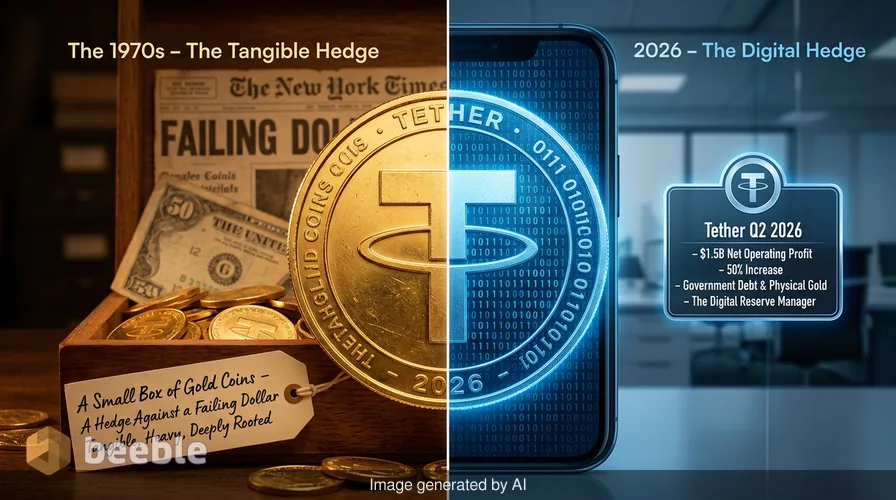
In the early 1970s, a family might have kept a small box of gold coins as a hedge against a failing dollar. This was a tangible, heavy, and deeply rooted way to protect value when the global economy felt fragile. Today, that same impulse for security exists in a digital form through the smartphone in your pocket. Tether, the issuer of the world’s most used stablecoin, USDT, just released its second-quarter report for 2026. The numbers are staggering and reflect a profound change in how money moves across borders. The company reported a net operating profit of $1.5 billion for the quarter. This is a 50% increase from the start of the year. While traditional banks struggle with shifting interest rates and office space vacancies, this digital reserve manager is amassing a fortune in government debt and physical gold.
The mechanics of a digital treasury
To understand how a company makes $1.5 billion in three months without charging you a fee to use its token, we must look at the hidden plumbing of the financial system. When you buy USDT, you give Tether a dollar. Tether does not let that dollar sit in a dusty vault. Instead, the company buys short-term U.S. Treasuries and other liquid assets. These investments pay interest. In everyday terms, Tether is like a giant savings account where the bank keeps all the interest for itself while you get the convenience of a digital dollar that moves instantly.
On a macro level, this creates a fascinating paradox. The U.S. government issues debt to fund its operations, and Tether is now one of the largest buyers of that debt. By the end of June 2026, Tether held approximately $187.75 billion in total assets. The majority of these assets are short-term government bonds. These are the same instruments that your local bank uses to stay solvent. Paradoxically, the very system that crypto was meant to replace—government-backed debt—is the exact foundation that makes the largest stablecoin possible.
A massive hoard of physical gold
One of the most striking details in the Q2 report is Tether's appetite for gold. During these three months, the company added 14 metric tons of physical gold to its reserves. Its total holdings now exceed 146 metric tons. To put that in perspective, this is more gold than the central banks of many developed nations hold. Curiously, while the world moves toward purely digital finance, the most successful digital dollar issuer is anchoring itself in the oldest form of money humans have ever known.
Zooming out, this gold purchase is a defensive move. Gold is a tangible asset with no counterparty risk. If a bank fails, the gold is still there. If a government defaults, the gold is still there. Tether is building a reserve that looks less like a tech startup and more like a 19th-century central bank. This strategy provides a cushion against market volatility. The report shows that Tether’s reserves now exceed its liabilities by $4.11 billion. This surplus is the financial equivalent of a forest fire break; it ensures that even if a large number of people want their money back at once, the system remains resilient.
The evolution of the global wallet
For an individual in a country with high inflation, USDT is not a speculative investment. It is a tool for survival. Historically, people in fragmented economies had to buy physical dollars on the black market to protect their savings. Today, they use a digital wallet. Tether CEO Paolo Ardoino noted that the company is delivering financial inclusion in the developing world. In practice, this means a street vendor in Argentina or a freelancer in Nigeria can hold a currency that stays stable relative to the dollar.
Financially speaking, the stablecoin market actually shrank during the second quarter of 2026. Yet, Tether’s circulation grew to $184.6 billion. This suggests a flight to quality or, at the very least, a flight to the biggest player. Tether now controls more than 60% of the stablecoin market. When the broader market is uncertain, people tend to cluster around the largest pool of liquidity. Liquidity is the ability to turn your assets into spendable cash quickly. In the digital world, USDT is the most liquid asset available.
Risk management and the shift away from lending
Behind the scenes of this trend, Tether is changing how it manages risk. In previous years, the company faced criticism for its secured lending practices. Critics worried that if those loans failed, the backing for USDT would vanish. In the Q2 report, Tether revealed it reduced its secured lending exposure by $2.38 billion. This is a 15% reduction in just three months.
Ultimately, this shift makes the company’s balance sheet more transparent and less speculative. By moving away from private loans and toward U.S. Treasuries and gold, Tether is aligning itself with the most conservative practices of traditional finance. The company is trading potential high returns from risky loans for the systemic safety of government-backed assets. From a consumer standpoint, this is a positive development. It means the "glass bank vault" is becoming easier to see through, and the assets inside are getting harder and heavier.
Beyond the artificial intelligence hype
Many technology firms are currently pouring billions into artificial intelligence valuations. These companies often bet on future growth that may or may not arrive. Ardoino contrasted Tether’s strategy with this trend. Tether is investing its profits into technologies that expand financial access rather than just chasing the next stock market darling. While the stock market acts as a global mood ring—swinging wildly based on the latest AI news—Tether is positioning itself as a mundane utility.
Through this economic lens, we see a company that is becoming a structural part of the global economy. It is no longer just a crypto tool. It is a massive repo market participant, a major holder of U.S. debt, and a significant player in the global gold market. The $1.5 billion profit is a symptom of a world that is hungry for dollars but frustrated by the traditional ways of moving them.
Cultivating a mindful financial perspective
As we observe these massive shifts in global liquidity and digital reserves, it is easy to feel small. A $1.5 billion profit for a single company feels disconnected from the price of a gallon of milk. However, the connection is direct. The same inflation that makes your groceries more expensive is what drives the demand for stable assets like gold and USDT. The high interest rates that make your credit card balance harder to pay off are the same rates that Tether uses to generate its billions in profit.
Instead of viewing crypto as a separate world, we should see it as a mirror of our current economic reality. The success of Tether is a signal that trust is shifting. People are looking for alternatives to traditional banking, even if those alternatives are built on the same U.S. debt that anchors the old system. We should reflect on where we place our own trust. Whether you hold cash, gold, or digital tokens, the goal remains the same: to find a safe harbor in a volatile world. Understanding the mechanics of these digital giants helps us make more informed decisions about our own financial futures.
Sources:
- Tether Q2 2026 Assurance Opinion (BDO Italy)
- U.S. Treasury Holdings Report (June 2026)
- World Gold Council Central Bank Reserves Data
- Stablecoin Market Share Index (DeFiLlama)



See you on the other side.
Our end-to-end encrypted email and cloud storage solution provides the most powerful means of secure data exchange, ensuring the safety and privacy of your data.
/ Create a free account
