


The silent shift: how global banks are turning stablecoins into the new plumbing for cash

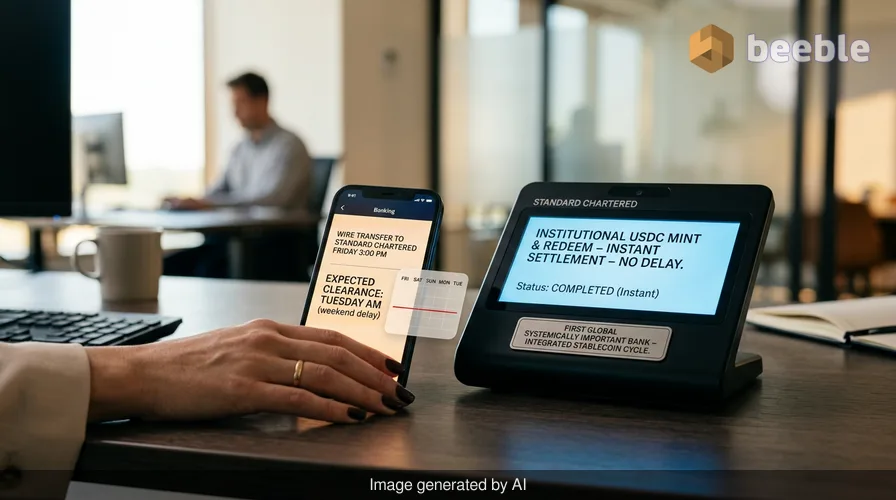
Most people experience modern banking through a smartphone app that feels instantaneous until they try to move money across a border or wait for a paycheck to clear. You tap a button on a Friday afternoon, but the funds do not arrive until Tuesday morning. This delay is a relic of a paper-based era, a structural lag where digital numbers still wait for manual approvals behind the scenes. On a macro level, this friction is more than an inconvenience; it is a massive inefficiency that ties up trillions of dollars in global trade every year. Standard Chartered just took a step to erase this lag by becoming the first Global Systemically Important Bank to let institutions mint and redeem USDC directly through their own accounts.
Historically, banks and crypto firms lived in different worlds. If a large corporation wanted to use a stablecoin like USDC for faster payments, they had to open an account with Circle, the private company that issues the coin. They then had to move money from their bank to Circle, wait for the transfer, and then finally get their digital assets. Consequently, the process was fragmented. Standard Chartered is changing this by integrating the entire cycle into its own banking platform. Now, a multi-national company can swap fiat currency for digital dollars without ever leaving the bank. This is a profound shift in how the largest financial institutions in the world view blockchain technology.
The glass bank vault and the end of the business day
To understand why this matters, we must look at how money moves today. Imagine the current banking system as a series of opaque, heavy steel safes scattered across the globe. To move money from one to another, you need a long chain of messengers and ledgers to verify the transfer. In contrast, the blockchain is like a glass bank vault. Everyone can see the money inside, and the rules for moving it are written in public code. Only the owner has the key, but the transaction happens in seconds, not days. By offering USDC services, Standard Chartered is essentially putting a door on its traditional vault that leads directly into this glass vault.
This move targets the mundane but essential tasks of treasury and liquidity management. When a global shipping company needs to pay for fuel in a foreign port, they often have to hold massive amounts of cash in various local currencies. This cash sits idle, losing value to inflation or becoming trapped by banking holidays. Stablecoins allow these companies to move value instantly, regardless of what time it is or what day the calendar says. Standard Chartered is the first of the roughly 30 banks deemed too big to fail to offer this bridge, signaling that the traditional financial guard is no longer just observing the digital asset space; they are building the infrastructure to own it.
The paradox of systemic importance
Through this economic lens, we see a fascinating contradiction in how we trust money. Standard Chartered is a Global Systemically Important Bank (G-SIB). This designation means regulators consider the bank so interconnected with the global economy that its failure would trigger a systemic crisis. Paradoxically, these are the very institutions that were once most skeptical of decentralized finance. The designation brings heavy oversight and strict capital requirements. For such a bank to offer USDC indicates that the regulatory environment has shifted from hostility to integration.
In everyday terms, this is like a major utility company suddenly deciding that every home should have solar panels but still wants to be the one to install and manage them. The bank is not trying to replace the dollar; it is trying to give the dollar a faster set of tracks to run on. This integration helps institutions access new opportunities while maintaining the compliance and risk management standards they expect. It is a move away from the speculative wild west of early crypto and toward a transparent, regulated utility. Curiously, this institutional embrace often happens just as retail interest in the same assets begins to wane during market cycles, showing a clear divide between professional strategy and public sentiment.
Why Dubai is the first laboratory
Standard Chartered is launching this service first through its operations in the Dubai International Financial Center. This choice is not accidental. While many regions have struggled with confusing or contradictory rules, Dubai has established a clear framework for digital assets through its Virtual Assets Regulatory Authority. On an individual level, we see this pattern everywhere: capital flows to where the rules are clear and the environment is predictable. The bank plans to expand this global stablecoin strategy to other markets, but only as local regulators catch up.
This geographical rollout reflects the fragmented state of global finance. Even as we move toward a more interconnected digital world, the physical location of a bank branch still dictates what a customer can and cannot do. Standard Chartered is navigating this by using Dubai as a proof of concept. If they can successfully manage institutional USDC flows there without compromising their systemic stability, other financial hubs like London, Singapore, and eventually New York are likely to follow. The goal is to create a seamless experience where a treasurer in London can settle a debt in Tokyo using USDC minted in Dubai, all within a single banking relationship.
The battle for the future of digital dollars
Behind the scenes of this trend, a quiet war for dominance is brewing. Circle, the issuer of USDC, recently saw its stock price pop by 9% following the Standard Chartered announcement. However, the market remains volatile. Just days before, the stock fell when a rival stablecoin called Open USD was announced, backed by a massive coalition of 140 firms including Coinbase. This competition is symptomatic of a larger realization: the company that controls the most trusted digital dollar will likely control the plumbing of the next generation of finance.
| Feature | Traditional Bank Wire | Institutional USDC (via SCB) |
|---|---|---|
| Settlement Speed | 1 to 5 Business Days | Near-Instant (24/7) |
| Intermediaries | Multiple Correspondent Banks | Single Bank Platform |
| Transparency | Opaque Tracking | Public Blockchain Ledger |
| Accessibility | Bank Hours Only | Always Available |
| Account Requirement | Direct Bank Relationship | Single Onboarding Experience |
This competition is healthy for the system because it forces providers to lower fees and increase transparency. But for the average observer, it can feel like a speculative mess. Zooming out, we can see that the real winners are not necessarily the issuers of the coins, but the institutions that make these coins easy and safe to use. By removing the need for a separate account at Circle, Standard Chartered is simplifying the user experience for corporations that are traditionally risk-averse. They are making the blockchain feel like just another tab in a standard banking portal.
In everyday terms: how this reaches your wallet
Practically speaking, you might never hold USDC in your own personal bank account, but this shift will still affect your finances. When the underlying cost of moving money drops for big companies, those savings eventually trickle down into the prices of goods and services. A more efficient global payment system means companies can manage their supply chains with less overhead. It also means that in the future, your own bank might offer you a way to send money to a relative abroad that clears instantly and costs pennies, powered by the same infrastructure Standard Chartered is building now.
Ultimately, this is about the evolution of trust. We are moving from a world where we trust a bank because it has a large building and a long history, to a world where we trust a bank because it uses technology that is verifiable and fast. Standard Chartered is betting that their institutional clients want both. They want the reputation of a 160-year-old bank and the speed of a public blockchain. This launch is the first major proof that these two worlds are no longer mutually exclusive.
Food for thought
- Observe your banking delays: The next time you wait for a transfer to clear, ask yourself who is currently holding that money and what they are doing with it while it is "in flight."
- Question the "business day": As global banks move toward 24/7 blockchain settlement, the concept of a business day will become an elective choice rather than a technical necessity.
- Look at the plumbing: Most financial innovation happens in the infrastructure that you never see. The real revolution is not a new coin you can buy, but a new way for the money you already have to move faster.
- Re-evaluate your trust: Do you trust a government-backed institution more than a code-based protocol, or do you prefer a hybrid of both?
Sources
- Standard Chartered Press Release (July 2026)
- Circle Internet Group Commercial Reports
- Financial Stability Board (FSB) G-SIB List 2025
- Dubai International Financial Center (DIFC) Regulatory Filings
- Yahoo Finance Market Data (CRCL)



See you on the other side.
Our end-to-end encrypted email and cloud storage solution provides the most powerful means of secure data exchange, ensuring the safety and privacy of your data.
/ Create a free account
