


The Silicon Sovereignty: Why the 'Mined in America Act' Matters for Your Wallet

Have you ever turned over a kitchen appliance or a pair of sneakers to find that familiar 'Made in China' stamp and wondered how much of your daily life actually belongs to a global supply chain you can’t see? We often think of our digital lives as being untethered from the physical world, floating somewhere in a cloud of code and light. But the reality of our money—especially the burgeoning world of Bitcoin—is deeply rooted in heavy machinery, humming cooling fans, and massive amounts of electricity.
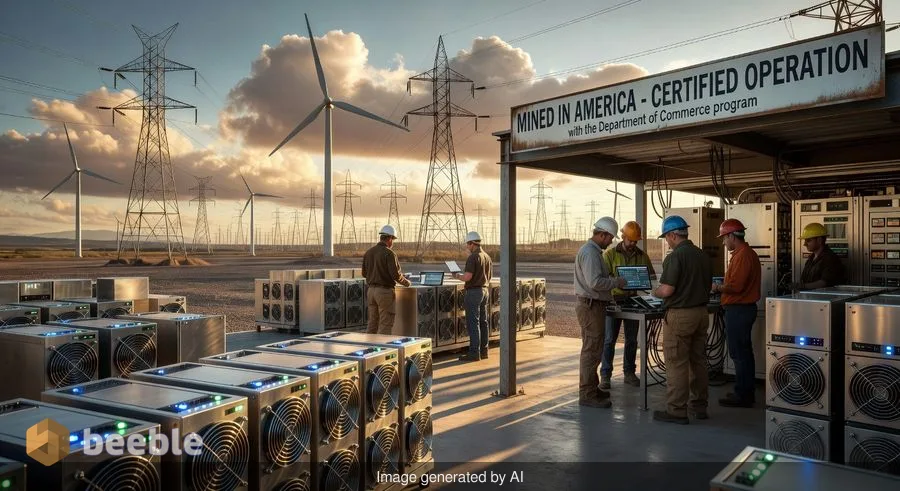
Recently, Senators Bill Cassidy and Cynthia Lummis introduced the Mined in America Act, a piece of legislation that aims to bring the physical backbone of the Bitcoin network back to U.S. soil. On the surface, it looks like a standard trade policy. However, zooming out, it represents a profound shift in how we view the security of our financial future. If Bitcoin is becoming a systemic part of the global economy, who owns the tools that create it?
The Invisible Label on Your Digital Assets
To understand why this bill matters, we have to look at a curious paradox in the current crypto landscape. Currently, the United States accounts for about 38% of the global Bitcoin hash rate—the computational power used to secure the network. That sounds like a position of strength. Yet, behind the scenes of this trend, a staggering 97% of the hardware powering those American mines comes from China.
In everyday terms, it’s like owning a fleet of high-tech electric cars but realizing that every single replacement part and the software updates are controlled by a competitor who could turn them off at any moment. For the average person holding a bit of Bitcoin in a digital wallet, this might seem like a distant concern. But financially speaking, if the hardware supply chain is compromised, the very security that makes Bitcoin a 'glass bank vault'—where everyone can see the transactions but no one can force the lock—becomes vulnerable to external pressures.
The Mined in America Act: More Than Just a Sticker
The proposed legislation doesn't just slap a flag on a server rack. It directs the Department of Commerce to create a voluntary certification program for mining facilities. To get the 'Mined in America' seal of approval, these operations would need to transition away from equipment manufactured by foreign adversaries.
Rather than printing new money or creating massive federal debt to fund this, the bill cleverly integrates these projects into existing energy and rural development programs. It’s a pragmatic approach. By supporting the National Institute of Standards and Technology (NIST) in developing energy-efficient hardware domestically, the government is essentially trying to jumpstart a new manufacturing sector. For a resident in a rural town, this isn't just about 'digital gold'; it’s about the tangible possibility of high-tech jobs and a more resilient local power grid.
The Strategic Reserve: A New Kind of National Savings Account
Perhaps the most talked-about provision of the bill is the formal establishment of a Strategic Bitcoin Reserve within the Treasury. This codifies an idea previously suggested by the executive branch, treating Bitcoin not as a volatile toy for speculators, but as a sovereign asset.
Historically, nations have held gold, foreign currencies, and oil as a hedge against uncertainty. Adding Bitcoin to this mix is a symbolic acknowledgement that the digital economy is here to stay. On an individual level, think of this as the government setting up a rainy-day fund that isn't tied to the traditional inflationary pressures of the dollar. While the dollar remains our primary collective belief system, a Bitcoin reserve acts as a structural insurance policy against a shifting global financial landscape.
Strengthening the Grid, One Block at a Time
One of the most pervasive myths about Bitcoin mining is that it is purely a drain on resources. Paradoxically, the Mined in America Act views mining as a tool for grid stabilization. Because mining rigs can be turned off almost instantly during peak demand, they act as a 'flexible load.'
In practice, this means that a mining facility in a rural area can pay for the build-out of renewable energy infrastructure that wouldn't otherwise be profitable. When a heatwave hits and everyone turns on their air conditioning, the miners power down, leaving that extra energy for the community. It’s an interconnected system where the pursuit of digital currency helps secure the physical comfort of your home.
The Behavioral Shift: From Speculation to Sovereignty
From a consumer standpoint, the importance of this bill lies in the psychological shift it signals. For years, Bitcoin has been viewed through the lens of the 'digital wild west'—a place of high risk and opaque actors. By bringing the manufacturing and the mining process under a transparent, domestic regulatory framework, the government is attempting to reduce the systemic risk that keeps many conservative savers on the sidelines.
We often see market cycles driven by the twin engines of greed and fear. When we hear that our financial infrastructure is dependent on a foreign adversary, fear takes the wheel. When we see domestic investment and clear legal standards, that fear is replaced by a sense of structural resilience. This bill is an attempt to move Bitcoin from the 'speculative' column of the national ledger into the 'infrastructure' column.
Food for Thought
As we watch this legislation move through the halls of power, it’s worth reflecting on our own relationship with the tools of our trade.
- Question your dependencies: Just as the U.S. is looking at its hardware supply chain, look at your own financial 'supply chain.' Are you overly dependent on a single institution or a single type of asset?
- Observe the physical roots: The next time you see a headline about a 'digital' trend, ask yourself where the physical machinery lives. Who builds it, and who powers it?
- Reclaim your perspective: Financial sovereignty isn't just about owning an asset; it's about understanding the systems that support it. Awareness is the first step toward moving from a passive consumer to an informed participant in the global economy.
Ultimately, the Mined in America Act is a reminder that even in an increasingly decentralized world, geography still matters. The 'glass bank vault' is only as strong as the steel and silicon used to build it.
Sources:
- U.S. Senate Press Gallery: Summary of the Mined in America Act (March 2026).
- Satoshi Action Fund: Report on Global Bitcoin Hash Rate and Hardware Distribution (2025-2026).
- Department of Commerce: Preliminary Guidelines on Digital Asset Manufacturing Standards.
- National Institute of Standards and Technology (NIST): Energy Efficiency in High-Performance Computing Report.



See you on the other side.
Our end-to-end encrypted email and cloud storage solution provides the most powerful means of secure data exchange, ensuring the safety and privacy of your data.
/ Create a free account
