


The Strange Sight of Hotel Staff Wearing Cameras to Teach Their Future Replacements

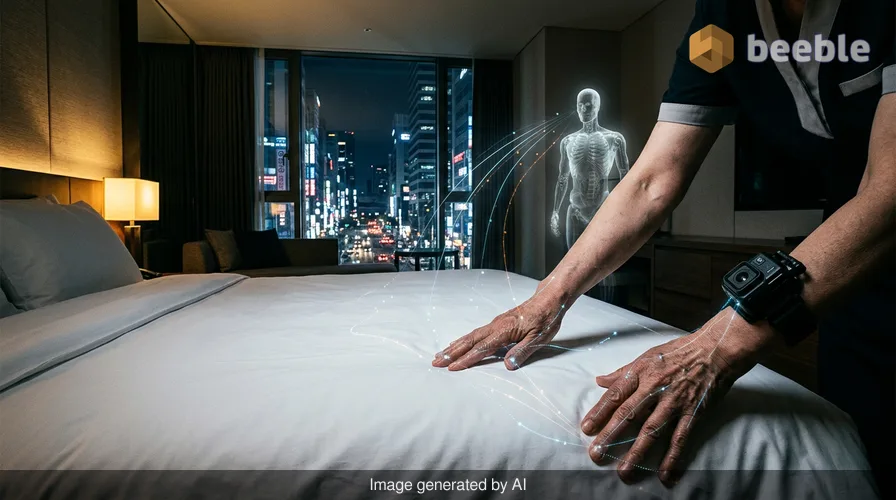
Step into a luxury hotel in Seoul’s bustling Gangnam district today, and you might notice something unusual. It isn’t the sleek décor or the automated check-in kiosks that catch the eye, but rather the staff. As a housekeeper smooths the linens on a king-sized bed or a concierge carefully arranges a welcome basket of seasonal fruit, they aren’t just working—they are being watched. Mounted to their wrists and the backs of their hands are tiny, high-definition cameras, capturing every micro-movement of their fingers.
Behind the scenes, this isn’t about surveillance in the traditional sense. These workers are acting as the foundational data source for a new generation of humanoid robots. By tracing the journey from a perfectly folded towel back to the data centers processing these movements, we can see how the hospitality industry is attempting to solve a systemic labor crisis with a disruptive blend of human intuition and robotic precision.
The Digital Apprentice in the Lobby
For years, robots in hotels were little more than glorified vacuum cleaners or motorized boxes that brought you extra pillows. They were programmed with rigid logic: move from point A to point B, avoid the elevator door, and stop if a child runs in front of you. While useful, they were incapable of the nuanced, tactile tasks that define high-end service. You couldn't ask a wheeled box to carefully unpack a designer suit or polish a delicate wine glass without it ending in disaster.
To put it another way, robots lacked the dexterity that humans take for granted. This is where the Korean hospitality sector is pivoting. By using egocentric cameras—cameras that see exactly what the human sees—developers are treating AI as a tireless intern. This intern doesn't learn through lines of code, but through imitation. When a human worker wears these cameras, every flick of the wrist and pressure point of the thumb is recorded. This data is then fed into a neural network that allows a humanoid robot to replicate the motion. Essentially, the human is the master craftsman, and the robot is the apprentice shadow-boxing every move until it achieves a scalable level of proficiency.
Under the Hood: Why Cameras on Hands?
Historically, training robots required expensive motion-capture suits or labor-intensive manual programming. Both were impractical for the messy, unpredictable environment of a hotel. A hotel room isn't a controlled factory floor; it’s a volatile space where every guest leaves things in a different spot.
From a technical standpoint, the cameras on the workers' hands provide what researchers call 'first-person demonstration data.' By seeing the world through the worker's perspective, the AI learns the relationship between its "hands" and the objects it interacts with. If a worker picks up a glass, the AI sees how the fingers wrap around the rim, how the weight shifts, and how the arm compensates for the movement.
This process, known as imitation learning, is the digital crude oil of the modern robotics age. The goal is to create a robust library of movements that can be deployed across a fleet of humanoids. Once one robot learns to perfectly tuck a sheet, that knowledge can be instantly uploaded to ten thousand others. It is the ultimate form of streamlined training.
The Economic Engine: Solving the Labor Puzzle
Looking at the big picture, this isn't just a tech experiment; it’s a response to a harsh economic reality. South Korea is currently facing an unprecedented demographic shift. With one of the lowest birth rates in the world, the pool of service-level workers is shrinking rapidly. The hotel industry, which relies heavily on physical presence and repetitive tasks, is feeling the squeeze more than most.
On the market side, the cost of human labor is rising while the cost of humanoid hardware is beginning to follow a downward, cyclical path similar to that of flat-screen TVs or smartphones. For a hotel group, investing millions into a training program today is a hedge against a future where there simply aren't enough humans to staff the night shift.
| Feature | Traditional Automation | Humanoid Imitation Learning |
|---|---|---|
| Task Range | Single-purpose (e.g., floor cleaning) | Multi-purpose (e.g., cleaning, tidying, carrying) |
| Environment | Must be mapped/static | Dynamic and adaptable |
| Training Method | Hard-coded software | Observation of human workers |
| Deployment Cost | Lower initial, limited utility | Higher initial, highly scalable |
| User Interaction | Functional/Mechanical | Intuitive/Human-like |
What This Means for the Everyday Guest
For the average user, the arrival of these digital apprentices brings up a mix of curiosity and skepticism. Practically speaking, the most immediate impact will be on the consistency of service. A robot doesn't get tired at 3:00 AM, and it doesn't forget to check if the minibar is stocked. From a consumer standpoint, we might see a more transparent pricing model where "human-serviced" rooms become a premium tier, while "robot-serviced" rooms offer a more affordable, yet highly efficient, alternative.
However, there is an opaque side to this development that involves privacy. If a robot is trained by watching humans, and eventually operates by "seeing" the environment, what happens to the data it collects while cleaning your room? While the industry promises that these robots are decentralized and respect guest privacy by processing data locally, the interconnected nature of modern AI means that some level of data sharing is almost inevitable.
The Shift from Manual to Managerial
Curiously, this shift doesn't necessarily mean the end of human jobs in hotels, but rather a transformation of what those jobs look like. The workers currently wearing cameras aren't just cleaners; they are becoming "data curators." Their value is no longer just in the physical act of cleaning, but in their ability to perform that act with a level of grace and efficiency that is worth duplicating.
Zooming out, we are witnessing the democratization of high-end robotics. What starts in a luxury hotel in Seoul will eventually find its way into hospitals, elder care facilities, and eventually, our own homes. The foundational movements being recorded today—how to hold a spoon, how to help someone sit up, how to open a door gently—are the building blocks of a more resilient service economy.
Looking Ahead: A New Kind of Hospitality
Ultimately, the sight of a hotel worker with cameras on their hands is a temporary bridge between two eras. Once the AI has gathered enough data to handle the overarching variety of human tasks, the cameras will come off. The human role will shift toward guest relations, empathy, and managing the fleet of robotic assistants that handle the heavy lifting.
As a consumer, you shouldn't expect a robot to greet you with genuine warmth anytime soon—AI is still a poor substitute for authentic human connection. But you should expect that the next time you walk into a hotel room, the crispness of the sheets and the placement of the towels might be the result of a human’s expertise, delivered by a machine’s tireless hands.
It’s time to shift your perspective on automation. It isn't just about replacing people; it’s about capturing the best of what we do and making it accessible even when we aren't there to do it ourselves. Observe your next hotel stay closely; the invisible backbone of modern service is being rewritten, one recorded hand movement at a time.
Sources:
- International Federation of Robotics (IFR) World Robotics 2026 Report
- Korean Ministry of Trade, Industry and Energy: Service Robot Initiative
- Euronews Next: Humanoid Training Protocols in East Asia
- Journal of Robotic Hospitality and Automation Trends



See you on the other side.
Our end-to-end encrypted email and cloud storage solution provides the most powerful means of secure data exchange, ensuring the safety and privacy of your data.
/ Create a free account
