


The Structural Safety Gap: Why Your Online Bargains Are Breaking European Law

Imagine you are browsing an online marketplace for a new hair straightener. You find one for fifteen euros—a fraction of the price at your local electronics store. It looks identical, the reviews are glowing, and shipping is nearly free. You click buy, assuming that if a product is allowed to be sold in your country, it must have cleared some level of safety screening.
In reality, that assumption might be the most dangerous part of the transaction.
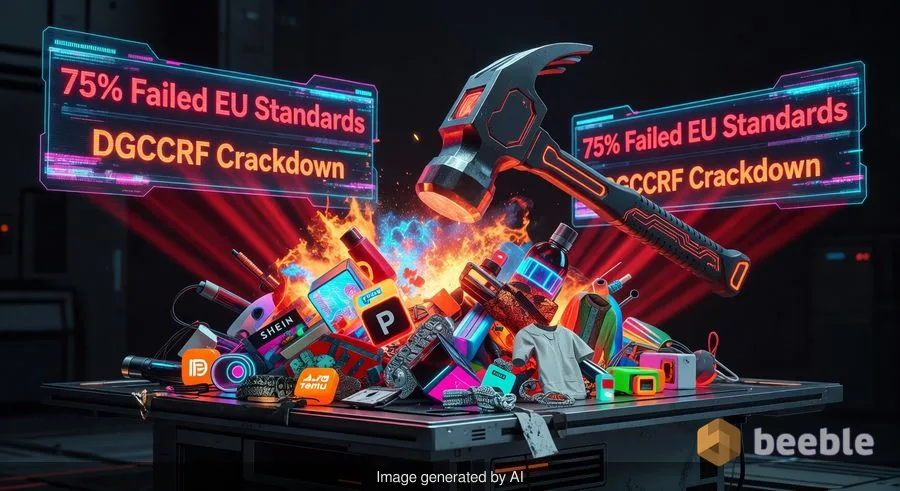
Recent data from France’s consumer protection authority, the DGCCRF, has pulled back the curtain on the staggering reality of international e-commerce. In a comprehensive study released this week, the regulator revealed that a whopping 75% of products tested from major foreign discount platforms failed to meet European Union standards. Even more concerning, 46% of those items were classified as both non-compliant and hazardous.
This is not a matter of a few bad apples or a minor labeling error. From a regulatory context, these figures suggest that the very business model of high-volume, low-cost direct shipping is built upon bypassing the safety shields that European law has spent decades perfecting.
The Direct-to-Consumer Loophole
For years, traditional retailers have acted as the gatekeepers of the European market. When a store like Carrefour or an electronics chain imports goods, they are legally liable—meaning they are held responsible by law—for ensuring every item meets stringent safety codes. They are the ones who face fines or lawsuits if a toy contains lead or a toaster explodes.
However, the rise of platforms like Temu, Shein, and AliExpress has shifted the burden. These companies often operate as marketplaces rather than traditional retailers. By shipping individual small parcels directly from factories to your front door, they often bypass the rigorous customs inspections that bulk shipments undergo. Furthermore, many of these parcels fall under a customs duty waiver for low-value goods, essentially creating a fast track into your home that avoids the usual regulatory checkpoints.
In the eyes of the law, when you buy from these platforms, you are often technically the importer of record. This places the consumer in a precarious position, as the robust safety net of EU consumer law is stretched thin when the seller is located thousands of miles away in a different jurisdiction—the geographic area where a specific set of laws and courts has authority.
Where the Risks Are Hiding
The DGCCRF did not test products at random; they focused on high-risk categories where a failure isn't just a nuisance, but a threat to life and limb. The results for electrical appliances were particularly grim. Every single hair-care device and small appliance tested was found to be non-compliant. Nearly three-quarters of them were deemed dangerous, presenting immediate risks of fire or electrical shock.
Children’s products were another minefield. The regulator identified widespread breaches involving choking hazards—small parts that detach too easily—and excessive levels of restricted chemicals. Jewelry and clothing were also flagged for containing heavy metals or dyes that are strictly regulated under EU health standards.
To put it another way, the 'bargain' you found might be subsidized by the absence of safety testing and quality control. While a five-euro necklace looks like a steal, the presence of cadmium or lead makes it a liability that no traditional store would dare put on its shelves.
The Shift from Accidents to Business Models
Perhaps the most striking takeaway from the French report is the shift in how officials are describing these failures. Regulators are moving away from treating these as isolated incidents. When three out of four products fail, the issue is systemic.
As one official noted during the briefing, such high failure rates indicate that non-compliance is part of the business model. By ignoring the costly process of ensuring statutory—or legally required—safety standards, these platforms can maintain price points that European manufacturers and compliant importers simply cannot match. This creates an uneven playing field where the 'cheapest' option is only cheap because it externalizes the risk onto the buyer.
Understanding the EU’s Response: The Digital Services Act
The European Commission is not standing idly by. It is currently wielding a powerful new tool called the Digital Services Act (DSA). This overarching framework is designed to hold massive online platforms accountable for the content and products they host. Under the DSA, the Commission has the power to impose fines of up to 6% of a company’s global turnover—a massive sum that could run into the billions.
Investigations are already underway into several of these giants. The goal is to force these platforms to implement better vetting processes, making it harder for dangerous goods to reach the market in the first place. Think of the DSA as a new set of digital brakes for a system that has been accelerating without much oversight for the last decade.
| Product Category | Failure Rate (Approx.) | Primary Risks Identified |
|---|---|---|
| Electrical Appliances | 100% | Fire, electrical shock, overheating |
| Children's Toys | High | Choking hazards, chemical toxicity |
| Jewelry & Fashion | Widespread | Heavy metals (lead/cadmium), skin irritants |
| Overall Testing Pool | 75% | Non-compliance with EU safety labels (CE) |
How to Protect Yourself in the Digital Wild West
While the law is catching up, the burden of proof—the obligation to prove that a product is safe or unsafe—often falls on the consumer in practice after a purchase is made. To stay safe while shopping online, consider the following strategy:
- Look for the 'CE' Mark, but Verify: The CE mark is a declaration by the manufacturer that the product meets EU standards. However, it is easily forged. Check if the seller provides a formal 'Declaration of Conformity' upon request.
- Price Check Against Reality: If a product that usually costs €50 is being sold for €5, ask yourself what was cut to make that price possible. Usually, it is the testing and high-quality components.
- Check the 'Sold By' Field: On large marketplaces, look at who the actual seller is. If they are a third-party entity with a string of random letters as a name and no physical address in the EU, your recourse—your legal right to a refund or compensation—will be nearly impossible to enforce.
- Avoid High-Risk Imports: For items that plug into a wall or go into a child's mouth, it is statistically safer to buy from a reputable retailer with a physical presence in your country.
What to Do If You’ve Bought a Dangerous Item
If you realize a product you bought is unsafe—perhaps it gets unusually hot, has a chemical smell, or parts break off easily—stop using it immediately. Do not simply throw it away; document the issue with photos.
In most European jurisdictions, you have a legal right to a refund for defective goods, but getting that money back from a foreign platform can be a marathon. Your best bet is to report the item to your national consumer protection agency (like the DGCCRF in France or the CMA in the UK). These reports are the fuel that regulators use to build cases against platforms, eventually leading to the kind of systemic change we are starting to see today.
Ultimately, the law should be a shield that protects you from harm. But in the fast-paced world of global e-commerce, that shield is still being forged for the digital age. Until it is complete, a healthy dose of skepticism is your best defense.
Sources:
- Directorate General for Competition, Consumer Affairs and Fraud Control (DGCCRF): 2025 E-commerce Compliance Report.
- EU Digital Services Act (DSA): Regulation (EU) 2022/2065 on a Single Market For Digital Services.
- General Product Safety Regulation (GPSR): Regulation (EU) 2023/988 on product safety requirements in the EU.
- French Court of Appeal (Paris): Ruling on marketplace suspension requests (March 2026).
Disclaimer: This article is for informational and educational purposes only and does not constitute formal legal advice. Laws regarding product liability and consumer rights can vary significantly by jurisdiction. If you have been injured by a defective product or require specific legal assistance, please consult a qualified attorney in your area.



See you on the other side.
Our end-to-end encrypted email and cloud storage solution provides the most powerful means of secure data exchange, ensuring the safety and privacy of your data.
/ Create a free account
