


The Sudden Transparency of Your Direct Messages

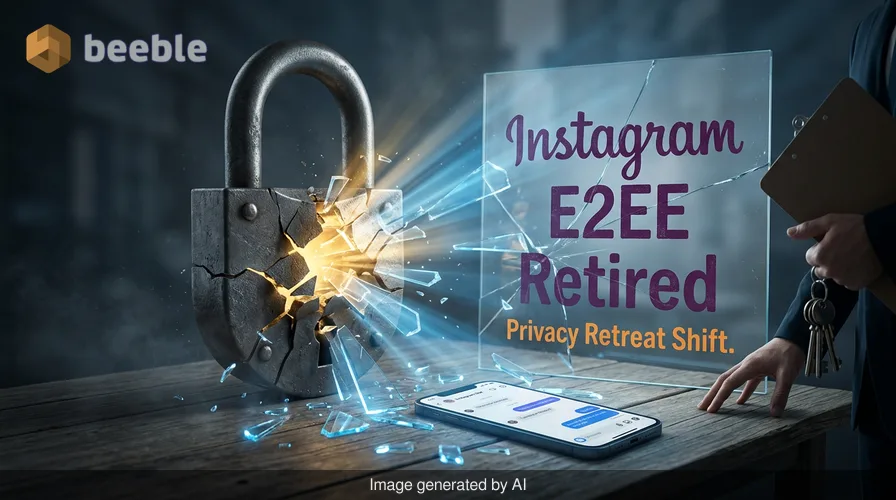
Yesterday, you could walk into a digital room on Instagram, lock the door, and know that not even the building's owner had a copy of the key. Today, that door has been replaced by a pane of glass; while you are still shielded from the strangers on the street, the landlord is now standing in the hallway with a master key and a clipboard. On May 8, 2026, Meta officially retired the option for end-to-end encrypted (E2EE) chats on Instagram, marking a significant retreat from a privacy-first vision that once defined the company’s long-term roadmap.
For the average user, the change might feel like a minor UI tweak or a footnote in a long list of terms-of-service updates. However, zooming out to the industry level, this shift represents a profound paradigm shift in how social media giants balance the competing pressures of user privacy, regulatory compliance, and the relentless march of algorithmic processing. To understand why your DMs are changing, we have to look under the hood at the engineering and philosophical conflicts that led to this moment.
The Illusion of the Lock
To grasp what has been lost, we must first define what was actually there. End-to-end encryption is often described as the gold standard of digital privacy. In practice, it means that data is scrambled on the sender’s device and only unscrambled on the recipient's device. For a brief window, Instagram offered this as an opt-in feature, creating a silo where even Meta’s own servers couldn't read the text of your messages or view your shared photos.
Technically speaking, this was a robust implementation of privacy that mirrored the architecture of Signal or WhatsApp. But as of this week, Instagram has reverted to "standard encryption." In everyday terms, this is the difference between sending a letter in a tamper-proof titanium box (E2EE) and sending it in a standard envelope (Standard Encryption). The envelope protects the letter from the mail carrier and the neighbors, but the post office—in this case, Meta—retains the technical ability to steam the envelope open if they have a reason to do so.
The Evolutionary Contrast: 2019 vs. 2026
In 2019, Mark Zuckerberg famously declared that "the future is private," signaling a pivot toward ephemeral, encrypted communication across the entire Meta ecosystem. Paradoxically, the 2026 reality is one of curated visibility; where the previous decade sought to build unbreakable walls for the individual, this new era seeks to install monitored windows for the collective.
The industry has moved from a period of disruption to a period of pragmatism. In 2019, encryption was a marketing shield against the fallout of data scandals; in 2026, transparency is a legal shield against the pressure of global safety regulations. This evolution highlights a stark industry shift: the idealistic goal of total user anonymity has been deprecated in favor of a more manageable, centralized oversight model.
The Regulatory Squeeze and Child Safety
Meta’s primary justification for this retreat centers on child sexual abuse (CSA) prevention and general platform safety. For years, government bodies and safety organizations have argued that E2EE creates a "dark space" where predatory behavior can flourish undetected. From a developer's standpoint, building a safe platform while maintaining E2EE is a monumental task—it requires moving safety detection from the server to the user's device (client-side scanning), a move that privacy advocates have historically decried as a backdoor.
Consequently, Meta has chosen the path of least resistance. By reverting to standard encryption, they regain the ability to run automated safety filters on the server side. This allows the platform to flag prohibited content before it reaches a recipient, satisfying regulators who have grown increasingly impatient with the "encryption-at-all-costs" mindset. It is a classic example of the friction between individual rights and institutional responsibilities.
Encryption Tiers at a Glance
To help visualize where Instagram now sits in the broader ecosystem, consider the following comparison of how various platforms handle your data:
| Platform | Encryption Type | Who Can Read the Content? |
|---|---|---|
| Signal / WhatsApp | End-to-End (Default) | Only sender and recipient |
| Facebook Messenger | End-to-End (Default) | Only sender and recipient |
| Instagram (Post-May 2026) | Standard (TLS/SSL) | Sender, Recipient, and Meta |
| Gmail | Standard (TLS/SSL) | Sender, Recipient, and Google |
| Telegram | Standard (E2EE is Opt-in) | Sender, Recipient, and Telegram |
Technical Debt and the Cost of Privacy
Beyond the headlines of safety and regulation lies the mundane reality of software architecture. Instagram was never built as an encrypted-first platform; it is a legacy application that has been bloated with features over nearly two decades. Retrofitting E2EE onto a fragmented codebase that supports everything from ephemeral "Stories" to complex shopping APIs is an engineering nightmare.
Meta reported that the uptake for E2EE chats on Instagram was limited. For a product manager, maintaining a high-security feature that only 5% of users utilize is often viewed through the lens of technical debt. Every new feature—like AI-powered message summaries or integrated chatbots—becomes significantly more complex to build if the underlying data is encrypted. By dropping E2EE, Meta has streamlined its development pipeline, allowing for faster deployment of the proprietary AI features that are currently driving the company’s stock price.
The AI Elephant in the Room
While Meta has clarified to outlets like Snopes that it does not use private DMs to train its generative AI models, the removal of E2EE removes the technical barrier to doing so in the future. In a proprietary ecosystem, the only thing preventing a company from accessing your data is their own policy—and policies can be updated with a single click.
Through this user lens, the move feels like a loss of digital agency. When encryption is baked into the code, you are protected by the laws of mathematics; when it is removed, you are protected only by a corporate promise. For users who rely on Instagram for professional networking or sensitive community organizing, this shift highlights the fragility of trusting a centralized platform with private communication.
Reclaiming Your Digital Perimeter
This change is a reminder that the apps we use for entertainment are rarely the ones we should use for our most sensitive interactions. Instagram remains an intuitive, seamless tool for visual storytelling and casual socializing, but its days as a secure communication channel are officially over.
Ultimately, we must recognize that no single app can be everything to everyone. As users, we should become more multifaceted in our choice of tools. If you are discussing a business merger, sharing sensitive medical information, or managing financial details, you should move that conversation to a platform where privacy is a core architectural requirement, not a deprecated feature.
As you navigate this newly transparent landscape, ask yourself: which parts of my digital life belong in the public square, and which parts deserve the silence of an unbreakable lock? The "private" era of Instagram was a brief, experimental chapter; now that the book is closed, it is up to us to decide where we write our next secret.
Sources
- Meta Newsroom: Updates on Messenger and Instagram Encryption (Archived 2024-2026)
- European Parliamentary Research Service: Report on Child Sexual Abuse Online and Encryption (2023)
- Snopes Fact-Check: Meta AI and Private Message Training (November 2025)
- GitHub: Open Source Signal Protocol Documentation
- International Journal of Digital Literacy: The Evolution of Social Media Architecture



See you on the other side.
Our end-to-end encrypted email and cloud storage solution provides the most powerful means of secure data exchange, ensuring the safety and privacy of your data.
/ Create a free account
